Tracking train lengths

Tracking train lengths

By Angela Cotey | November 1, 2017

| Last updated on November 3, 2020


Ask Trains from the December 2015 issue

TRNAT1215_10
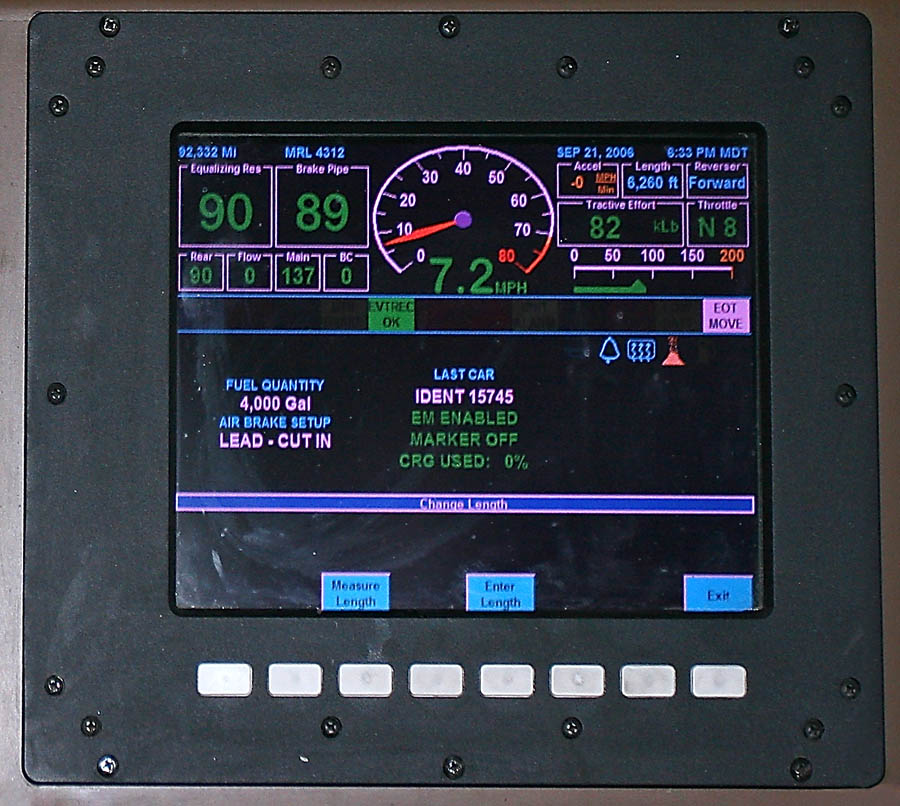
Controls for measuring the length of a train (circled) are integrated into the touch screen Video Information Display on an EMD SD70ACe.
Tom Danneman
Q If an engineer has a train with 100 or more cars and he gets a signal to take the siding, how does he know when he and all the cars have cleared the switch? – Richard Hampton, Homestead, Fla.

A Railroaders employ a device known as a “distance counter” to measure feet covered by the train to determine if it has cleared a switch or speed restriction, for example. Nearly every mainline locomotive operating today has a distance counter. The devices tend to take on two common forms, although many variations are in use. On modern computer-controlled locomotives, the distance counter is a button on the engineer’s display that will count the feet of track covered from the time it is activated. They will generally count up from zero, down from a preset length, or do both. The ones that will do both, count up or down, are shown as a choice the engineer makes when setting the locomotive up for that trip. Some locomotives will only count down from a preset length. For example, when a train has to clear the main line at Waukesha, Wis., the location of a short passing siding, on a northbound train, the engineer starts the distance counter just past the signal on the siding that governs the south end of the siding. That is the “clearance point” that the train needs to be past to enable the opposing train to pass safely. When the distance counter shows the train is in the clear, the engineer stops the train and awaits the meet. On older locomotives without computer controls, an analog distance counter is located in the end-of-train receiver box in the cab that also shows brake pipe pressure on the train’s rear end. – Ray Weart, locomotive engineer

Share this article