Introduction
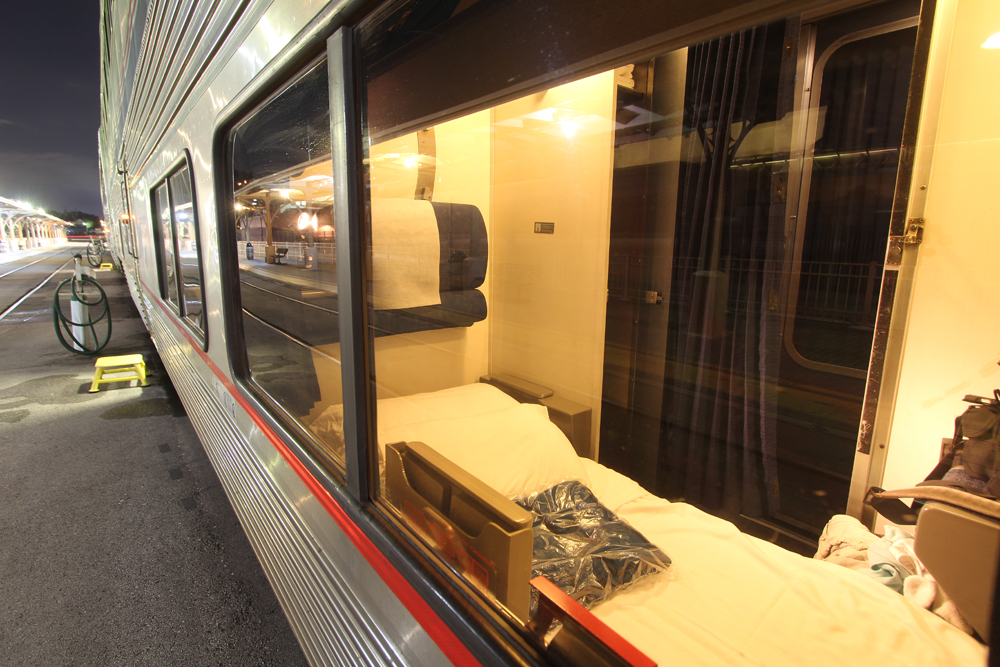
CHICAGO — Amtrak’s Superliners are double-decked, stainless steel, window-loaded passenger cars — among the most modern available to the traveling public in the United States today. Trains offers passengers a look at what they can expect when they book tickets to ride these cars. This article looks at Superliners’ history and offers a review of Superliner sleeping cars. A look at the rest of the Superliner fleet is available here.

Superliner history
The Superliners piggybacked on the idea introduced by the Atchison, Topeka & Santa Fe Railway’s “Hi-Level” passenger car fleet, built by the Budd Co. in the mid-1950s. These cars re-equip the Santa Fe’s El Capitan, its Chicago-Los Angeles coach streamliner; the San Francisco Chief; and eventually, the Texas Chief.
The Hi-Levels’ primary advantage over traditional, single-level sleeping cars was that upstairs sleeping compartments needn’t be encroached upon by restrooms, baggage storage, or dining-car kitchens.
Superliners use electricity (head end power) instead of relying on steam from locomotives for heating and cooling, as was the case with the heritage equipment used to launch Amtrak. Superliners also meet the needs of mobility-impaired passengers — something absent from many classic-era passenger cars.
Amtrak engineering personnel and the Louis T. Klauder design firm came up with specifications that the winning bidder, the Pullman Co., translated into an initial 284-car order that began revenue service in 1979. Pullman exited the carbuilding business with the delivery of the last car in 1981, but Bombardier acquired rights to the patents and was ready when Amtrak ordered 195 “Superliner IIs,” which began hauling passengers in 1993.

Standard sleeper
Superliner sleeping cars include four distinct types:
— Ten two-person roomettes on the upper level (rooms numbered 2-10; 1 is occupied by the attendant) and four (11-14) on the lower level feature two facing seats by day. Parallel to the windows, the seats fold flat to form a lower berth; the pull-down upper berth contains the bedding. Rooms 9 and 10, next to the center aisle’s end doors, tend to be noisy at night.
— Five bedrooms (A-E) on the upper level with a wash basin, plus an enclosed toilet that also contains a shower. The wider lower berth, which can snugly accommodate two people, is perpendicular to the window and becomes a couch for day lounging. Room A at the end of the car is slightly smaller, but the other rooms have a (often rattling) folding wall on one side that can be opened when two bedrooms are sold “en suite.”
— One family room (No. 15) that runs the width of the car on the lower level, with full-length upper and lower berths on the back wall that convert to a daytime sofa. Two seats parallel to the windows on either side become very short beds at night, so only kids up to about 8 or 9 years old can stretch out here, but they each have a window.
— One accessible bedroom (room H) is at the other end of the downstairs hall and contains a sink, toilet, and upper and lower berth.
The car has one bathroom for roomette passengers on the upper level and three on the lower level, which also contains a relatively spacious shower with a dressing area.

Transition sleepe r
These include 16 roomettes on the upper level, though at least eight normally accommodate onboard service personnel.
They have a center aisle with interior steps on the crew end that descend to a lower-level vestibule affording baggage-car access, as well as two bathrooms with showers upstairs. The lower level contains a full complement of bathrooms and shower, an accessible bedroom that isn’t sold because the car isn’t staffed, and an employee lounge usually occupied by conductors.
The cars are usually right next to the locomotive, meaning plenty of horn noise on routes with many highway crossings. But, because of the need to have that stairway to the vestibule at the front of the car, the car is always turned so that, facing in the direction of travel, odd numbered roomettes are on the left and even are on the right — a redeeming feature for scenery seekers who know which side of the train they want to ride on. (Standard sleepers can be positioned either way.) If enough space is available, agents at Amtrak’s call center can shuffle rooms after a reservation is made.

Deluxe sleeper
There are six of these cars, with two assigned to each Auto Train. On the upper level, they have 10 bedrooms (A-E, J-N) and no bathrooms. The lower level has the same accommodations as a “standard” car.
While the Superliner sleepers greatly increased capacity over their single-level predecessors and more recent Viewliners that operate in the East, the stacked design’s main drawback is the narrow headroom for upper-berth passengers; they have no window and can’t sit up in bed. Though lower-level rooms come with more track noise, they are more conveniently situated to the toilets, shower, and luggage racks.