Digital or film railroad photography? Before the advent of digital technology, the photographic standard of our hobby was transparency, or slide film. While multiple manufacturers guaranteed the user the desired color temperature and punchiness, the preferred emulsions were the various flavors of Kodachrome and Fujichrome.

The former was prized for its “pop,” particularly on bright, sunny days and its rendition of reds, yellows, and browns. The latter came on strong in the late 1990s-early 2000s and is loved for its saturation, particularly greens and blues.
Then came commercially available digital.
During its infancy, more than a quarter-century past, affordable digital for the masses was not seriously considered a viable competitor to film. Tyros using three- and four-megapixel cameras could not produce the overall quality and consistency of a roll of Kodachrome, or any other emulsion for that matter. It was regarded as a clever technology for instant gratification, but nothing to dump your film mailers for. “Chrome” was still king.
But for the champion, the battle was already lost.
It would take a decade or so of putting competitive technology in the hands of shooters in the field that would eventually meet and surpass what could be had from film. Today, many camera manufacturers even allow the user to dial in the desired film simulation to mimic the days of old.
If not on the camera, there are various plug-ins and filters incorporated into photo processing software that can do this — even on your smartphone.
But for some, nothing will replace film, and while many shoot digital for its ease of use, they also pack a camera loaded with Kodak or Fuji transparency film. It’s not vanity or being stuck in the past; for many there are real reasons to keep recording images one roll of celluloid at a time.
“There is no single answer for everybody,” says David Styffe, a retired community college graphic designer in Southern California’s Orange County. He went straight from black-and-white film directly to digital color.
“I turned the page to digital cameras in 2004. When shooting color, we now have a much broader tonal range, which has gotten better as the technology continues to improve. With digital I have the color of Kodachrome with the tonal range of Tri-X.”
For Hal Miller, editor of Kalmbach Media’s Classic Toy Trains, nothing beats the ease and speed of working in digital, but he says there have been unexpected trade-offs.
“I was a better photographer in my film days,” he says. “I can say without reservation that digital has made me lazy.” He says he was far more careful and thoughtful about his pictures when using slide film, in his case Fujichrome and later Velvia, mostly because he was paying for the processing.
Today he shoots with digital equipment for its ease of use and time savings, especially when dealing with magazine deadlines. “I get instant assurance that I have the shot, but I don’t have the same sense of accomplishment when I was waiting for the film to be processed. Did I get the shot, or did I blow it?”
Brian Schmidt, editor of Classic Trains, says digital photography gives him more opportunities to get it right the first time.
“I must emphasize that it is the photographer who has the vision for the photo. The camera is just the tool you use to make that vision. Is the photographer any better than a water colorist? No, as they both create an image. They just use two different tools to get to the same end goal.”
Schmidt says acquiring his first digital camera around 2010 forced him to see photography a little differently because he was using a cropped sensor but with his older film lenses. The lens may have been marked 50mm, but on his equipment that meant 75mm.

“If you’re shooting for your project, what you see on the slide is what you get. With digital it’s easy to manipulate the final image to what you want.”
Additionally, he says slides add a layer of complexity to his job.
“There was a generation of photographers that shot almost exclusively for projection, and they compose all the way to the edges of the frame and a little dark to get more saturation.
That made for great slide shows, but now that we have to deal with these photos for publication, it can be more difficult,” Schmidt says.
There are still some among us, however, who default to film whenever possible.
John Wade, a photographer in Long Beach, Calif., bucks the digital trend and swears by his Fuji Velvia now that Kodachrome is a thing of the past. He shoots digital when he feels it is the right choice, but if given a choice, goes for film whenever he can.
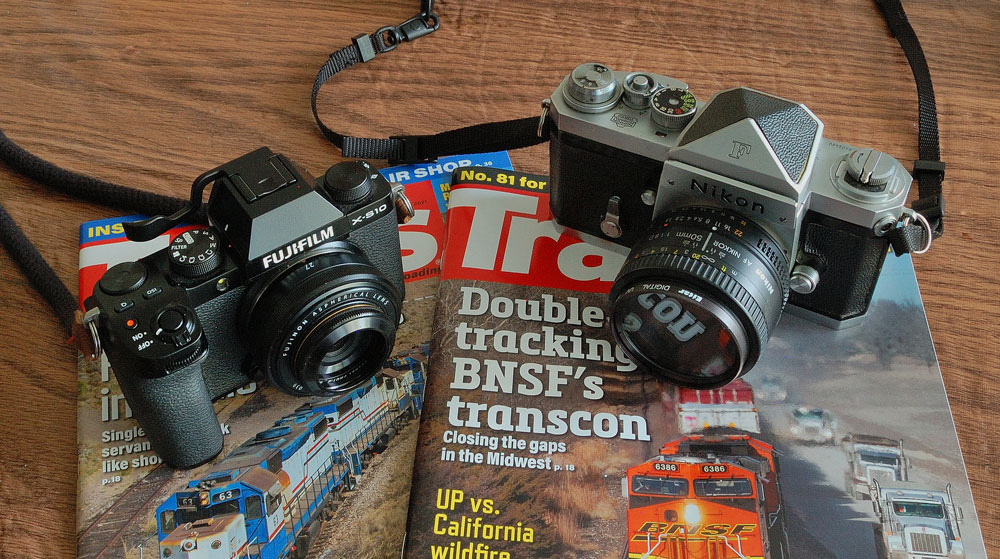
“I like the feel and the nice bright colors, the cleanness of a well-exposed transparency that shows the dramatic countryside of the Southwest where I live,” he says. “I have nothing against digital; it’s just not the medium I want to use. For me there is nothing like the solidness of hearing my Nikon F3 capture the scene the way I want it.”
There are virtues and drawbacks to both media. Ultimately, though, everyone using them arrives at the same place.
“It’s up to the photographer on what tool – in this case film or digital – he or she wants to use to achieve a specific effect,” Hal Miller says. “Right now, digital is predominant but there is now, and always will be room for film, as well.”