Top preserved diesel locomotives are units that were not only saved from the scrap heap, but special.
These locomotives are important to see and understand not only because they were saved but because visionary railroad management saw them as examples of the past that should be saved to be enjoyed by the present and future generations. These locomotives are just as much a part of American history as a preserved battlefield or monument. When looking at the bottom line, every preserved locomotive means that much less the railroad received in their scrap value for future purchases.
There are dozens of candidates, but here is an informal list of must-see units from around the United States. You will have other candidates just as deserving. It was tough limiting the list to 10. We looked not only at their esthetics but their impact on railroading itself.
See if you agree.
EMD GP7 — a preserved diesel locomotive

The very first GP7, Chicago & North Western No. 1518, is alive and well at the Illinois Railway Museum in Union, Ill. The design was not the first road-switcher on the market – Alco and Baldwin were already selling their models first – but with more than 2,700 copies built between 1949 and 1954, it was certainly the most influential. The GP7 proved it could work branch lines, switching jobs, and fast mainline freights with ease.
GE 44 tonner — a small workhorse

For a while it seems every builder offered a small diesel-electric switcher that could satisfy union rules for one-person operation yet still have enough horsepower to shuffle a cut of cars. The most well remembered of them all is the General Electric 44-tonner. The little center-cab found homes everywhere, from the smallest short line to major Class I railroads and everybody in between including interurbans, the military, and private industry. Easy to maintain, many are still in active service today. Google “preserved GE 44-ton diesel locomotives” and watch the long list unfold. Examples are everywhere.
Alco PA1 — a top diesel

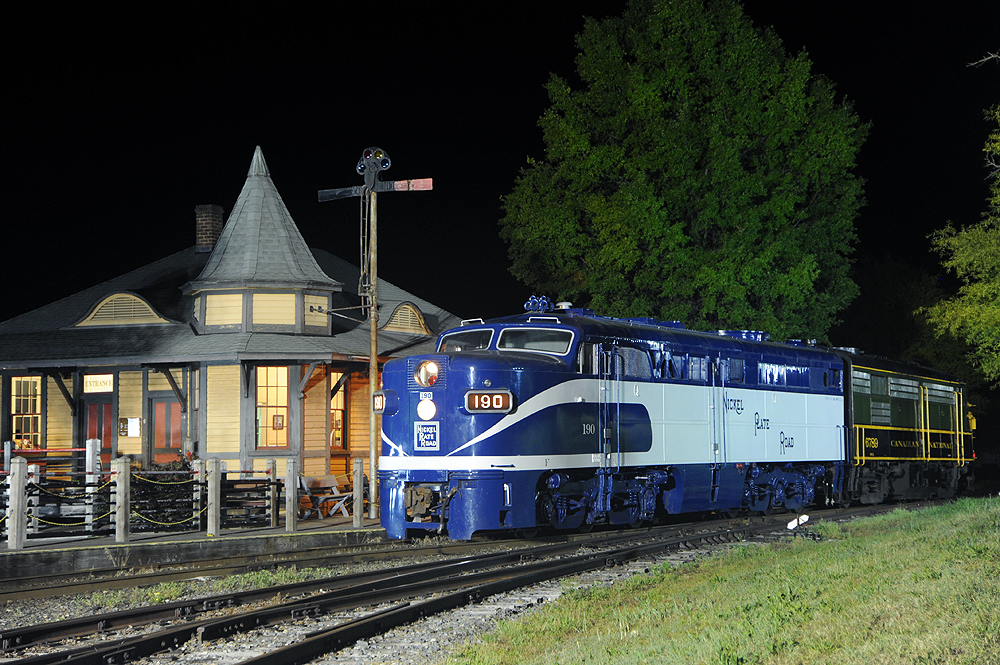
Chief competition to EMD’s E-line of passenger locomotives, the high, wide, and handsome six-axle units could be found everywhere from New York to California, throughout the Midwest and the South. Most all North American models were scrapped except for a handful picked up by Delaware & Hudson for passenger trains. Ultimately sidelined, they were sold to Mexico, with only two returning after intense negotiations. One is at the Museum of American Railroads in Frisco, Texas. The other is at Oregon Rail Heritage Center in Portland.
EMD DDA40X — a preserved diesel locomotive

For a long time Union Pacific liked its motive power king-sized. While Union Pacific was famous for its Big Boy 4-8-8-4 steam locomotives, it was equally as proud of its 47 DDA40Xs, 6,600-hp, dual-engine machines that were the pinnacle of many experiments to create the biggest and best diesel locomotive that technology could produce. Built between 1969 and 1971, they had an average locomotive life span and were off the roster by 1986. One, No. 6936, was given to the railroad’s Heritage Fleet based in Cheyenne, Wyo. Of the 47 units built, an incredible 13 exist today in museums and parks all over the western United States, including one in Omaha near Union Pacific’s headquarters. A check of the internet will produce a list that mirrors the company’s system map.
EMD BL2 — a top diesel

Predecessor to EMD’s well-respected GP7, BL stood for Branch Line, which is where the builder’s marketing department thought it would be a perfect fit. Fewer than five dozen of the 1,500-hp units were sold and although it was usually derided as an ugly beast with standard EMD guts churning inside, it worked and performed well, often m.u.’d with other models. Original owners included Bangor & Aroostook, Boston & Maine, Chesapeake & Ohio, Chicago & Eastern Illinois, Monon, Rock Island, Florida East Coast, Missouri Pacific, and Western Maryland.
Surprisingly, a number of those oddballs exist, including a former Monon unit at the Kentucky Railway Museum, a Western Maryland at the B&O Museum in Baltimore, another WM unit on the Durbin & Greenbrier Valley Railroad, a Bangor and Aroostook unit at the National Railroad Museum in Green Bay, Wis. Another BAR unit is on the Lackawaxen & Stourbridge in Honesdale, Pa., and another at the Cole Transportation Museum in Bangor, Maine.
EMD FT — a preserved diesel locomotive

The granddaddy of EMD four-axle streamlined freight units, the 1,350-hp unit was originally marketed as a 5,400-hp four-unit design capable of cutting steam-era timetables to ribbons by keeping the same track speed and just eliminating the fuel and water stops and engine swaps. More than 1,000 rode U.S. rails, about a third of them for Santa Fe, which practically dieselized parts of its system with it. Santa Fe even painted a few sets into its red-and-silver passenger paint scheme. The design was for the most part warmly welcomed and it soon found a home on Southern; Atlantic Coast Line; Baltimore & Ohio; Boston & Maine; Chicago & North Western; Burlington; Milwaukee Road; Rock Island; Lackawanna; Rio Grande; Erie; Great Northern; Lehigh Valley; Minneapolis & St. Louis; Missouri Pacific; New York Central; New York, Ontario & Western; Northern Pacific; Reading; Cotton Belt; Southern, and Western Pacific.
If you want to see one of these pioneering units today, you can find one of the demonstrator A units at the Museum of Transportation in St. Louis, and a B unit at the Virginia Museum of Transportation. The North Carolina Transportation Museum at Spencer also has a booster unit.
Baldwin DRS-64-1500 — a top diesel

The first Baldwin diesel road-switcher built for service in the U.S. is still among us stuffed-and-mounted in front of the Columbus & Greenville short line at its shops in Columbus, Miss. Its importance is immeasurable and deserves a place of honor among top preserved diesel locomotives. Baldwin, along with Alco, was a leader in providing early road-switchers that could work branch lines and yards as well as handle mainline freight trains. Only about a dozen Baldwin road-switchers escaped the scrapper’s torch to become examples of yesterday’s technology from a builder that exited the field a half-century ago.
EMD Model 40 — a preserved diesel locomotive

EMD produced a handful of two-axle, 300-hp center-cab switchers powered by a pair of Detroit Diesel truck engines. Their original owners were mostly the military. Looking like they were built from leftover parts found in the back of an assembly plant, they are important because almost all of them were immediately thrown into the war effort in the 1940s, working military bases and ammunition factories across the country. A number of them were saved and a few are still operable. The Model 40 shown here at TravelTown in Griffith Park in the city of Los Angeles began its working life switching cars at a torpedo factory at Goat Island in Rhode Island, later transferred to Douglas Aircraft in Torrance, Calif., before being donated to the city.
EMC E3A — a top diesel

One of the almost knife-nosed early EMC AlA-AlA passenger diesels designed to be as streamlined and futuristic as the new varnish they hauled. Atlantic Coast Line 501 is the sole survivor. The 2,000-hp unit, delivered in 1939, was upgraded to E6A status by the builder. It’s importance as a survivor is clear; the railroads were actively wooing passengers, and many were toting the latest designs coming from the builders. Can you just imagine standing at a station and seeing the 501 leading a train of stainless-steel passenger cars? It must have been glorious. You can visit this star among top preserved diesel locomotives at the North Carolina Transportation Museum in Spencer.
EMD FP45 — a preserved diesel locomotive

The EMD FP45 is a perfect example of a builder and a railroad working together to come up with a great-looking locomotive. Image conscious Santa Fe needed new power for its passenger trains in the late 1960s and really wasn’t fond of road-switchers, even the handful of GE U28Cs it painted in silver and red, on the point of their trains. Cowled U30Cs came next. Still not satisfied, the railroad turned to EMD and the FP45 was created. Not super streamlined but emoting power, the railroad was pleased with what was basically a standard SD45 with a cowl carbody. Nine rolled off the assembly line between 1967 and 1968, numbered 100 to 108. So impressed with the design, Milwaukee Road opted for five, appropriately numbered 1 through 5.
To everyone’s delight, upon retirement – they had been renumbered to 90-98 to clear the 100 number series for new GP60Ms – a number of them were donated rather than scrapped or traded-in, proving once again the Santa Fe had an incredible feel for public relations.
90 went to the Oklahoma Railway Museum in Oklahoma City.
92 wound up at the Illinois Railway Museum in Union.
93 resides at the Great Plains Transportation Museum in Wichita, Kan.
95 is at the Western America Railroad Museum in Barstow, Calif.
97 went to the Museum of the American Railroad in Frisco, Texas.
98 resides at the Southern California Railway Museum at Perris, Calif. It has been renumbered to its original 108.