

 |


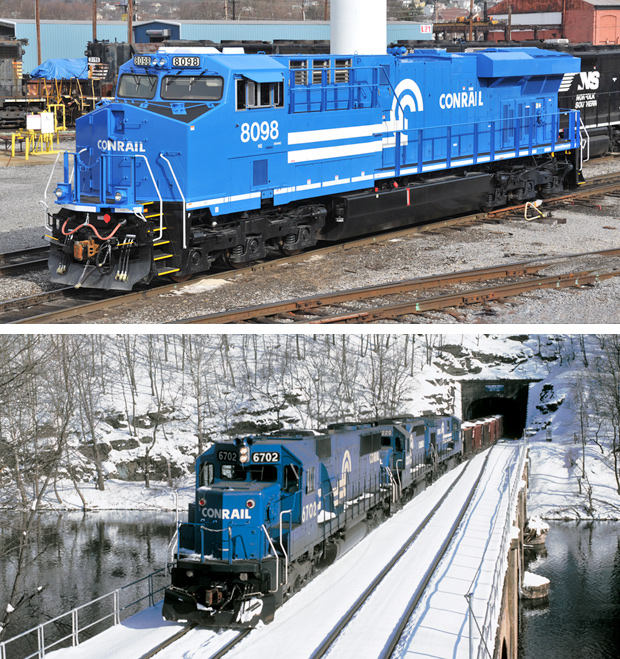
Bottom: Conrail SD60 6702, GP40-2 3220, and an unidentified GE lead a Philadelphia-to-Bethlehem iron ore train out of Black Rock Tunnel near Phoenixville, Pa., in 1984. The first Conrail locomotive to wear this scheme, GP40 3091, rolled out of the Collinwood, Ohio, paint shop seven weeks after CR’s April 1, 1976, formation. CR kept this look until the road was split between Norfolk Southern and CSX in 1999, although the word QUALITY was added earlier in the ’90s.
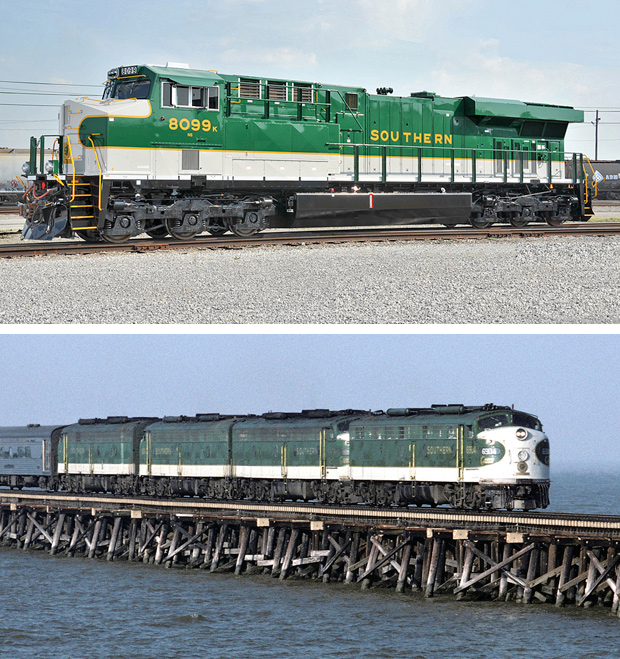 |
Bottom: Four Southern Railway E8s cross Lake Pontchartrain with the New Orleans–Washington Southern Crescent in April 1978. The road began painting its passenger steam engines green with gold trim in the late 1920s, and its early passenger diesels wore an ornate green-white-gold livery. This was simplified in the 1940s to match the lines of Southern’s freight diesel scheme, on which SOUTHERN appeared on the flanks in small letters, but with green in place of the early freight units’ black. The road then switched to black for all locomotives, but with enlarged lettering, until 1972, when Southern President W. Graham Claytor Jr. brought back the green. NS 8099 wears a version of this final passenger livery (albeit without the “Southern Crescent” nose emblem). Southern’s 1982 merger with Norfolk & Western created the new Norfolk Southern.
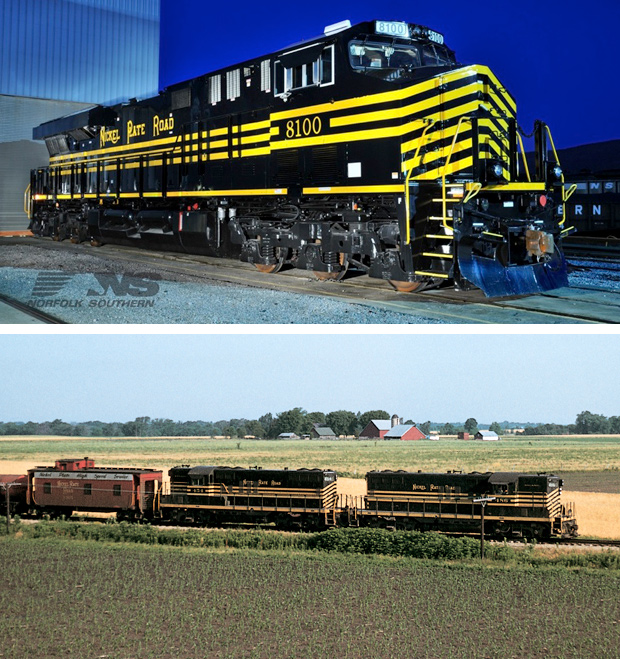 |
Bottom: The Nickel Plate’s road-switcher scheme of black with three yellow stripes, plus yellow safety stripes on the ends, illustrated here on GP9’s 486 and 454 near Livingston, Ill., in 1958, was simple but eye-catching. A later version omitted the stripes along the side and had fewer, thicker end stripes. NKP’s only cab units, 11 Alco PA’s, wore blue and silver. N&W absorbed the Nickel Plate in 1964.
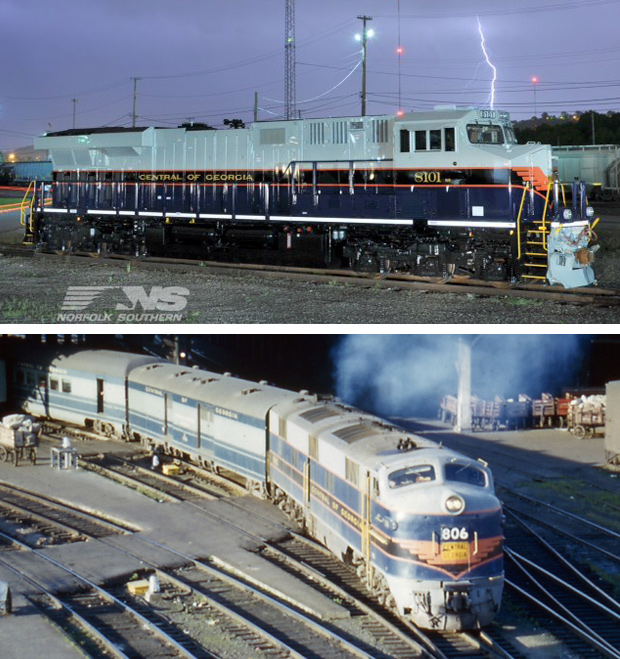 |
Bottom: Central of Georgia E7 806 departs Atlanta with the Nancy Hanks II in 1959. This same year, CofG began painting equipment in a solid Pullman green with gold striping. However, some locomotives still bore the handsome blue and gray colors at the time of the 1963 Southern Railway takeover, after which CofG used the black and white of its parent.
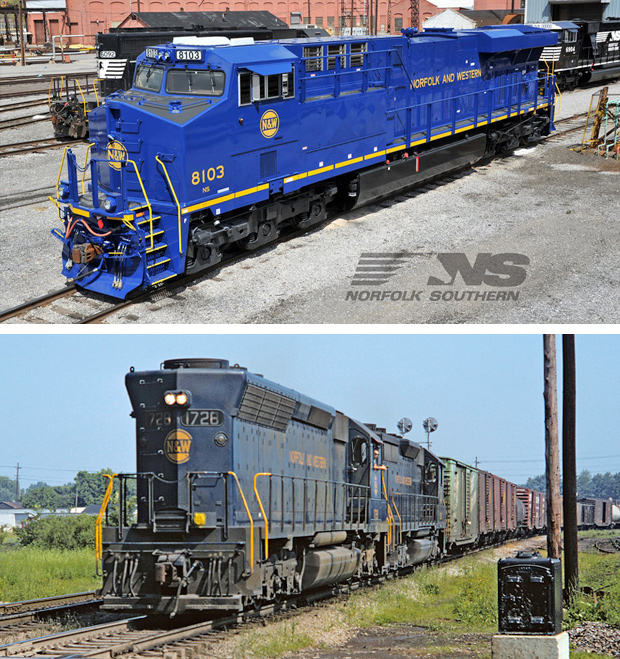 |
Bottom: Norfolk & Western SD45 1728 and an SD35, both equipped with dual controls for bidirectional operation, lead a southbound train on N&W’s ex-PRR line through Marion, Ohio, in 1970. After merging with the Nickel Plate Road and Wabash in 1964 and in anticipation of a proposed (but never completed) merger with C&O, N&W switched its diesel colors from black (freight) and red (passenger) to a dark blue before reverting to black several years later. N&W’s 1982 merger with the Southern created the new Norfolk Southern.
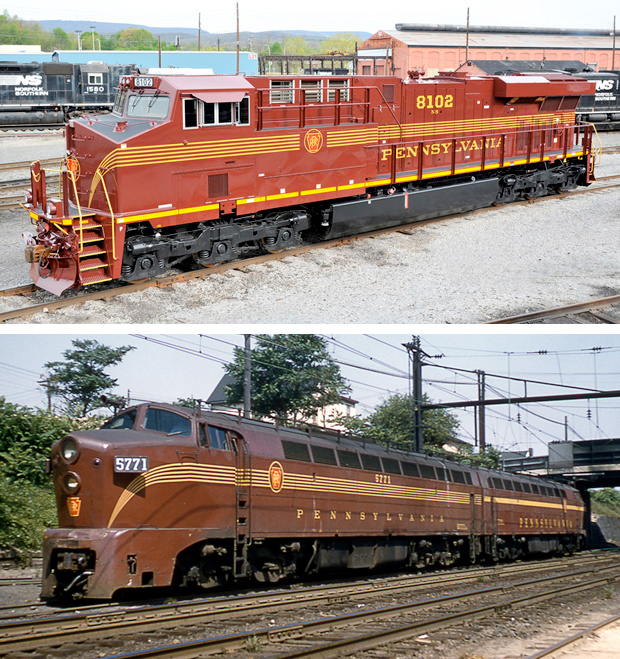 |
Bottom: The Pennsylvania Railroad pinstripe livery, designed for the GG1 electric and subsequently deployed on seven EMD, Alco, and Baldwin cab-diesel models, never graced a hood unit. The version applied to NS 8102 most closely resembles that of PRR’s Baldwin model DR-6-4-20 passenger “Sharknoses,” like No. 5771 at South Amboy in June 1957. Among PRR diesels, the keystone-within-circle motif was unique to the Sharks. All of PRR’s Sharks, passenger and freight, were delivered in dark green, which was replaced by red for the passenger units beginning in 1952. Although there were exceptions, when the Sharks and other PRR passenger power were green, the nose keystone contained the road number; when red, the keystone contained the “PRR” monogram. In the late 1950s, some Sharks received the single-stripe/large lettering livery carried by No. 5783 in the photo. By the time of the 1968 Penn Central merger, Pennsy had retired all its non-EMD passenger cab units.
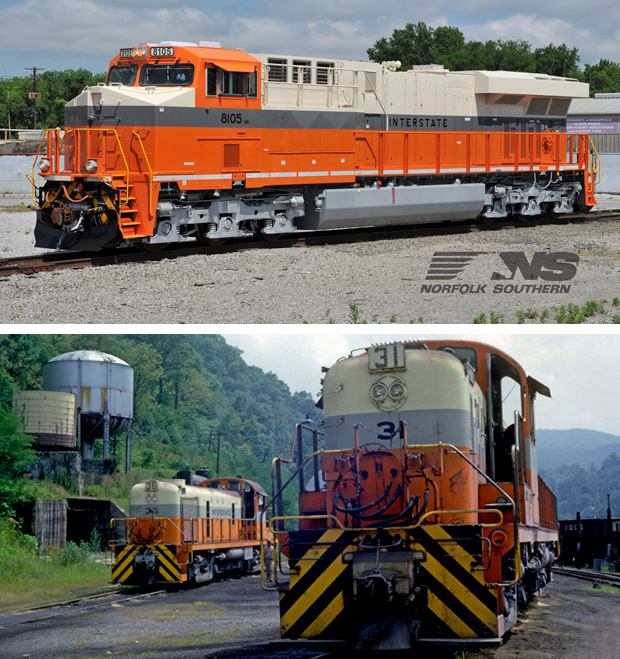 |
Bottom: Tucked away in far western Virginia until Southern Railway took over in 1960 was 85-mile coal-hauler Interstate Railroad. Its only diesels were 10 Alco RS3’s, Nos. 30–39, two of which stand at Andover, Va., circa 1955. Southern black and white with gold INTERSTATE lettering replaced this colorful scheme.
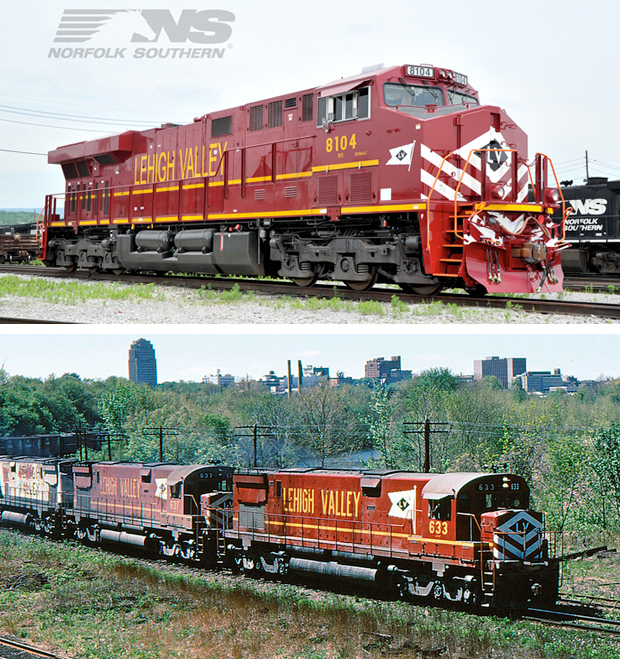 |
Bottom: Three Lehigh Valley Alco C628s pass East Penn Junction in Allentown, Pa., in 1974. Probably no other Class I fielded more color schemes than the Lehigh Valley in the few years before it went into Conrail in 1976. LV’s C628s all originally wore the white-and-black livery carried by the trailing unit here, but in the 1970s several got the red scheme carried by 633 and 637. LV’s final new units, U23Bs and GP38-2s, wore a similar livery, but without the big white flag. The livery on NS heritage unit 8104 combines elements of the red C628 scheme (white flag, but smaller and farther forward in deference to the ES44 carbody) and the final GP38-2 scheme (no nose safety stripes, only a small diamond herald).
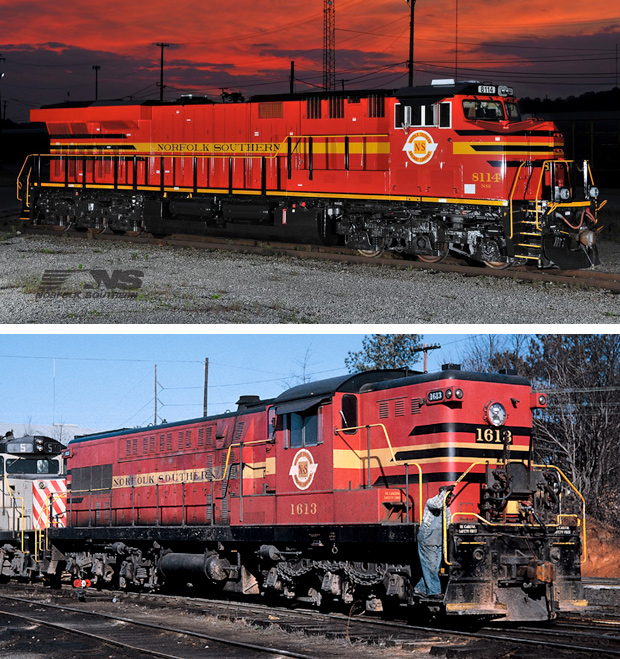 |
Bottom: Baldwin AS416 No. 1613 of the 700-mile original Norfolk Southern Railway is with GP18 No. 5 at Raleigh, N.C., in 1966. The colorful livery worn by the Baldwin was succeeded by the gray modeled by the Geep. The road became part of the Southern Railway in 1974.
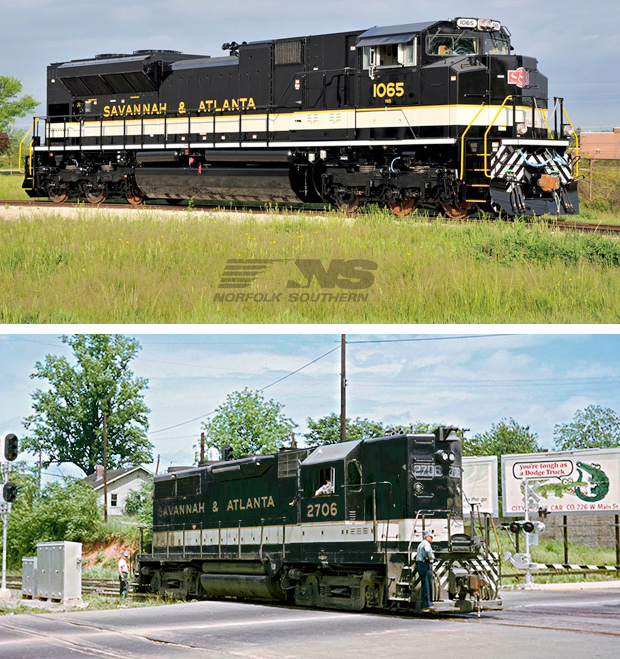 |
Bottom: Savannah & Atlanta became a subsidiary of the Central of Georgia in 1951. S&A had dark green Baldwin road-switchers to begin with, but after Southern Railway purchased the Central in 1963, CofG and S&A locomotives began appearing in the Southern’s “tuxedo” livery of black and white (officially, “imitation aluminum”) with gold trim and lettering, as seen on S&A GP35 2706 at Spartanburg, S.C., around 1965. Accordingly, Norfolk Southern EMD SD70ACe No. 1045 recalls the image worn by thousands of Southern diesels before the 1982 NS merger. Although the red-and-white “S&A” emblem did not appear on tuxedo-liveried diesels, it’s well remembered from the tender of S&A Pacific No. 750, star of many Southern steam fantrips in the 1960s, ’70s, and ’80s and the SD70 carries it on its nose.
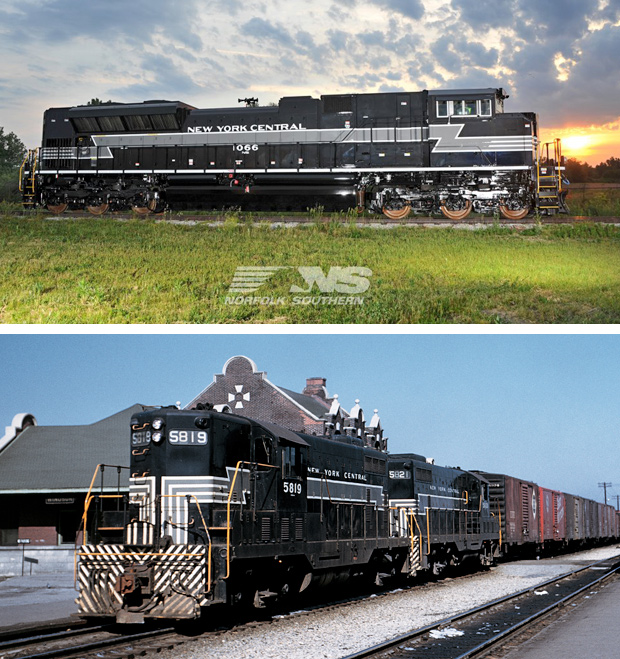 |
Bottom: Two New York Central GP7s bring a freight from Detroit into Windsor, Ont., in 1962. NYC’s lightning-stripe livery was rendered in two-tone gray on passenger cab units (and a smattering of Geeps) and in black-and-gray on freight engines. Cab units, regardless of service or overall body color, had a pronounced “zig-zag” toward the front, and passenger cabs had a smaller one toward the rear, but road-switchers bore zig-zags of equal depth on each end, as seen here. On road-switchers, the lightning stripes gave way to solid black with white trim about eight years before the 1968 Penn Central merger.
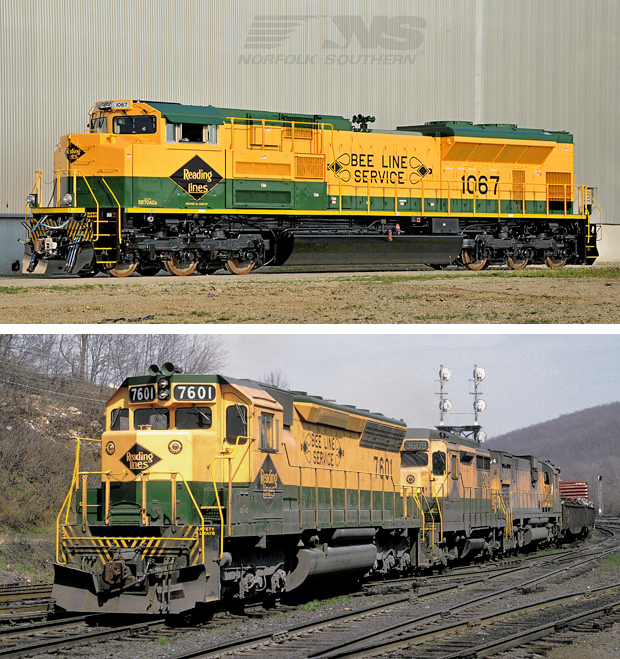 |
Bottom: Reading SD45 7601, GP30 3609, and C630 5304 — all dressed in the snappy yellow-and-green the road adopted for switchers and road-switchers in 1962 — are at Allentown, Pa., in 1968. Designed by EMD, the scheme was a bright departure from the solid dark green on first-generation switchers and road-switchers (cab units were black with a lighter green stripe and gold trim). Solid bright green returned for the Reading’s final new units shortly before it entered Conrail.
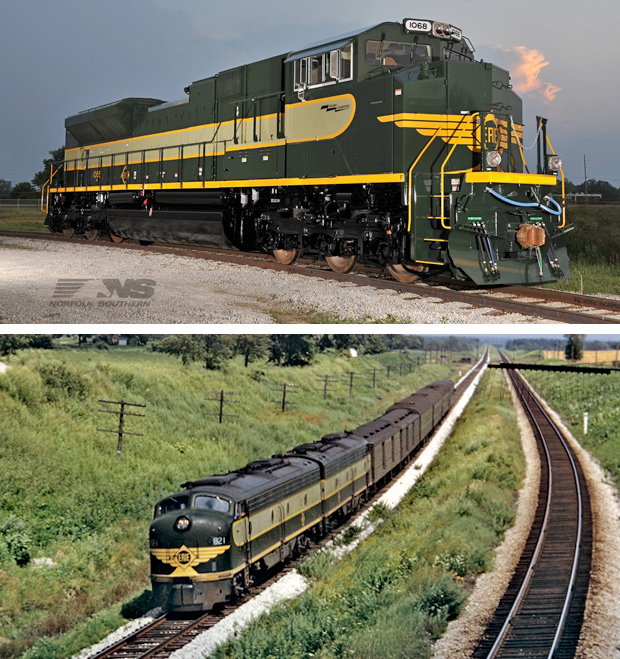 |
Bottom: Erie Railroad E8 821 and a sister roll the Lake Cities west across Indiana. The Erie’s 14 E8s, built during the first three months of 1951, introduced the two-tone green passenger livery that also was subsequently applied to some of the road’s Alco PAs. Some ex-Erie units, relettered for EL, carried this scheme into the 1960s, but it was gone by the 1976 Conrail launch.
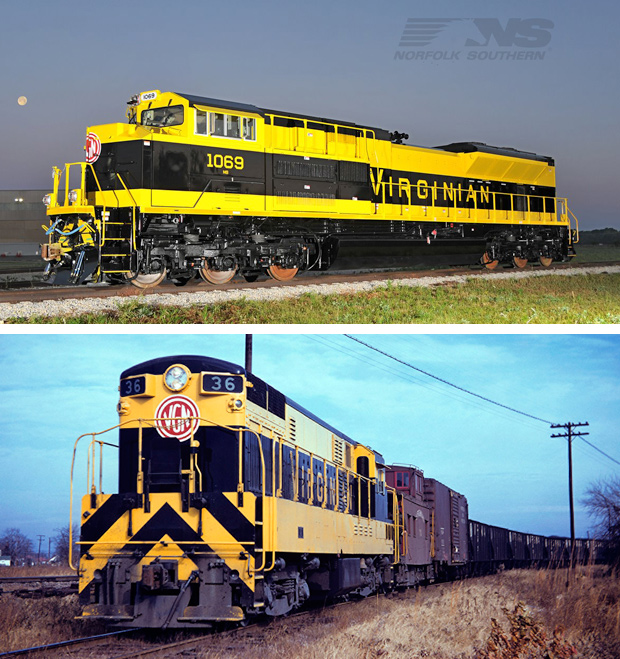 |
Bottom: The Virginian Railway dressed all 64 of its diesels — 38 Fairbanks-Morse H16-44’s, 25 FM H24-66 Train Masters, and a lone GE 44-tonner — in a striking yellow and black. The livery was short-lived, however, as the Virginian was absorbed by Norfolk & Western in 1959. Like all of the road’s F-M diesels, VGN H16-44 No. 36 carries its road number in its number boards only, not painted on the carbody.
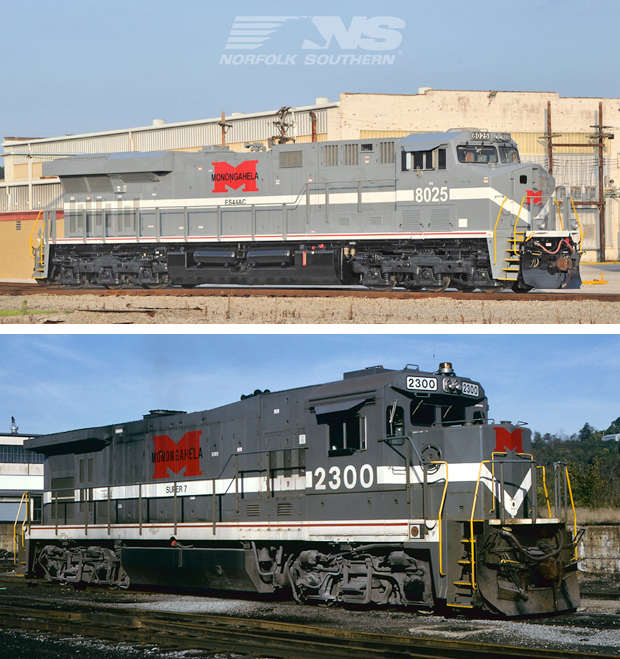 |
Bottom: Ownership of the Monongahela Railway, a 162-mile coal-hauler in the southwest corner of Pennsylvania and northern West Virginia, was split evenly among the Pennsylvania Railroad, Pittsburgh & Lake Erie, and Baltimore & Ohio. P&LE sold its third to Conrail in 1989, B&O did the same in 1990, and Conrail absorbed the Monongahela in 1992. The obscure road gained fame in the mid-1960s for an all-Baldwin diesel roster that included the last active Sharknoses, which were followed by GP7s and GP38s, all dressed in utilitarian black. NS 8025 is painted in the scheme worn by the Monongahela’s final locomotives, 11 rebuilt U23Bs designated model S23-7B. Note 8025’s “ES44AC” lettering in the same position as the “Super 7” slogan on the 2300.
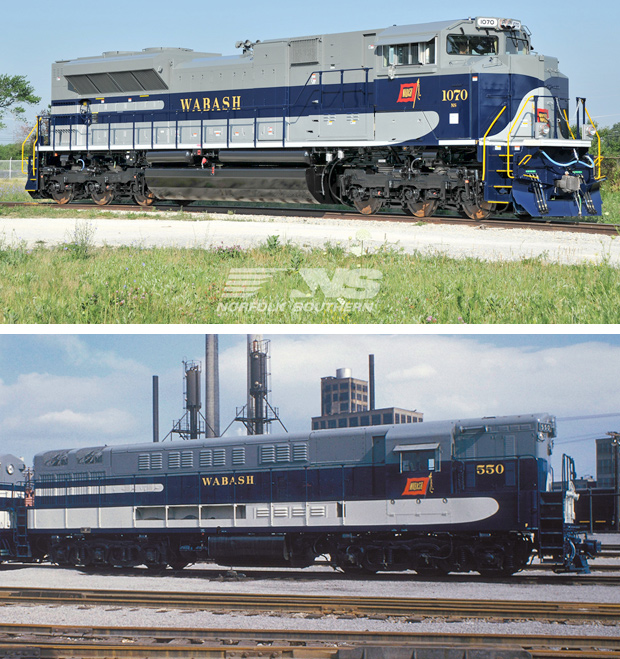 |
Bottom: Wabash H24-66 Train Master 550 (formerly Fairbanks-Morse demonstrator TM-1) shows off the color scheme worn by Wabash road diesels — cab units and road-switchers alike — in the 1950s. The “right-handed” flag on the engineer’s side of No. 550 is unusual, as the Wabash’s emblem was nearly always rendered with the staff on the left. Only cab units featured the flag on their nose. NS 1070 incorporates both these features. The road switched to a solid blue with gold striping a few years before being merged into N&W in 1964.
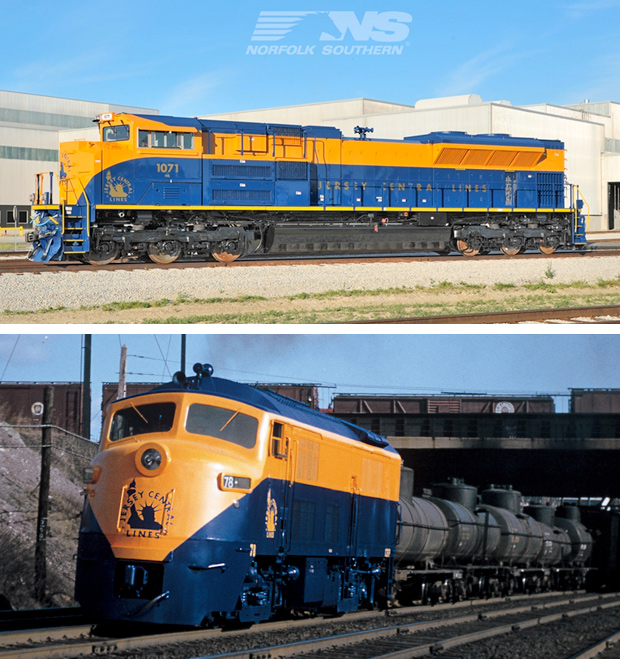 |
Bottom: Jersey Central “Babyface” Baldwin DR-4-4-15 freight unit No. 78 is just out of the shops at Elizabethport, N.J., on a short local run in Jersey City so its fresh tangerine and blue paint can dry. Not long after this February 1952 photo, CNJ abandoned this striking livery in favor of a more somber dark green with gold stripes. By 1976, when CNJ became part of Conrail, old green units mixed with those bearing the road’s final color, a bright red.
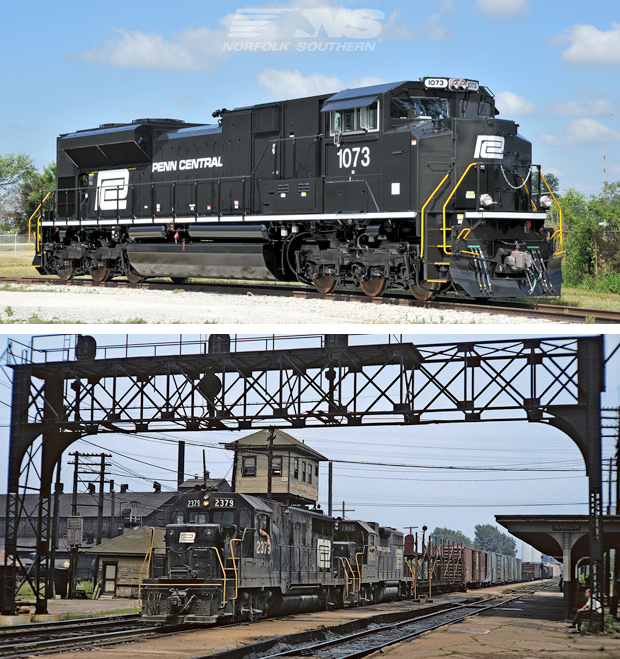 |
Bottom: Penn Central GP35 2379 and GP38 7803 roll a westbound freight through Marion, Ohio, in 1970. The second unit wears PC’s full livery, officially in force for the duration of the troubled carrier’s 1968–1976 life, but often abbreviated, as on the lead unit, on which the road name is omitted. Although a few units of several types got a red “P” or “C” in the “mating worms” emblem, and some PC-owned FL9s in publicly funded New York commuter service got Metropolitan Transportation Authority blue and yellow, PC stuck with black and white until Conrail.
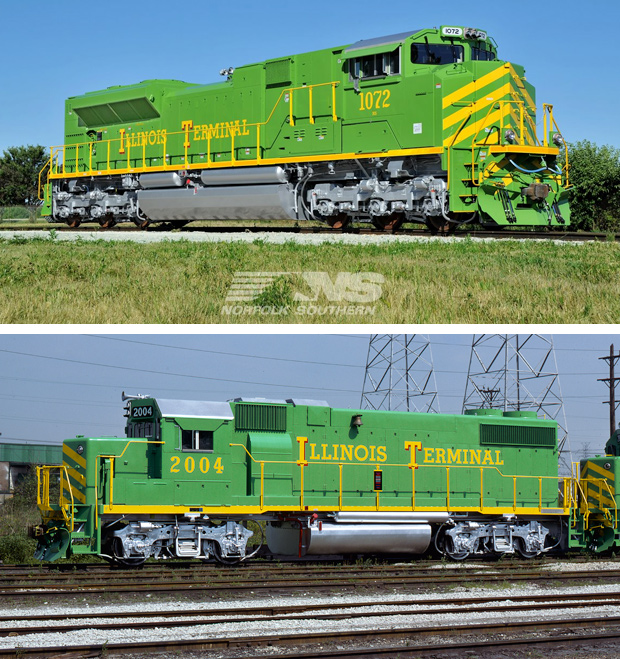 |
Bottom: Illinois Terminal GP38-2 2004, the last of four and brand-new at EMD’s La Grange plant in 1977, displays the final IT livery. After early black diesel switchers, the former electric interurban used progressively simpler green-and-yellow schemes on its diesels until being folded into Norfolk & Western in 1982.
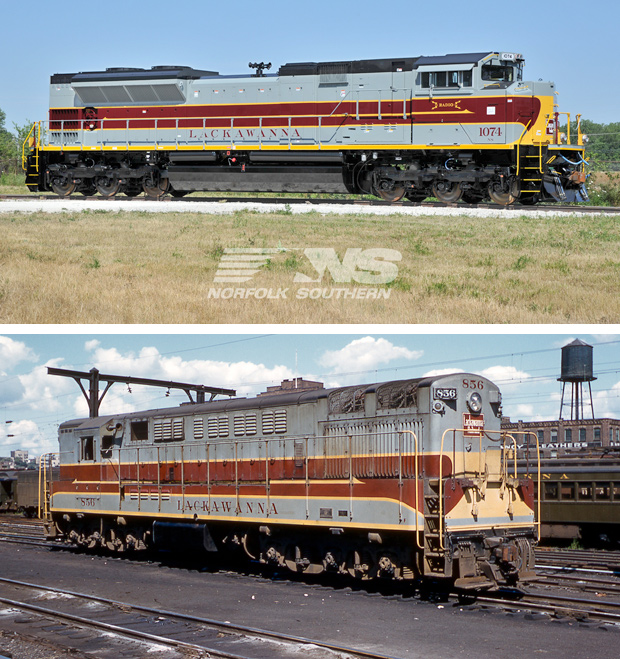 |
Bottom: Delaware, Lackawanna & Western Fairbanks-Morse H24-66 Train Master 856 models the classic DL&W passenger livery, designed by EMD for the road’s E8 passenger diesels, at Hoboken, N.J., in 1956. Successor Erie Lackawanna adopted a simplified version for all its diesels a few years after EL’s 1960 creation.


Here’s where to get the latest news
News Wire stories are free to subscribers: www.TrainsMag.com
Share your photos of NS heritage units: www.flickr.com/groups/1884885@N24/
Get hot updates: www.facebook.com/TrainsMagazine and www.Twitter.com/TrainsMagazine
Subscribe to our free e-newsletter: www.TrainsMag.com
Blogs: Norfolk Southern’s heritage units sure are gorgeous, but they need nicknames; also the story behind 8099’s odd suffix
BNSF: It’s time for heritage locomotives
Sunset (and a New Dawn) at Andover
Fifty shades of blue: How Conrail’s paint scheme changed from brown to blue
Would you like to take part in a photo opportunity to capture all 20 NS heritage locomotives? Here’s how!