Train timetables

The digital information age has spawned a flurry of welcome advances in rail transportation, such as the convenience of online , ticketing and instantaneous notification of delays. Getting rid of easy-to-access timetables showing stops trains make isn’t one of them. Fortunately, other providers have helped fill the void.
History
From their inception in 1971 and 1978 respectively, both of North America’s passenger rail operators, Amtrak and VIA Rail Canada, published system timetables listing all trains operating on every route. They were continuing a tradition that individual railroads began in earnest in 1883, when uniform time zones were created. For the next 88 years, when hundreds of interconnected rail routes provided essential transportation throughout the continent, timetables showed what times trains arrived and departed from isolated rural stations to bustling connection points.
Each railroad published its own schedule book, which also usually contained fares for coach and first class accommodations that rarely changed. The Official Guide of the Railways, updated monthly, served as an indispensable compendium of all U.S., Canada, and Mexico train schedules, including details such as how many feet or miles apart stations might be in towns served by more than one system.
The big book with the flimsy pages thinned through the 1960s and eventually disappeared.
Why timetables are useful

The Guide was no longer needed, because the consolidation of a reduced number of routes in an Amtrak and VIA system timetable provided all the information anyone required to not only plan trips, but also allowed travelers to:
- understand how different routes connected.
- see at a glance which trains were expresses and locals.
- decide at which station to board; addresses and station services were listed.
- determine what stop is next while onboard; the timetable always had a map as well, a feature especially valuable when riding long-distance routes.
- observe posted schedules at stations showing “where trains go and when they leave.”
Sure, passengers were always warned, “times subject to change without notice,” but so what? There was always a phone number to call after tickets were purchased; having basic arrival and departure times determining whether to take the trip at all was more important than such minutia. Amtrak timetables were generally issued at least twice yearly, with print runs in the 300,000 range in later years, though Northeast-Corridor-only schedule printing often more than doubled that.

Not needed?
But the cadre of ex-airline managers hired by Amtrak’s board of directors beginning in 2017 had no respect for what they saw to be an outmoded tradition that could easily be supplanted by electronic versions. They had conducted business in the point-to-point airport world. Thus, schedules showing multiple stations and departure times were supplanted by a “do-it-yourself” ordeal which requires potential customers to know the origin and destination to input. Information about intermediate stops or other choices? Executive-suite thinking apparently ranged from “people don’t need that” to “schedules cost too much to revise if there is a change.”
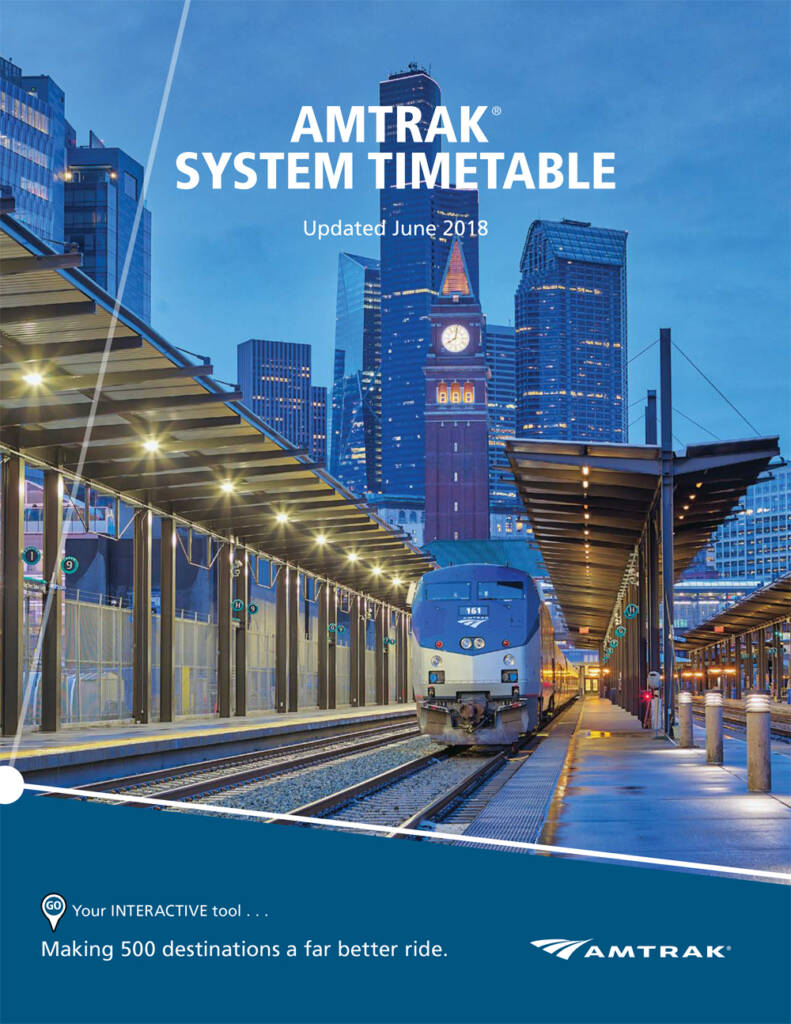
Amtrak last printed a system timetable in 2016, and the company stopped offering a downloadable version after issuing the June 2018 timetable. Schedules made a brief comeback beginning in October 2020 when the reduction of most long-distance trains to tri-weekly frequencies introduced widespread confusion across the system, but those were eventually withdrawn as trains returned to daily operation.
The final VIA Rail Canada system timetable was issued in 2019; schedules were removed with the onset of the COVID-19 pandemic.
Timetables today
Both the Amtrak and VIA Rail Canada websites provide complicated ways to access accurate individual route schedules, which we won’t get into here. But inputting an origin and destination for a selected date on their ticketing platforms will display exact arrival and departure times at fares specific to that train. Once ticketed, passengers should be notified if there is a schedule change.
The sites also offer route maps. The Amtrak map dates from the last 2018 system timetable, so it omits the 2022 extension of the Ethan Allen Express to Burlington, Vt.

VIA’s map is strictly rudimentary.
However, the Rail Passengers Association website has filled the void with downloadable schedules for most Amtrak and VIA Rail Canada routes.
The Rail Passengers’ collection does require knowledge of where trains operate. The schedules are revised periodically but may not reflect the latest changes. For instance, though an advisory says timetables were updated on April 24, 2024, the grid schedule for Wolverines operating between Chicago and Pontiac, Mich., doesn’t reveal that May 6 through Oct. 17, 2024 (except holidays), trains 350 and 353 are cancelled Monday through Thursday for daytime track construction. This is why the Amtrak and VIA ticketing websites should always be consulted for confirmation.
The RPA site also provides links to state-supported services that still publish their own timetables, often with the kind of useful information previously offered in system timetables. Omitted is the North Carolina site, which shows individual train schedules for the New York-Charlotte, N.C. Carolinian and four Raleigh-Charlotte round trips.
There is, however, a hopeful sign. When Amtrak recently announced the debut of a second train between Chicago and the Twin Cities, the press release did offer a grid listing station times for both the eastbound and westbound Empire Builder and the new Borealis [see “Amtrak to launch Chicago-St. Paul train May 21,” Trains News Wire, May 1, 2024]. The horizontal schedule for the two trains is not in the classic vertical format, but it does show times at all the intermediate stops.
That’s progress!