

Metra
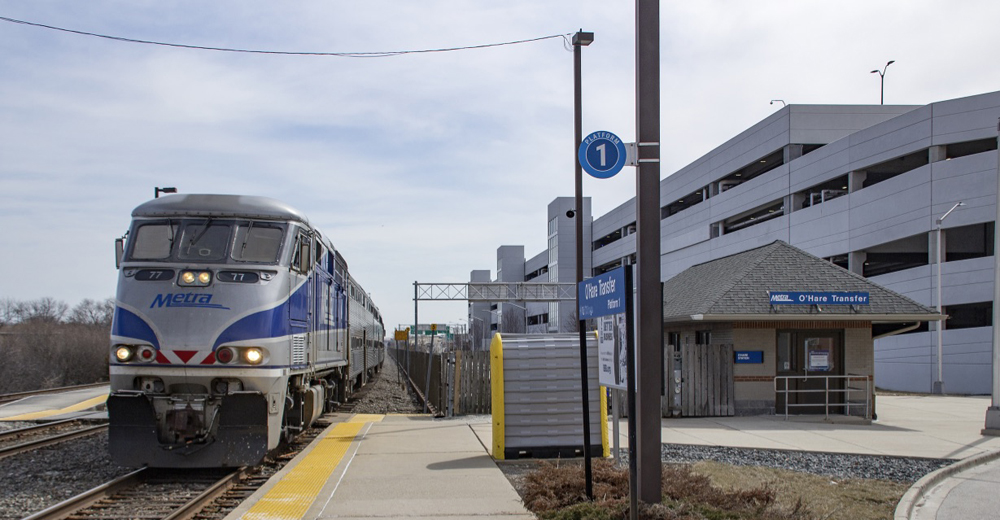
It’s likely many passengers don’t realize commuter rail operator Metra serves Chicago O’Hare International Airport. But then, “serves” may be generous. What the commuter operator provides is more akin to a cameo appearance.
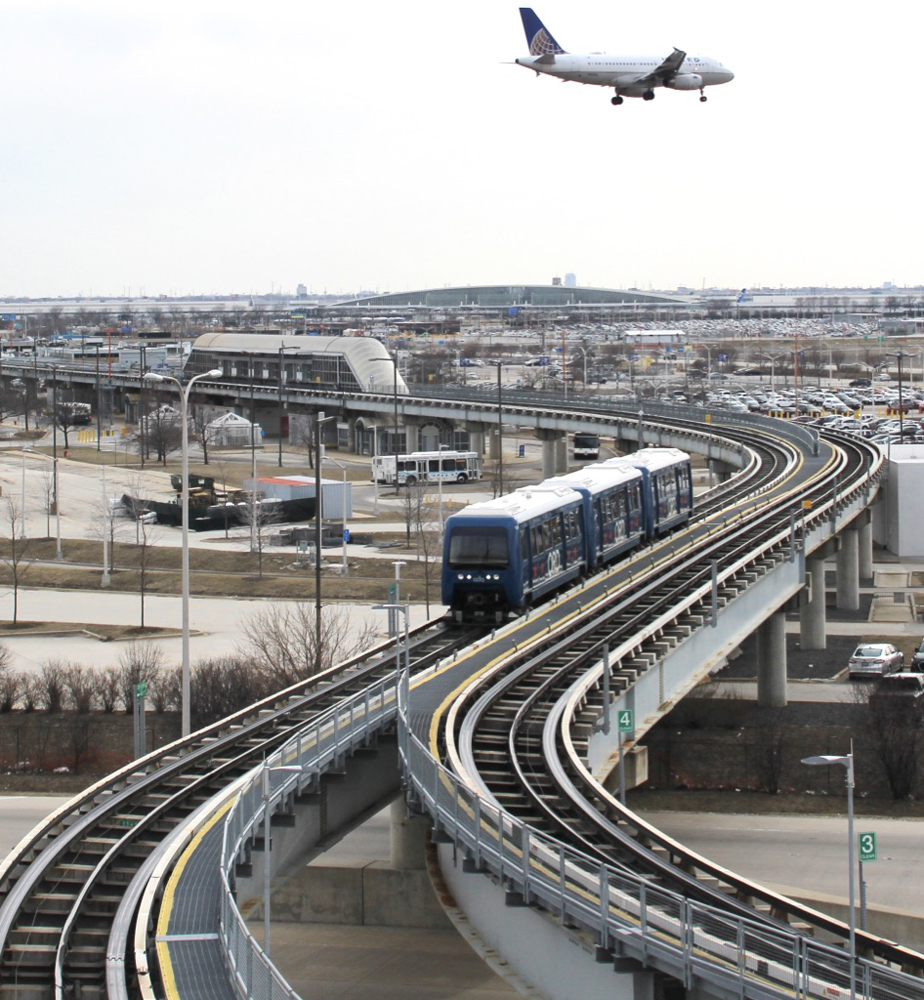
In 2022, the airport handled almost 664,000 commercial flights and more than 68.3 million passengers. Metra addresses this with 12 trains, Monday through Friday only, on its North Central line. Those trains stop at a modest station behind the airport’s massive rental car building, the Multi-Modal Facility, connected to the terminals via the Airport Transit System, a people-mover using Bombardier trainsets.
The Metra station — officially known as the O’Hare Transfer stop — is rarely busy. In 2018 (the last year station-by-station data is available) a fall passenger count found 241 people used the station, ranking it 183rd among 233 non-downtown stops.
CEO/Executive Director Jim Derwinski would like to change that. He says Metra is nearing the point of moving expanded O’Hare service “from just a concept on the white board to a design concept.” That would mean beginning preliminary engineering “so we can start getting our hands around, ‘What would this cost? How many phases could it be put in?’”
One aspect would be equipment dedicated to O’Hare service — “vehicles that are designed to handle luggage,” he says. “Even our friends at the CTA today, their cars just aren’t designed to handle luggage.” (The CTA’s Blue Line serves O’Hare, but Metra could be much faster. An L train from Jackson Boulevard in the Loop takes about 50 minutes. A North Central train from Union Station takes 34 minutes; express service would decrease that.)
New equipment, though, brings its own demands: Derwinski says new trains would also require land for yards to maintain it: “Our yards are congested.”
But equipment is only a small part of what Metra needs to become a serious player at O’Hare. The big part is the ability to run a significant number of trains.
“The one thing that O’Hare service needs is to be consistent and reliable,” Derwinski says, noting the current service is a “random hit” in terms of usefulness. “If it’s every hour, we’re getting better. And ideally, we’re down to 30 minutes or 20 minutes.”
Accommodating that many trains, on tracks shared with other Metra trains, freight traffic, and Amtrak (near Union Station) will require a major investment.
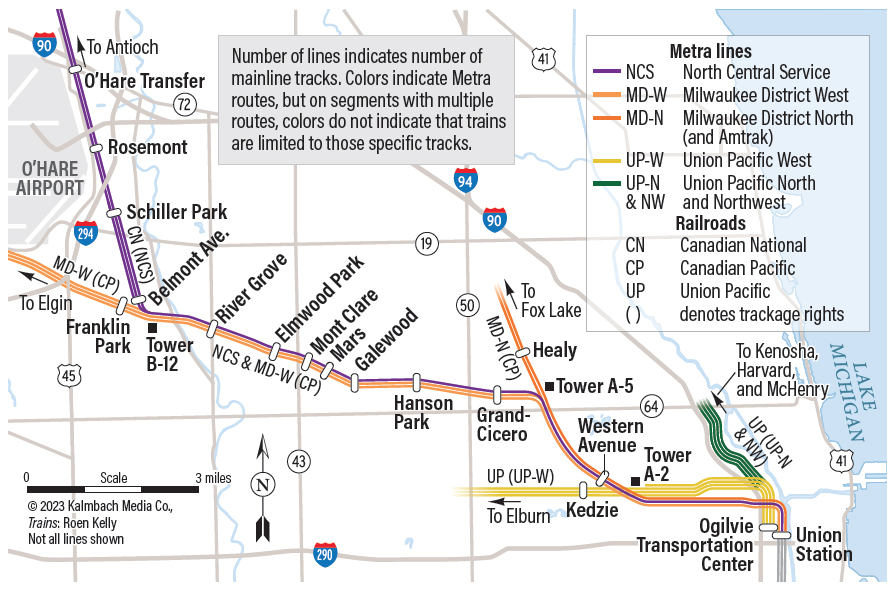
“It’s going to take capacity on the segment from [Tower] A-2 to Oglivie and Union Station. It’s going to take capacity from A-2 to A-5,” Derwinski says. “A necessary infrastructure improvement is going to include an entire main line section from A-5 to B-12. … Figuring out how we would be able to run robust enough service, but not impact [CN and CPKC] freight movement, those are the challenges.”
The answer?
“Infrastructure, infrastructure, infrastructure: flyovers, crossovers, mainline sidings,” he says. “But I can tell you there’s a big interest to do that.”
Derwinski, Chief Operating Officer Kevin McCann, and Dan Miodonski, manager of service design, have been mapping out an O’Hare plan for at least four years. And O’Hare service was part of an ambitious $5 billion proposal, dubbed the “Big Ask,” that Metra presented to the state in 2019. “COVID has slowed a lot of things down,” Derwinski says.
While the pandemic put the brakes on the project, there are now financial incentives to move it forward. The federal Infrastructure Investment and Jobs Act, and the $45 billion Rebuild Illinois Capital Plan, signed into law in 2019, means money exists that makes it worthwhile to look at “some visionary stuff that really could produce some different ridership patterns for us,” he says. But to chase federal funding in particular, he says, “you’ve got to have a ready project: partly engineered, environmentally done, and [with] a financing plan. Those are the core elements to being a grant winner.”
It is likely not coincidental that, when Metra ran a special train on Dec. 10 for the Bipartisan Policy Center Congressional Exchange [see “News photos: Metra operates congressional special,” Trains News Wire, Dec. 10, 2023], the train ran between Union Station and O’Hare. Chicago-area U.S. Rep. Mike Quigley, who was on board, said in a post on X that the trip was to discuss the infrastructure needs of Metra and other rail lines.
So don’t be surprised if you hear more about Metra service to O’Hare soon. Perhaps that station tucked behind the rental-car building won’t remain the little-used stop it is today.
— This article originally appeared as part of new article on Metra in the updated 2023 edition of the Trains special issue, “Chicago: America’s Railroad Capital.” That issue is available at the Kalmbach Hobby Store.