LIRR FA2

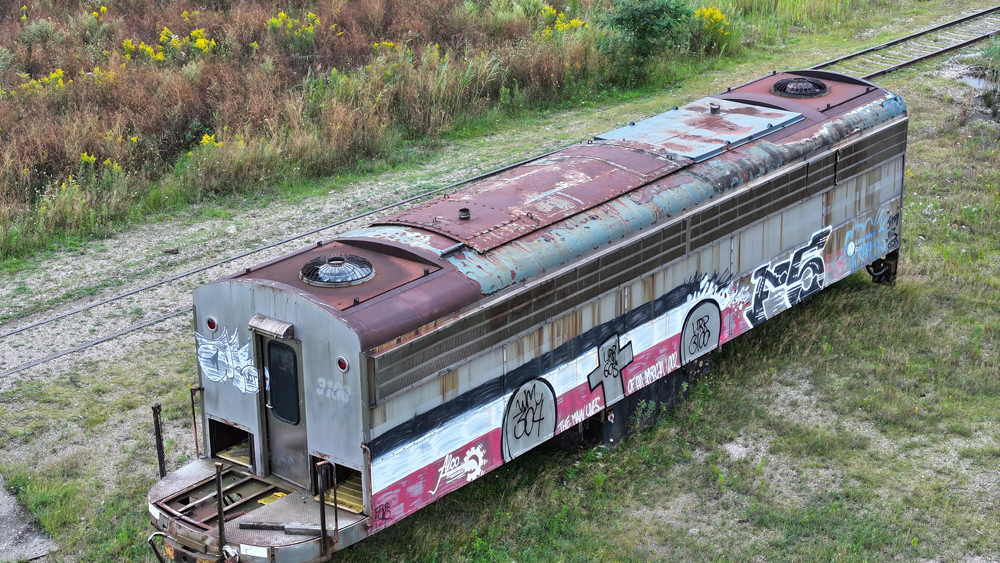
It’s an unusual sight — what looks almost like a diesel B unit, resting on the cold ground in an Ohio scrapyard. A closer look reveals that this wasn’t always a B unit — it had a cab at one point, removed with significantly greater care than any scrapyard could give. On its side, a curious collection of official logos and affectionate graffiti proclaim the unit’s history of this engine in broad letters: WM 304, LIRR 608, and LIRR 3100.
What is this engine, and how did it get here?
From Hagerstown helper to commuter cab car
Nothing has ever been standard about LIRR 3100. Built as WM 304 — the last built of Western Maryland’s fleet of four Alco FA2s — in 1951, it and its three siblings served primarily as helper units in the Hagerstown area. In their final years, arriving early in the railway’s dieselization, the 304 was the only FA to wear all of the railroad’s pre-Chessie System colors. Arriving painted in the road’s “Fireball” livery, it was later repainted into the “Speed Letters” scheme, before finally ending up in the red-and-white “Circus” livery that defined the last years of the WM.
In 1972, the thoroughly worn-out 304, along with sibling units 301-303, was sold to General Electric, which was rebuilding Alco FA units for Long Island Rail Road, which would use them in double duty: They would provide head end power to passenger cars as well as serve as control cabs on trains. LIRR used older coaches and demotored electric m.u. cars converted to HEP heating and lighting. Initially, the railroad used its Alco road-switchers to pull the cars, but those units had steam generators incompatible with the trains’ coaches.
Long Island acquired 19 former FA1s and FA2s, originally built for Western Maryland, New York Central, New Haven, Louisville & Nashville, and Spokane, Portland & Seattle. Stripped of their traction motors, the streamlined cab units no longer could move on their own. But they retained their Alco 244 prime movers and generators, which provided 600-volt HEP electrical power to the coaches, while the Alco C420s and RS3s provided propulsion to the trains. Dubbed “Power Packs,” the former FAs also retained their control stands, allowing them to lead a train as the Alco at the rear pushed. The Power Packs soon became mainstays on LIRR trains, remaining in service long after the C420s and RS3s were replaced by EMD GP38-2s and MP15ACs in the mid-1970s. Many of the control cab units also received newer diesel engine/generator sets, replacing the original Alco 244 prime movers.
WM 304 became LIRR 608, and was painted into the road’s blue, yellow, and white paint scheme of the early 1970s, before being repainted in 1979 into an experimental red, white, and blue livery. This was found to be too difficult to keep clean, and so the unit was painted yet again into the LIRR’s 1980s-era blue and white livery, which it kept until 1992.
Losing its cab

In 1992, the unit entered its final form. In the early 1990s, the LIRR began work on offering a single-seat trip on the partially electrified Port Jefferson Branch. As full electrification of the line was not economically feasible, the railway instead acquired three EMD FL9AC dual-mode locomotives, and ordered a small fleet of bilevel coaches from the Tokyu Car Cor. Dubbed the C1, the fleet of 10 coaches arrived before the FL9AC locomotives, so a need for a dedicated HEP unit arose. FA2 608 was chosen for this role, and was rebuilt for a second time, with its cab removed, a new generator installed, and clad in stainless steel to better match the C1 cars. Renumbered 3100, the unit rolled out of the Morris Park locomotive shop in 1991 and was dedicated to the memory of R. “Buff” Stickevers, a key worker on the project who died shortly before it was completed.
From all accounts, the 3100 performed its duties as designed, and provided HEP until the arrival of the FL9ACs. Subsequently, an effort was made to use the unit as a stationary power source in LIRR yards, but problems with the fuel tank and system, which dated back to the Western Maryland and possibly the Alco factory, led to constant fuel delivery issues. The unit was sidelined just a few years after it was built.
It languished for years in the Morris Park yard, tagged at some point in the mid-2010s with an elaborate graffiti mural depicting its history, including a makeshift rendition of the Western Maryland “Circus” paint scheme. Finally, in May 2018, the unit was sent out for scrap. It was sold to Republic Metals, a scrapyard in Ashtabula, Ohio.
As of October 2023, it remained relatively intact. Republic has found easier pickings with ex-New York City Transit R32 cars, Metra Highliner cars, and LIRR M1 electric multiple units, but should that change, the 3100 may finally be parted out.
Updated Jan. 10, 2024 in regards to the cars used by LIRR.