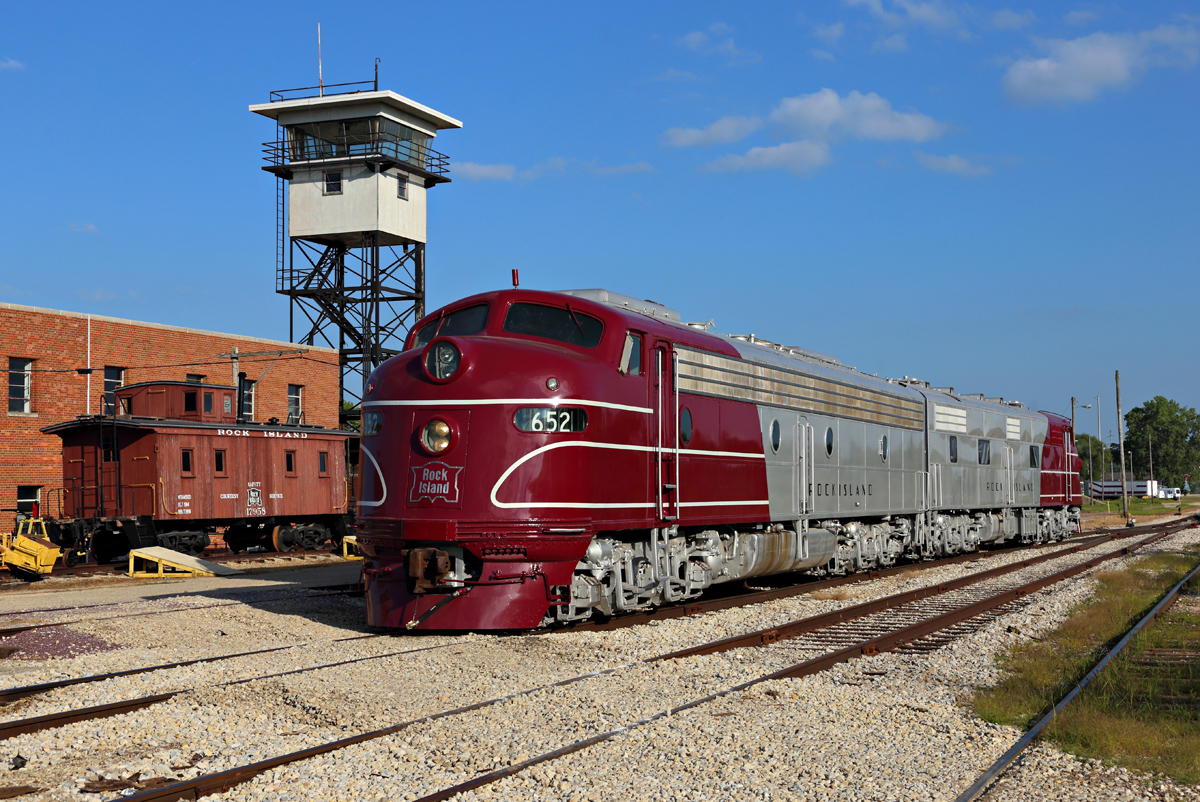
Iowa Northern’s Oelwein turn brought the two E units to Oelwein from Waterloo, Iowa, on Aug. 18, for public display and a night photo shoot at the Hub City Heritage Corporation Railway Museum in Oelwein. Both units have been repainted in the Rock Island’s simplified 1960s-era red and silver paint scheme. Manly Junction Railroad Museum President Dan Sabin, who’s also president of Iowa Northern and once worked for the Rock Island, made the units available for the event.
Both locomotives once pulled Rock Island’s famed Rocket streamliners, and are the last remaining Rock Island E units. EMD built No. 630 in 1941, one of five E6As the railroad purchased. Today it’s one of only a few remaining slant-nosed E units. It pulled long-distance passenger trains for decades before ending its Rock Island career on Chicago commuter trains.
No. 652 was one of 13 E8As purchased by the Rock Island in 1951. In 1976, it received a red, white, and blue paint scheme by Chicago’s 20th Century Railroad Club for the United States’ bicentennial. In that scheme, it led Peoria and Quad Cities Rockets until the end of Rock Island passenger service in 1978. Nos. 630 and 652 returned to passenger service for about a decade on the 20-mile Midland Railway at Baldwin City, Kan. They were sold to the Manly Junction Museum in 2009.
While the two E units are not yet operational, Sabin hopes to restore them to operation and to move them to Manly where he says they will become major attractions at the museum.