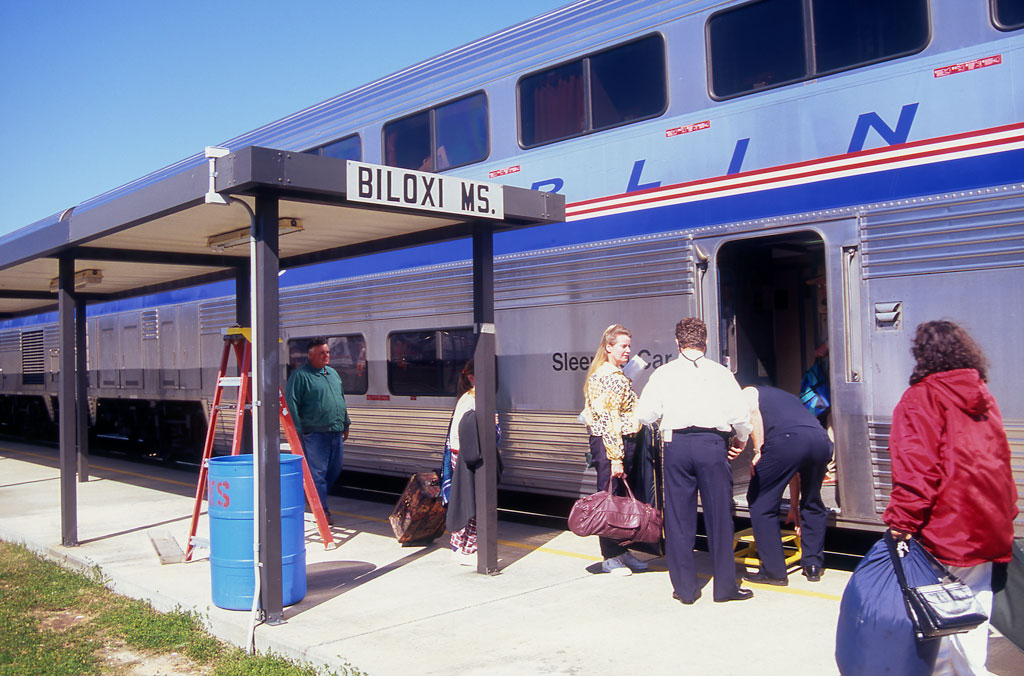
In a perfect world, we’d have fond memories of a bottle of champagne being ceremoniously smashed across the pilot of an Amtrak P42 heading the maiden trip of long-sought passenger service between Mobile, Ala., and New Orleans. And we’d be able to take the train to the beach at Biloxi or the aquarium at Gulfport, Miss.

Instead, after more than five years of studies and fruitless negotiations, Amtrak this month hauled CSX Transportation and Norfolk Southern before the Surface Transportation Board in the hopes of forcing the freight railroads to host four daily state-supported passenger trains – or show why they can’t.
This sets up a clash with stakes that are much higher than simply restoring passenger service on a 144.1-mile stretch of the Gulf Coast. The fate of Amtrak’s growth strategy – developing regional corridors by connecting cities that are less than 400 miles apart – may hinge on the outcome.
What’s not in dispute is that Amtrak has a legal right to access freight rail lines and that it must pay for passenger-related upgrades. Rail traffic control studies are always performed to sort out how passenger and freight trains can coexist. And they determine what track and capacity improvements are needed.
The latest New Orleans-Mobile study, due out in January, never crossed the finish line. Amtrak and its partner, the Southern Rail Commission that includes officials from Louisiana, Mississippi, and Alabama, accuse CSX and NS of dragging their feet. And so Amtrak asked the STB to step in so that passenger trains can roll as soon as January 2022.
The Class I railroads rightly fear the precedent that would be set by Amtrak launching service without a traffic study. They’re also nervous about the Federal Railroad Administration’s new Amtrak performance standards, which require host railroads to ensure that at least 80% of passengers arrive on time. This is uncharted territory.
Amtrak rightly fears the precedent that would be set by freight railroads needlessly delaying proposed passenger service, raising unreasonable objections, and putting up prohibitively expensive roadblocks. On the Gulf Coast, all the stars have aligned for new service: The Southern Rail Commission has $66 million to fund improvements to CSX’s 138.5-mile single-track New Orleans & Mobile Subdivision. If Amtrak can’t launch service here, the thinking goes, then it will be unable to do so anywhere.
An exhaustive 2017 study looked at running two New Orleans-Mobile regional trains along with the resumption of the Sunset Limited east of New Orleans. You’d think that the ill-fated 2020 study would go quickly: Dust off the 2017 report, update it to reflect current freight operations including a 3.3-mile stretch of NS in the Crescent City, and then toss four daily passenger trains into the mix.
But CSX has raised a host of operational issues. Among them: Potential delays posed by seven drawbridges on the line, inadequate siding capacity, and concerns that the Amtrak trains would interfere with freight traffic heading to and from the busy Port of Mobile. Privately, operations people say these concerns are overblown and would be solved by the publicly funded track improvements and Coast Guard agreements giving Amtrak priority on drawbridges.
In the court of public opinion, CSX has painted itself into a corner. CSX executives have said their existing network has the capacity to handle 30% more traffic. Plus, CSX is the self-proclaimed best-run railroad in North America and boasts that it has the top operating team in the business. CSX now runs only eight daily freights between Mobile and New Orleans. So you wonder if CSX can really say with a straight face that adding four Amtrak trains to a beefed up, lightly used route would bring such a crackerjack railroad to its knees.
Despite passenger advocates’ claims that CSX has taken a “death by study” approach to new passenger service, CSX insists that it is only opposed to Amtrak launching service without following the usual traffic study process.
There’s plenty of blame to go around. While the latest study was under way, Amtrak and the Southern Rail Commission moved the goalposts by considering the use of Talgo equipment, only to shelve the idea, and Mobile suggested an alternate site for its passenger stop. In December the Southern Rail Commission said the study was going well. But bad data from a host railroad subsequently set back the traffic modeling, and that was the last straw for Amtrak. This blindsided CSX and NS, who stress the need to complete the study.
What’s clear from this mess is that there must be a better way.
You can reach Bill Stephens at bybillstephens@gmail.com and follow him on twitter @bybillstephens
Share this article