

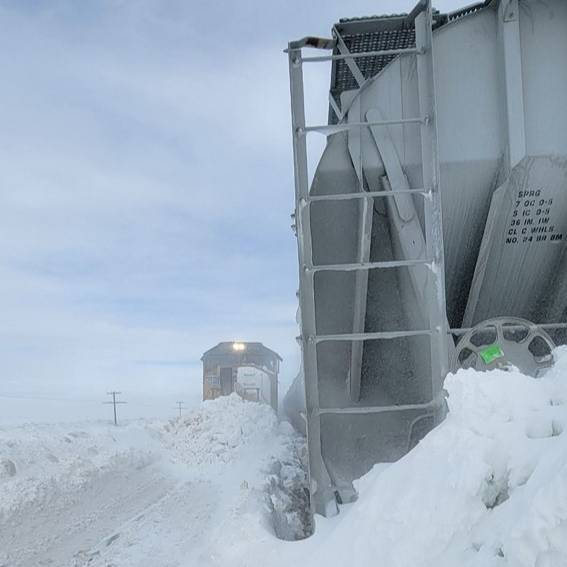
“The story of the past quarter for Union Pacific is one of resiliency,” CEO Lance Fritz told investors and analysts on the railroad’s earnings call on Thursday morning. “Battling heavy snow, arctic temperatures, flooding, and tornadoes, the team maintained service levels and exited the quarter on a positive trajectory. Persevering through those harsh conditions, our employees delivered for our customers, which demonstrates again that our people are the foundation for the great things that lie ahead.”
UP’s quarterly operating income declined 3%, to $2.29 billion, as revenue increased 3%, to $6 billion. Earnings per share rose 4%, to $2.67. The railroad’s operating ratio increased 2.7 points to 62.1% due to a combination of inefficient operations, inflation, and the impact of harsh winter weather.
Overall, UP’s volume was down 1% for the quarter. Bulk volume was down 3%, industrial products traffic was flat, and premium traffic, which includes intermodal and automotive, was down 1%.
Trip-plan compliance was relatively unchanged from a year ago: Intermodal improved a point to 72%, while manifest and automotive traffic dropped a point to 61%.
The railroad’s key operations metrics – including freight car velocity, locomotive and employee productivity, and train length – all declined for the quarter. Average terminal dwell and average train speed were unchanged from a year ago. Executives said over the last three weeks operations have rebounded as winter has loosened its grip on the railroad.
Fritz says UP’s train crew levels are in much better shape than they were a year ago thanks to ongoing hiring. Conductor classes are full across the railroad, he says, which is different than last year, when UP struggled to find applicants at six crew hubs on its northern tier.
UP maintained its financial outlook for the year. The railroad expects its volume to be higher than the rate of industrial production, which is currently forecast to be down 0.7 points. UP expects operating ratio improvement this year and to obtain price increases that are above the rate of inflation.
Share this article