

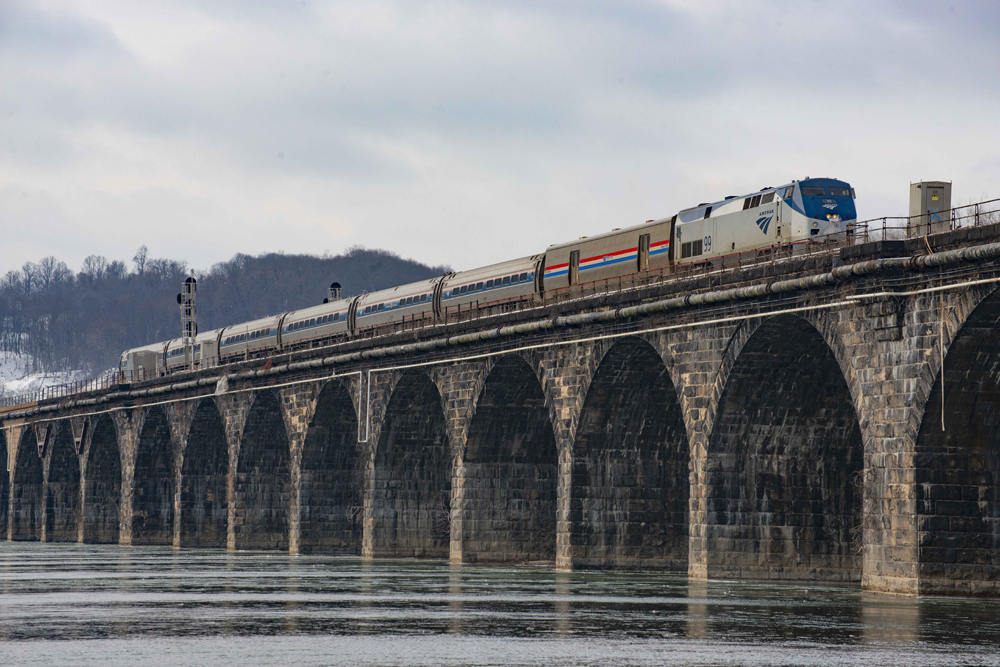
HARRISBURG, Pa. — Re-laying a third track on the historic Rockville Bridge over the Susquehanna River and building a new 5-mile-long main line track through the Altoona, Pa., yard are part of a proposed Norfolk Southern-Pennsylvania Department of Transportation plan to add a second Pennsylvanian daily passenger train. In addition, the plan would install three new interlockings and expand nine others on NS’s 248-mile long Pittsburgh Line.
The price tag to eliminate eight choke points to minimize freight-train interference with Amtrak service is estimated at $147 million to $171 million. It would be paid for from the $1.2 trillion federal Infrastructure Investment and Jobs Act, signed into law by President Joe Biden on Nov. 15.
The proposed improvements are spelled out in an NS report titled “Amtrak Pennsylvanian RTC (Rail Traffic Controller) Analysis.” Details are contained in a 58-page document available at the PennDOT website.
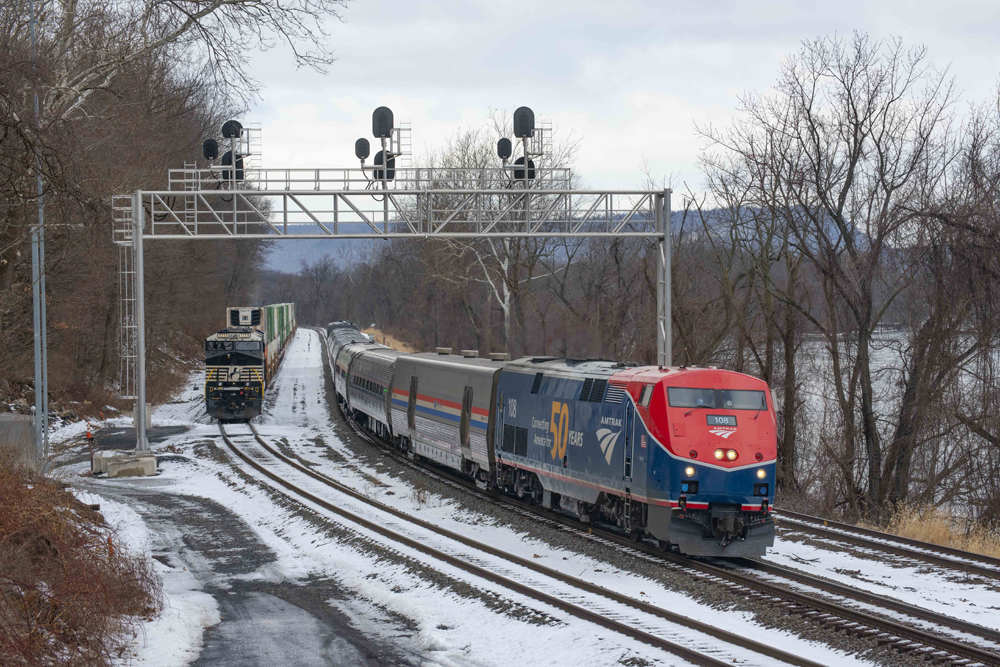
Governor Tom Wolf unveiled the broad strokes of the proposal at a Feb. 18 news conference in Pittsburgh, along with PennDOT Deputy Secretary Jennie Louwerse, Federal Railroad Administrator Amit Bose, elected and appointed state officials, and NS personnel [see “Pennsylvania, Norfolk Southern announce pending agreement …,” Trains News Wire, Feb. 18, 2022].
The Pennsylvanian runs for 195 miles between New York and Harrisburg on Amtrak’s Northeast Corridor and Keystone Corridor, and for 248 miles between Harrisburg and Pittsburgh on Norfolk Southern’s former Conrail/Penn Central/Pennsylvania Railroad main line.
The Pittsburgh Line, one of the heaviest-density freight routes in America, has in peak years carried as much as 100 million gross ton-miles. While much of the track is good for 79 mph passenger-train speeds, dispatching is complicated by a 40-mile helper district with 1.8 % grades over the spine of the Alleghenies, including the scenic and historic Horseshoe Curve.
Excluding helper moves, the route handles about 45 freights a day. It is double track or more from Harrisburg to Altoona, and three tracks or more (counting the Conemaugh and Port Perry-Mon Line bypass routes) from Altoona to west of Pittsburgh.
At its inception in 1971, Amtrak operated three daily trains over the route, the New York-Pittsburgh Duquesne, the Broadway Limited to Chicago and the National Limited to St. Louis and Kansas City, Mo. After the National was discontinued in 1979, PennDOT added the state-supported Philadelphia-Pittsburgh Pennsylvanian in April 1980, which in 1983 was extended to New York. Since 2005, the New York-Pittsburgh version of the Pennsylvanian has been the Pittsburgh Line’s sole daily Amtrak service.
The NS study, which used computer modeling to simulate passenger and freight traffic, concluded that “Norfolk Southern does not have adequate capacity to operate the proposed new and modified Amtrak schedules without degradation to both Amtrak and NS operations. To mitigate the added delay to both Amtrak and NS trains, and to protect NS priority (expedited) traffic, additional infrastructure is needed.”
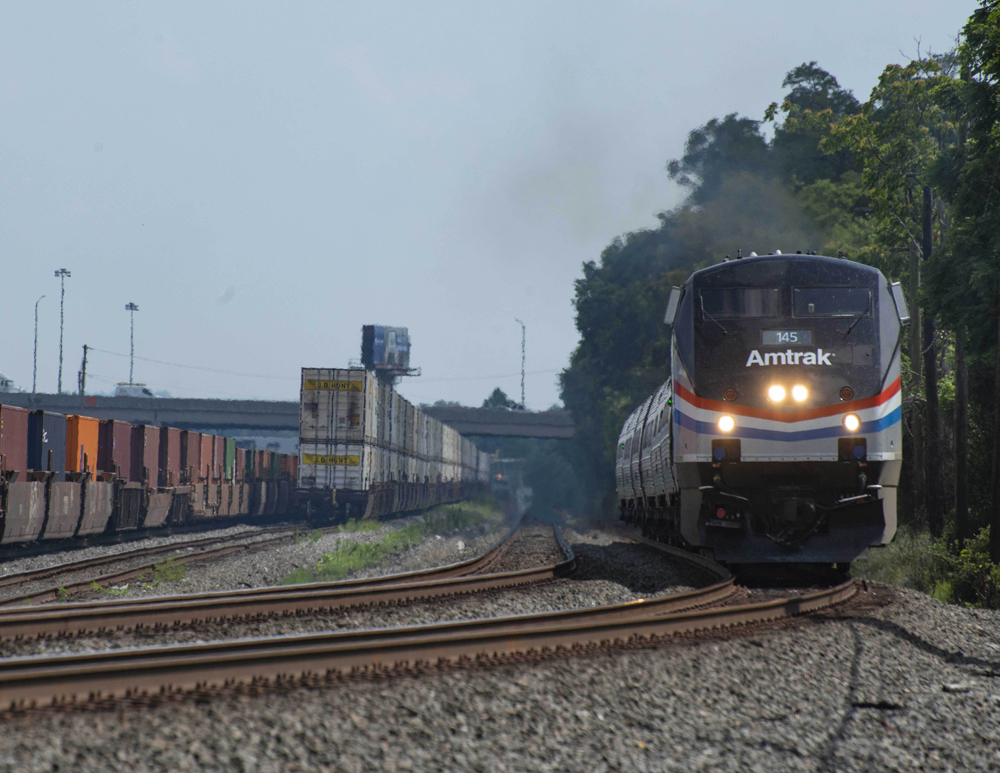
Forecasting to year 2040, the study assumes adding six merchandise freights and one intermodal train to the mix, all 10,000 to 12,000 feet long.
It left unexplained how NS formerly managed to operate two daily Amtrak passenger trains each way between 1999, when it took over this part of Conrail, and 2004, when Amtrak discontinued a successor to the Broadway named the Three Rivers.
The major operational change since then has been NS’s adoption of TOP21, its version of E. Hunter Harrison’s controversial Precision Scheduled Railroading model. On NS, PSR has produced days-late trains, outlawed crews, shortages of motive power, and wildly unpredictable deliveries for shippers. Shippers have complained to Congress and the Surface Transportation Board, calling for open access, re-regulation, or both.
Clearly, NS will have to get its operational model under control — which new NS President and soon-to-be CEO Alan Shaw has acknowledged to wary federal officials — in order to make reliable scheduling of two Pennsylvanians possible [See “Norfolk Southern reports some headway …,” News Wire, Dec. 13, 2021].
Projects envisioned (and their cost) include:
— Adding a mainline track to the existing two tracks through the Pittsburgh passenger station at CP-Pitt, Milepost 352.5, $12.5 million to $18.5 million.
— Adding a universal three-track interlocking at Milepost PT 276, just west of the Johnstown passenger station, $9.5 million to $11.5 million.
— Installing a universal three-track interlocking at Milepost PT 257, Portage, Pa., $7.8 million to $9.8 million.
— Constructing a new main track for 5 miles through the Altoona area, from CP Altoona, Milepost PT 236.8, to CP Antis, Milepost PT 232.5, $51.5 million to $61.5 million. This would entail upgrading interlockings at CP Altoona, CP Works, CP Homer, and CP Antis, and adding a helper pocket.
— Upgrading nine miles of an existing controlled siding, paralleling the existing double-track main, from CP Antis, Milepost PT 232.5, to CP Gray at Grazierville (Tyrone), Milepost PT 223.3, $11.5 million to $14.5 million. This would include installing a new universal three-track interlocking at Milepost PT 228, west of Fostoria Crossing.
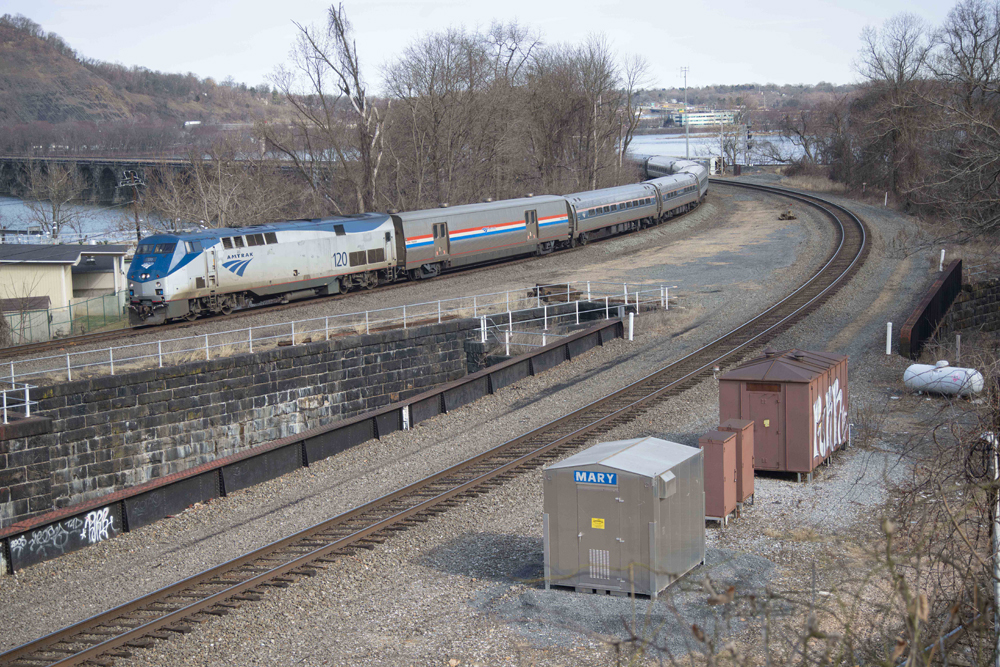
— Constructing a new third main line for 8 miles between Amtrak’s Harrisburg passenger station (CP Harrisburg, Milepost PT 105) and CP Banks at Marysville, Milepost PT 113, $50 million to $55 million. This would include restoring a third track across the 3,860-foot-long stone-arch Rockville Bridge (built in 1902 to carry four tracks) and converting the existing CP Banks interlocking to a universal configuration, capable of handling moves from any of three tracks on the west side to any of five tracks on the east side.
The report recommends cutting back a portion of the Pittsburgh station’s trainshed roof to permit double-stack freight trains to pass. This would benefit NS freight traffic, not Amtrak, as it would sharply increase the number of freight-train movements — and thus, potential for congestion and delay — through downtown Pittsburgh.
Because of the trainshed and other overhead restrictions, all NS double-stack trains – about 16 a day – now bypass downtown, taking the single-track Port Perry Branch and the Mon Line on the city’s South Side. Opening up the downtown main line to double-stacks will increase potential for passenger-freight conflicts on the 13 miles between CP Wing interlocking at Wilmerding (Milepost PT 340) and the passenger station. NS has recently received the go-ahead for other clearance work to create a second route for double stacks [see “Norfolk Southern gets mediator’s approval …,” News Wire, March 7, 2022].
Share this article