

WASHINGTON — Slack action was the probable cause of the Feb. 9, 2022, death of a BNSF Railway remote control operator helper who fell from the front platform of his locomotive in Denver, the National Transportation Safety Board said today.
“Surveillance video evidence reviewed by NTSB investigators shows slack action in the train consist at the moment the RCO helper fell from the platform,” the NTSB said in its report on the accident at BNSF’s Globeville Yard.
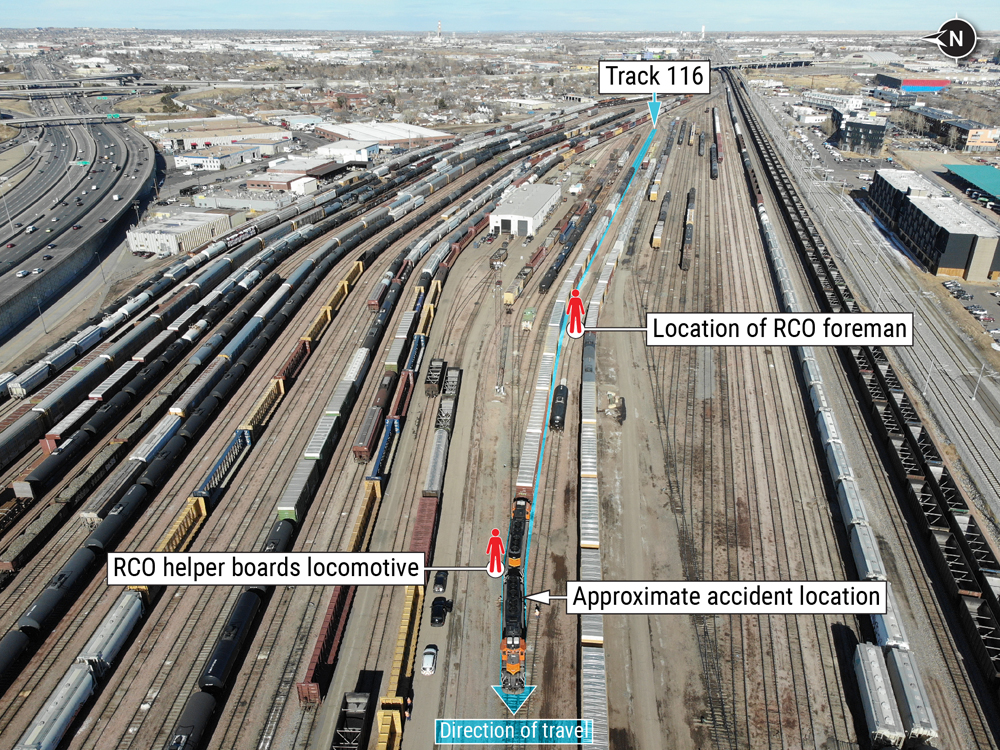
The switchman was struck and killed by 21-car BNSF train YDEN1152-09i during a switching movement on Track 116. The switchman was riding on the front center platform of the lead locomotive he was controlling remotely, BNSF 1961. The train suddenly decelerated, and the RCO helper fell forward onto Track 116, where he was struck by the locomotive, the report says.
The tilt feature on the operator control unit initiated an emergency brake application 12 seconds after the switchman fell onto the tracks. The remote control operator foreman heard the tilt timeout radio alert, walked to the accident scene, and called the yardmaster for emergency medical assistance. The RCO helper was pronounced dead at the scene.
“NTSB investigators measured 35.5 feet of potential slack in the accident train consist during post-accident observations and evaluations. The RCO foreman moved the locomotives forward 57 feet before the accident. Although theoretically 57 feet would be enough distance for 35.5 feet of slack to run out all the way, the actual accident and the NTSB’s accident re-creation suggest it was not,” the report says. “This was likely due to a combination of factors: locomotive speed and friction in the draft gear would have allowed the locomotives to travel without fully engaging all of the draft gear systems, and the stop at 10:56 a.m. during which the RCO foreman transferred control of the locomotive to the RCO helper would have allowed the railcars to bunch, or compress, leading to slack in the train.
“As the RCO helper boarded the locomotive platform, from a stopped position he selected a speed of 7 mph, which caused the locomotive to accelerate too quickly to manage the effects of slack action. Although the remote-control system functioned as designed, the RCO helper’s command for a quick increase in speed likely led to uncontrolled in-train forces. After the accident, BNSF reiterated the operating procedures and rules for remote control operation to employees, emphasizing the need to use low speed to stretch a train before commanding an increase in speed,” the NTSB says.
SMART Transportation Division Local 202 identified the RCO helper as Jeff Jones of Northglenn, Colo. He was a member of the union for more than a decade, joining in August 2011, and worked as a conductor for BNSF. In addition to Local 202, he previously was a member of Locals 945 in La Junta, Colo., and 113 in Winslow, Ariz.
Share this article