

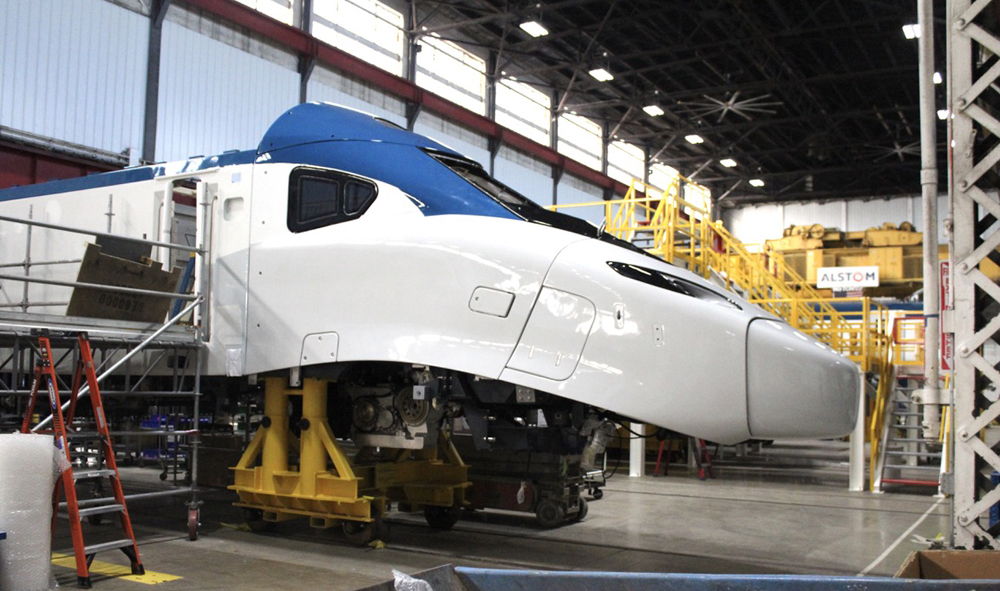
NEW YORK — Delays in launching Amtrak’s next-generation Acela fleet have cost the passenger company $140 million so far, and the figure continues to grow, the Wall Street Journal reported Wednesday in a paywalled article.
The figure includes the growing maintenance costs of keeping the current Acela trainsets — the first of which entered service in December 2000 — operational beyond their intended service life, and with parts no longer being manufactured. The Journal reports Amtrak has spent $48 million on parts, brake overhauls, and other work by private contractors to keep the current fleet in operation, and that four of the 20 trainsets built by Bombardier and Alstom between 1998 and 2001 never returned to service after being parked during the COVID-19 pandemic. Instead, they are being cannibalized for parts.
The Amtrak Office of Inspector General released a highly critical report on the manufacturing process for the new Acelas in October [see “Amtrak Inspector General: Production problems …,” Trains News Wire, Oct. 3, 2023], but all dollar figures were redacted in that report. The Journal reports it was able to review an unredacted version of the report, which is the source of its $140 million figure. That figure also includes losses from having fewer Acelas in operation and having less capacity in those that are running, compared to the larger next-generation trains.
The new Acelas were originally supposed to enter service in 2021 but now are projected to begin service sometime in 2024, eight years after they were ordered. The Inspector General’s report indicated ongoing issues include an inability to produce a computer model of the trains performance that matches predicted performance; such a model is part of the testing process required by the Federal Railroad Administration. The modeling issue was first reported by the Washington Post earlier this year [see “New Acelas face further delays,” Trains News Wire, May 30, 2-23].
The Inspector General report said trainsets have also been built with defects that must still be corrected, and no schedule has been established for addressing those defects.
Share this article