

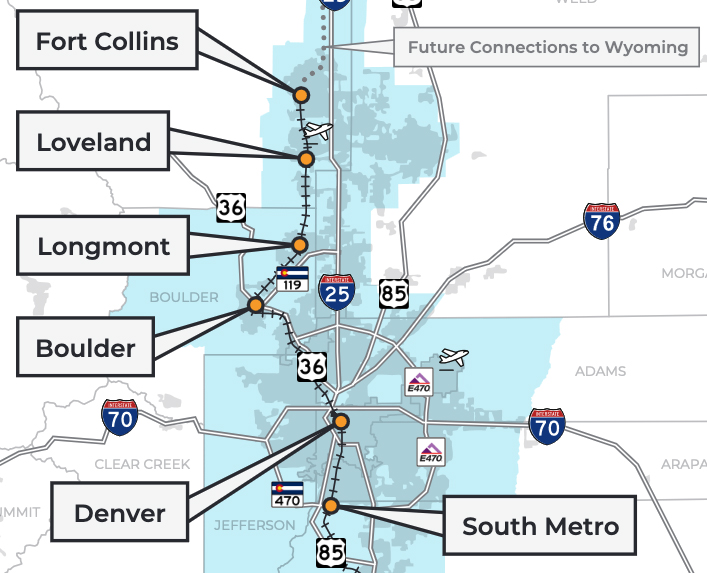
DENVER — A new plan released last week might finally lead to passenger rail service between Denver, Boulder, and Longmont, Colo., but not exactly as originally envisioned.
That route was part of the Fastracks commuter rail plan approved by voters in 2004, but has never been built out because of a lack of funding. Now, the Denver-area Regional Transportation District, the state Department of Transportation, and the Front Range Passenger Rail District are proposing to work together to build the route connecting those cities, as well as Fort Collins, as an intercity rail route, rather than a commuter line. The Denver Post reports that defining the route in that matter would unlock access to some $102 billion in federal funding not available for commuter projects.
The white paper released by the organizations dubs the effort the “Northwest Rail” project, which would use the existing BNSF Front Range Subdivision route. The agencies say they seek to “start a conversation of the benefits a partnership” between the three organizations to “maximize operational efficiencies and accelerate delivery of two parallel train services contemplated to run on the same existing train tracks,” according to a press release. By combining planning and financing, the three groups might be able to start a service together that they could not manage individually.
“Through a joint powers partnership, we can leverage the strengths, funding, and existing technical work from all of our potential partners to overcome the historic challenges for providing a starter service for Northwest Rail,” said John Putnan, senior advisor to the Department of Transportation. “And at the same time, by expanding the starter service to Fort Collins, we can achieve important passenger rail goals by completing a first phase of the project, unlocking more federal resources, and buying down the total potential cost of Front Range Passenger Rail.”
The Front Range project seeks to create a 160-mile route from Fort Collins to Pueblo, and was among the 69 routes included in the Federal Railroad Administration’s Corridor Identification and Development Program announced late last year [see “Full list of passenger routes …,” Trains News Wire, Dec. 8, 2023]. The basic Front Range plan, with six trains a day, is estimated to cost at least $2 billion, the Post reports, making federal funding an essential element.
The full 15-page white paper is available here.
Share this article