


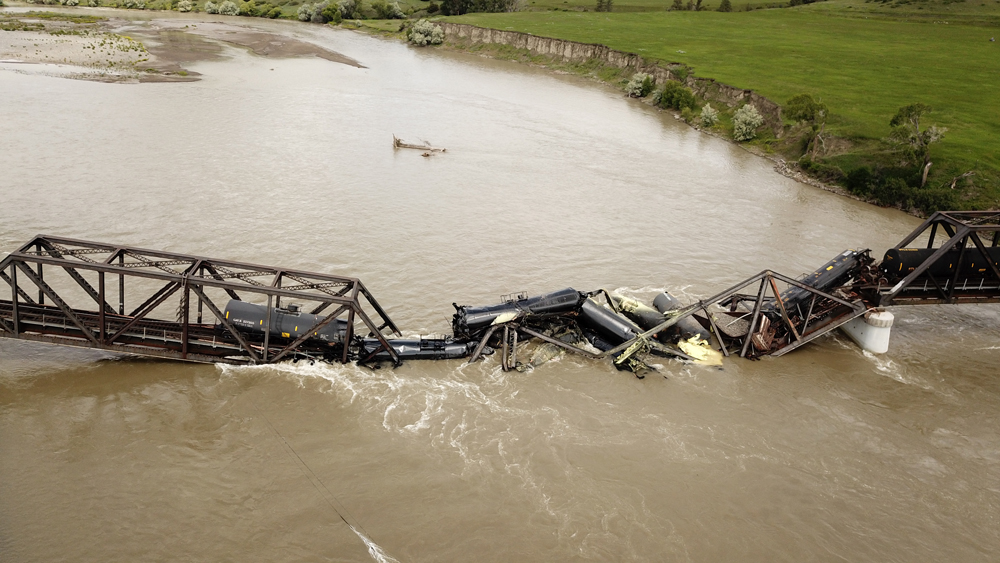
REED POINT, Mont. — The Montana Rail Link bridge over the Yellowstone River, which collapsed on Saturday, passed inspections in November 2022 and last month, railroad President Joe Racicot said at a unified command news conference on Monday evening.
“We feel confident that this bridge was suitable for stream flows,” Racicot says. A combination of snow melt and heavy rainfall has swollen the Yellowstone River in the area.
“We do invest heavily in our capital infrastructure and this bridge was no exception,” Racicot says.
The century-old former Northern Pacific bridge carries 16 or 17 trains per day, Racicot says, and an eastbound train crossed the span an hour before the 52-car westbound Laurel to Missoula, Mont., local that derailed around 6 a.m. on Saturday.
Officials said it remains unclear which came first: The bridge collapse or the derailment that sent 10 cars into the river.
The Federal Railroad Administration and National Transportation Safety Board are investigating, while the unified command team of officials from Stillwater County Disaster and Emergency Services, the Montana Department of Environmental Quality, the U.S. Environmental Protection Agency, and Montana Rail Link are handling incident response.
With derailment cleanup still under way, Montana Rail Link does not yet have an estimate for how long it will take to replace the bridge that has severed its main line, Racicot says.
The route is a key link for BNSF Railway traffic moving to and from the Pacific Northwest. MRL operates the route under lease from BNSF. The companies reached a deal last year on early termination of the lease, and BNSF expects to take over operations on Jan. 1.
MRL is working with its unions and BNSF to detour its own traffic via BNSF’s former Great Northern Hi-Line, Racicot says.
A BNSF spokesman says the railway is detouring the majority of its MRL overhead traffic via the Hi-Line by running it on its route from Laurel, Mont., to the Hi-Line junction at Shelby, Mont. Some BNSF detours are running on Union Pacific between Hastings, Neb., and Portland, Ore., BNSF says.
“We made some good progress today with cleanup,” Racicot said.
The contents of two tank cars containing sodium hydrosulfide, that were located on the west side of the bridge, have been transferred into stable railcars and moved to safety, the EPA said. Eight railcars on the eastern side of the bridge that did not reach the water have been removed, as well. Four asphalt cars remain on the eastern side of the bridge. These will be removed as cleanup efforts continue, according to the EPA.
State and federal environmental officials remain on scene, and MRL is bringing in environmental cleanup experts.
Ten cars remain in the river, including six loaded asphalt, three carrying molten sulfur, and one car of scrap metal.
EPA officials said water readings are not showing contamination but blobs of asphalt have been showing up downstream. Asphalt is not water soluble and is not anticipated to impact water quality, officials said. Water quality testing results from Saturday show no detectable levels of petroleum hydrocarbons or sulfur and samples continue to be taken and analyzed.
“We have brought in a specialized dive team. They’re going to help us not only assess what’s in the river but also help us secure the cars for removal from the river,” Racicot says.
Note: Updated with BNSF comment at 4:20 p.m. CDT.
Share this article