

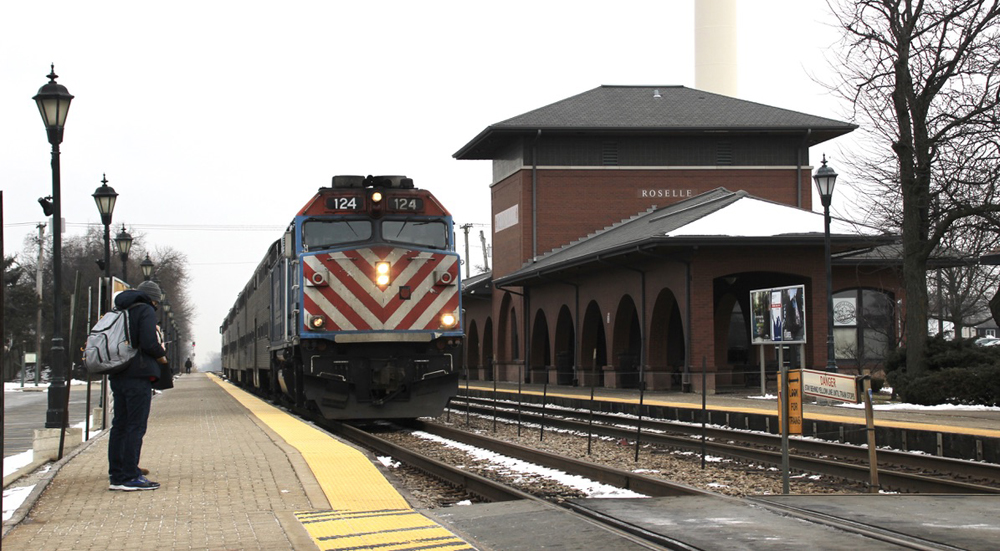
WASHINGTON – The impact of the Canadian Pacific-Kansas City Southern merger on Metra commuter operations is even worse than initially thought, the Chicago area commuter railroad has told federal regulators.
Changes to CP’s operations in the Chicago area as a result of the merger would cause up to a 1,200% increase in delays to commuter trains per 100 train-miles, Metra claims, based on a more detailed analysis using the amended operating plan CP and KCS submitted in May.
That’s triple the 400% increase in delays that Metra calculated based on information in the original CP-KCS operating plan.
Metra concludes that CP and KCS:
- Continue to exclude commuter and Amtrak traffic from their capacity analysis;
- Presume that available capacity on the Milwaukee District main line is “reserved exclusively for CP/KCS and fail to acknowledge Metra’s right to return to its pre-Covid passenger volumes;”
- Have not evaluated the impact of their operations on Metra or conducted Rail Traffic Controller simulations to determine whether their operating plan is feasible.
Metra says the capacity analysis that CP and KCS offer in support of their operating plan is “insufficient.” The agency also was critical of CP and KCS removing the growth of bulk-train traffic from their train count projections.
“Our RTC modeling reflects all future CP/KCS freight train volumes, regardless of whether CP/KCS attribute their projected existence to ‘transaction related’ or ‘organic’ growth, as well as all future passenger train volumes,” Metra’s consultants, Thomas Crowley and Robert Mulholland, wrote in a filing with the Surface Transportation Board last week. “Future freight train volumes will have an impact on future passenger services, and vice versa. CP/KCS made no effort to assess this in either their original or amended operating plan.”
CP has said that the impact of the CP-KCS combination is the only legitimate issue under review.
Meanwhile, the eight Chicago suburbs opposing the CP-KCS merger claim that the railways understate the projected increase of freight traffic on the double-track Elgin Subdivision that’s part of CP’s route linking Chicago with Kansas City, Mo.
The group includes Bartlett, Bensenville, Elgin, Itasca, Hanover Park, Roselle, Wood Dale, and Schaumburg, Ill., all towns along the Metra Milwaukee District West Line between Chicago and Elgin. Metra owns the trackage, which is dispatched by CP.
The Coalition to Stop CPKC notes that CP projects that the KCS merger will increase freight traffic on the route to 11 trains per day, up from the current average of three. But it now says the line could see an additional 6.6 trains per day, at least at the outset of the merger.
CP intends to shift north-south traffic currently interchanged in Chicago to a single-line CPKC route via its Marquette Subdivision in Iowa. Metra claims that the Marquette Sub lacks the capacity to handle the additional traffic, even with planned capacity increases on the line.
The Coalition to Stop CPKC claims this means that CPKC would run its new single-line traffic from the Twin Cities to Chicago and then from Chicago along the Elgin Subdivision toward Iowa and on to Kansas City.
“Adding these 6.6 trains to the 8.0 Applicants now state will be added over the next three years would mean the total number of freight trains running over the western end of the Elgin Subdivision could reach nearly18 trains per day where currently there are only around 3,” the coalition told the board. “This cannot be accomplished absent severe harm and disruption to the Coalition communities, and indeed it might not be operationally feasible in any event.”
The communities are seeking up to $9 billion worth of mitigation projects. Approval of the merger should be accompanied by conditions that include imposition of mitigation measures, elimination of any additional freight traffic on the western end of the Elgin Subdivision, and limits on train length on the Elgin Sub, the coalition has told the board.
Share this article