

Rail labor leaders welcomed the safety advisory that the Federal Railroad Administration issued last week that encourages railroads to take steps to reduce the in-train forces that can cause long trains to derail.
Railroads, meanwhile, said they were reviewing the advisory to make sure their operating practices are in line with the FRA’s recommendations.
“For years, rail workers and unions have been sounding the alarm about safety risks posed by longer and heavier trains, from rushed safety inspections and blocked road crossings to increased derailments,” says Greg Regan, president of the Transportation Trades Division of the AFL-CIO. “We welcome the Federal Railroad Administration’s safety advisory directing rail companies to address safety risks stemming from long trains and look forward to additional federal recommendations and best practices that can govern safer train lengths.”
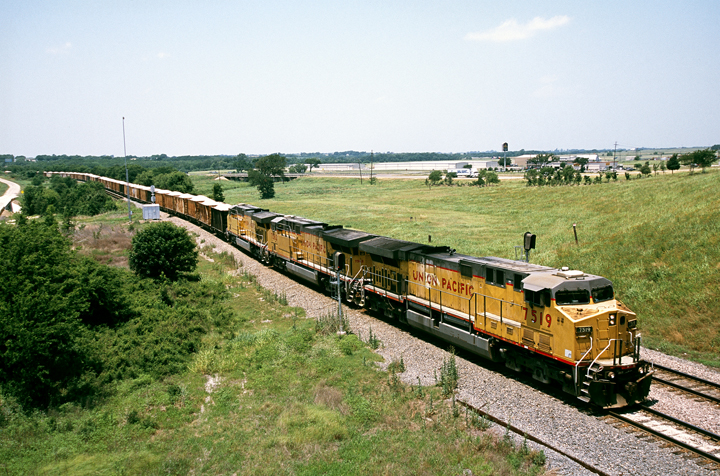
The U.S. Class I railroads have increased train lengths since 2017. Mainline derailments have not increased since then, but the FRA said it had “noticed a rising trend in recent incidents where train build and makeup have been identified as a potential cause or contributing factor.”
Train length and tonnage — when combined with the placement of loads, empties, and cars with cushioning devices — can cause slack to run in or out with enough force to cause derailments on grades, undulating terrain, or curves.
“Think about going through undulating territory sort of like a Slinky. You’re either trying to keep it stretched out or you’re trying to keep it all bunched together to control the forces from going in and out because that’s what causes derailments. And it causes train separations,” said Mark Wallace, vice president of the Brotherhood of Locomotive Engineers and Trainmen union, told The Associated Press. “The way to prevent this stuff from happening is to control the train lengths.”
Jared Cassity, the alternate national legislative director for the SMART-TD union, says the FRA safety advisory was overdue. “Obviously we’ve had concerns for years about the growing length of the trains and the problems associated with them,” he says.
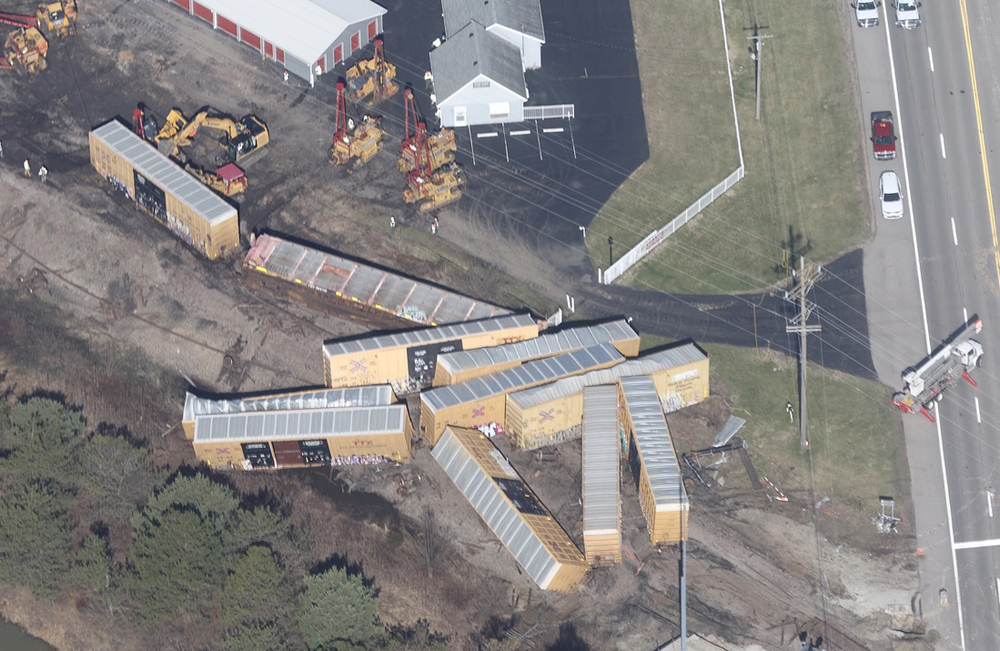
Train crews face pressure from management to have trains depart on time, regardless of whether the long trains are built properly, Cassity says. The 210-car Norfolk Southern train that derailed in Springfield, Ohio, last month, for example, had a “mind-boggling” amount of its tonnage on the rear end, Cassity says. “I don’t know how anyone sends that train out of the yard,” he says.
Cassity says he’s encouraged by the advisory and the focus railroads are now placing on how trains are built. But he says more stringent rules — rather than a safety advisory that lacks teeth — are required to solve the problem over the long term.
The Association of American Railroads points out that rail safety trends have improved.
“The last decade was the safest ever for railroading in this country, but there is still more work to be done. When building trains, railroads leverage advanced algorithms that account for numerous factors, many of which are noted in the FRA advisory, to place locomotives and blocks of freight cars within a train to maximize safety and effectiveness,” an AAR spokeswoman said. “The industry is committed to productive conversations about how we continue to advance our shared goal of ensuring the safety of the trains that serve customers and communities across the nation.”
The FRA safety advisory cited six derailments since May 2021 — three on Union Pacific, one on Kansas City Southern, and two on Norfolk Southern. All involved trains of 125 or more cars; featured distributed power units; far exceeded 4,000 trailing tons, the maximum weight threshold established by a 1992 AAR guide; and had an empty car as the first to derail. Other characteristics were shared in half or more of the incidents.
Norfolk Southern says it took action regarding train makeup last month, weeks before the FRA advisory was issued.
“With safety and continuous improvement in mind, we introduced a number of operational changes in March that address the way trains are built with the goal of minimizing train incidents, including derailments, by managing potential in-train forces,” NS spokesman Connor Spielmaker says. “Trains over certain lengths and weights, for example, require the use of distributed power units. We’ve also adjusted the positioning of lighter and heavier cars to further manage weight distribution in trains, as well as the positioning of cars equipped with cushioning devices to further manage slack.”
Union Pacific says its mainline derailments are down despite increased train length.
“Union Pacific shares the same goals as our regulators, customers and the communities we serve — to safely deliver every carload. Even as train length has grown, mainline and siding derailments are down 13% since 2013 and 26% since 2019. As we reported in January, maximum train length was flat in 2022 at 9,329 feet. We constantly evaluate our processes and continue to work with government agencies and industry partners to further improve safety,” spokeswoman Robynn Tysver says.
“Technology is playing a pivotal role in helping us to reduce variability and risk. One example is an advanced operating tool that calculates a train’s forces in real time and allows a 24/7 expert operating team to monitor and make changes to train makeup or train handling instructions prior to departure,” she adds. “This technology-driven approach has reduced mainline derailments throughout 2022 and thus far in 2023. Additionally, we are enhancing training programs and re-emphasizing our safety culture through a joint effort with our union partners. We are also conducting root-cause analysis of incidents and engaging employees to help us identify action items to reduce the risk of injury or incident.”
CSX Transportation says its operating practices already follow the recommendations outlined in the FRA safety advisory.
“CSX is committed to operating safely and constantly evaluates our operating rules to strengthen safe train handling practices,” spokeswoman Sheriee Bowman says. “We have reviewed the FRA’s recent safety advisory in detail and believe our current rules are in line with the agency’s recommended actions. We will continue to model and analyze train builds and work with the FRA and the industry to further enhance safe operations.”
BNSF says it was already focused on train makeup practices.
“As with all FRA safety advisories, BNSF takes this advisory seriously. Consistent with and even prior to the recommendation in the advisory, we have been focused on train makeup policies, practices and guidelines to ensure the safe movement of freight transportation,” spokeswoman Lena Kent says. “These train makeup practices have evolved considerably over the years, including technology advancements such as sophisticated modeling techniques and distributed power, the further development of air brake control valves and draft system design such as hydraulic end-of-car cushion units, and the advancement of training practices including the use of locomotive simulators.”
“As part of our train makeup process, BNSF evaluates new train builds through a computer simulated model over our most challenging territories to ensure in-train forces meet acceptable levels,” she adds. “Once the modeling achieves safe and acceptable levels, we then perform a supervised test run, collecting supervisor and crew feedback on how the train handled. We further collect locomotive event recorder data to analyze train performance and to ensure our distributed power placement is correct. Only when all aspects of the train operate at acceptable levels is that specific train build approved.”
Canadian National, Canadian Pacific, and Kansas City Southern say they are continuing to review the FRA advisory.
“Safety is a core value at CN. We use technology to ensure the systematic safe makeup of our trains both at departure and during transit,” spokesman Jonathan Abecassis says. “We continue to examine the safety advisory to review what CN would need to change, if anything, in its approach to comply as our systems are already comprehensive, effective and current.”
Note: Updated at 9:17 a.m. Central Time on April 12 with comments from SMART-TD union.
Share this article