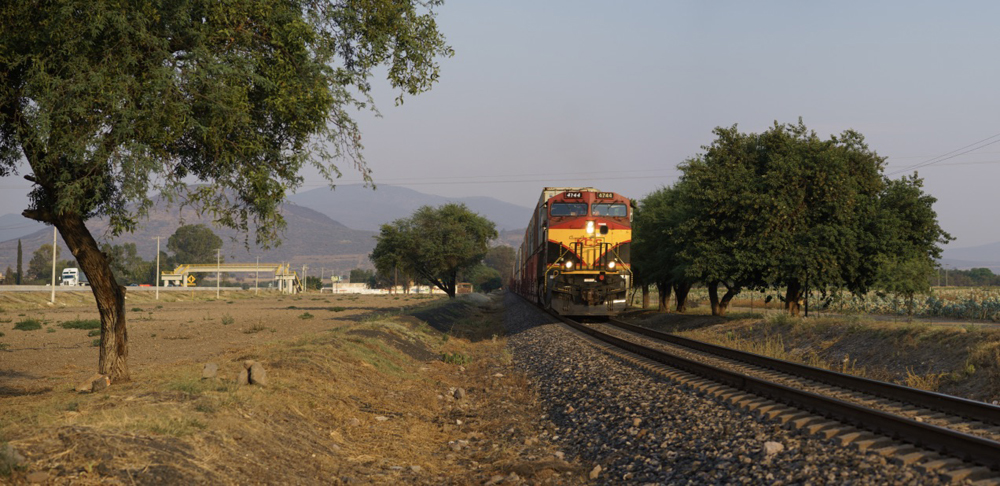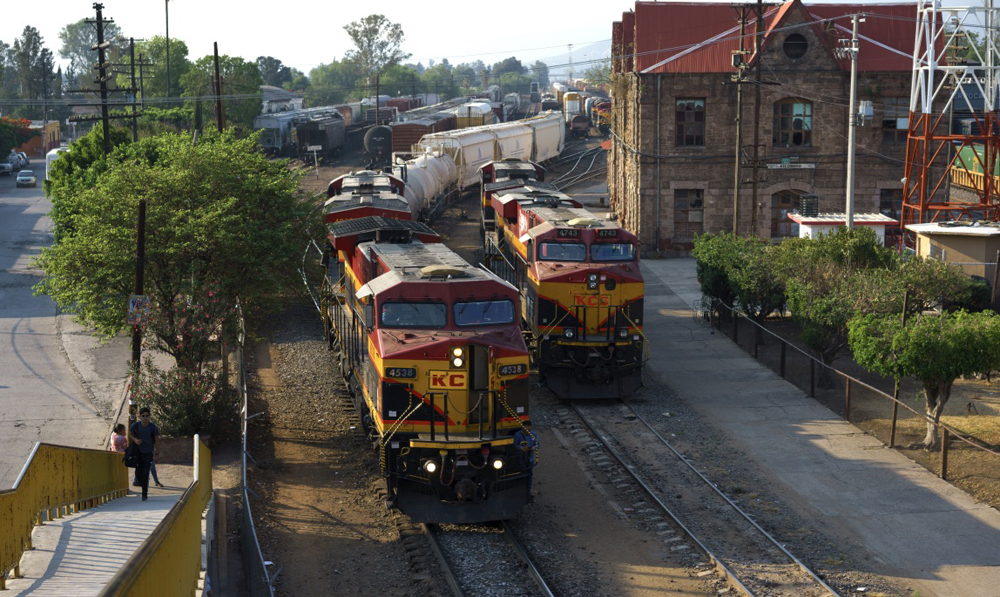
KANSAS CITY — Kansas City Southern de Mexico is battling congestion in key terminals thanks to a combination of stronger than expected traffic growth and a shortage of train crews.
The congestion, which began in December, now threatens to gum up Kansas City Southern’s U.S. network less than four weeks before Canadian Pacific gains control of the railroad and creates Canadian Pacific Kansas City.
But KCS says the railroad is on the mend. “KCSM’s service metrics are steadily improving and are expected to be at normal fluidity within two to three weeks,” KCS spokeswoman Doniele Carlson says.
Rick Paterson, a Loop Capital Markets analyst who closely tracks railroad performance measures, says the most recent KCS data shows a decline in velocity for the week ending March 18. Although systemwide dwell was down, it was up at Laredo, Texas.
“It’s pretty indisputable at this point that KCS de Mexico has melted down, with all the headaches that entails: unhappy customers, defections to truck, strained relations with all stakeholders, including government, and the typical one-year timeframe for a full service recovery,” Paterson wrote in a note to clients on Friday. “This is what Canadian Pacific is going to face on April 14 when the deal closes and the two systems are legally combined. We’re sure CP has thousands of pages of integration plans for KCS, but restoring and stabilizing service at KCSM has no doubt jumped to the top of page one.”
Traffic on KCS de Mexico is up 8.8% so far this year, compared with a 2% decline in KCS volume in the U.S. Systemwide, train velocity is down 22% compared to a year ago, while terminal dwell is up 35% through March 10, Paterson notes.
The congestion in Mexico is affecting most major KCSM terminals, including Monterrey, San Luis Potosi, and those in the Mexico City area. Terminal dwell is high at both of KCS de Mexico’s border yards in Nuevo Laredo, Mexico, where cars are spending an average of nearly 45 hours.
Dwell at Laredo, Texas, is 25 hours, a two-year high. Terminal dwell has risen for four straight weeks at the KCS hub of Shreveport, La., where cars spent 45 hours, on average. Paterson says that’s the highest in data going back to March 2017.
KCS de Mexico has taken numerous steps to ease the congestion. Among them:
- It has hired crews and has been negotiating with unions for more flexible work rules.
- Added 50 locomotives to the active fleet since Jan. 1.
- Sent high-ranking management to various trouble spots.
- Worked more closely with Ferrovalle to reduce congestion at interchanges.
- Updated train schedules to ensure that Monterrey has the capacity to move traffic south more frequently.
- Established a “war room” with teams from different departments.
“We continue to work aggressively to resolve the situation and are optimistic that improvements will be notable in the coming weeks,” KCS said in its latest service advisory, which was issued on Feb. 27.
CPKC is retaining key KCS operating executives. CPKC’s management team will include KCS’s current chief operating officer, the president of KCSM, and current CEO Pat Ottensmeyer will serve as an advisor through the end of the year. Meanwhile, Mark Redd, executive vice president of operations at CP, was once vice president of transportation at KCS. He will become CPKC’s operations chief.