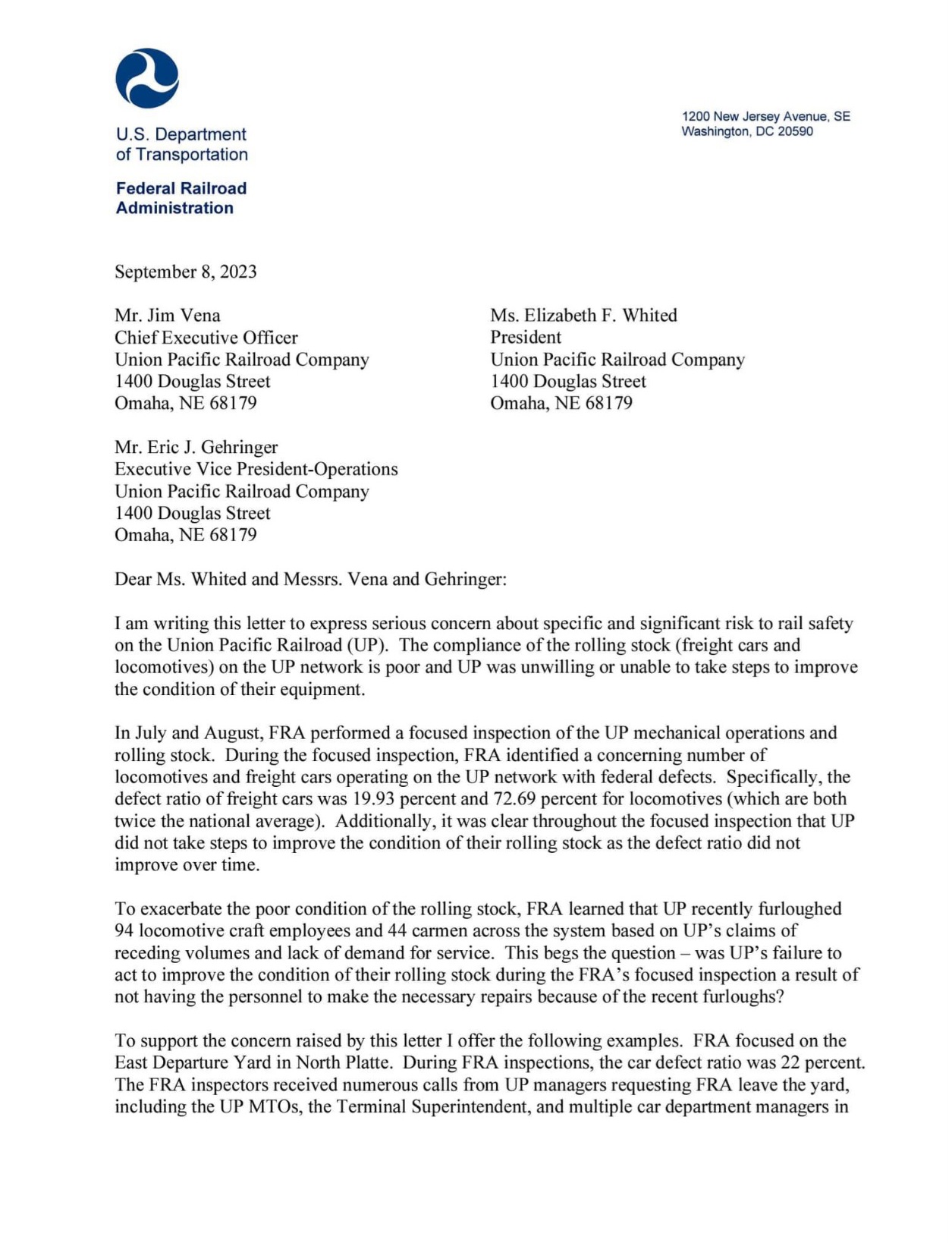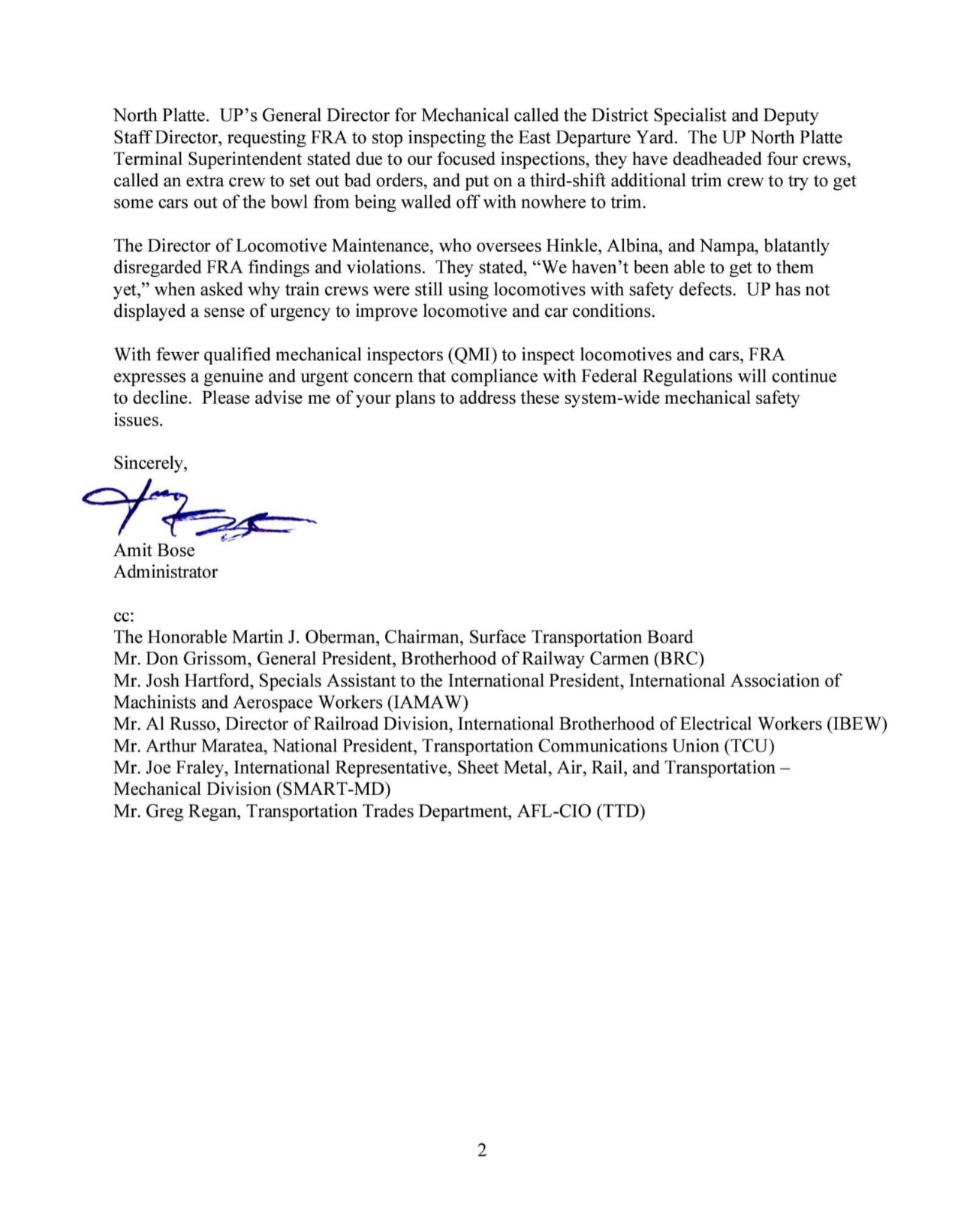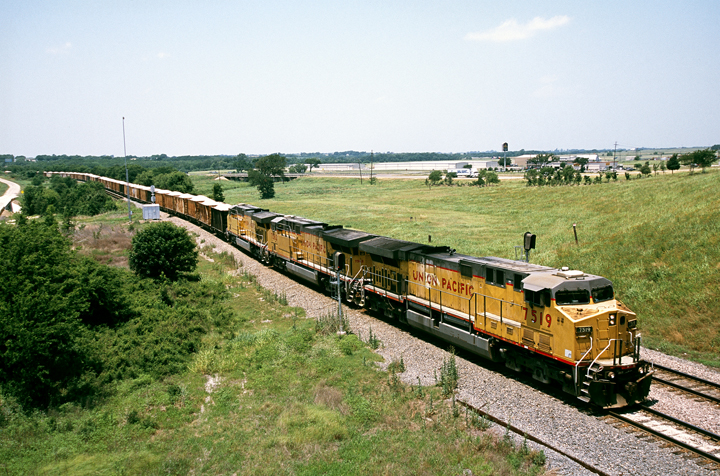


WASHINGTON — Union Pacific’s freight car and locomotive inspection and maintenance practices pose a “significant risk to rail safety,” the head of the Federal Railroad Administration said in a letter sent Friday to top railroad executives.
FRA Administrator Amit Bose said the agency conducted a focused inspection of UP’s mechanical operations and rolling stock in July and August, which found that the defect ratio of freight cars and locomotives was twice the national average.
“The compliance of the rolling stock … on the UP network is poor and UP was unwilling or unable to take steps to improve the condition of their equipment,” Bose wrote to UP CEO Jim Vena, President Beth Whited, and Eric Gehringer, executive vice president of operations.
“Additionally, it was clear throughout the focused inspection that UP did not take steps to improve the condition of their rolling stock as the defect ratio did not improve over time,” Bose said.
UP in August furloughed 94 locomotive mechanical employees and recently furloughed 44 carmen across the system due to lower freight volumes and the storage of 200 locomotives. “This begs the question — was UP’s failure to act to improve the condition of their rolling stock during the FRA’s focused inspection a result of not having the personnel to make the necessary repairs because of the recent furloughs?”
It was not immediately clear whether the furloughs occurred before or after the FRA inspection blitz. The furlough of 94 shop workers was announced in the week of Aug. 21.
Union Pacific, in a statement to Trains News Wire on Saturday, defended its safety practices and staffing levels.
“Union Pacific will never compromise on the safety of our employees. Safety is always our first priority, and we are reviewing and will address the concerns raised by the FRA,” spokeswoman Kristen South says. “There is no correlation between recent furloughs and Union Pacific’s ability to address mechanical repairs. We have the appropriate staffing for all crafts, and always leave a buffer to allow for the natural ebb and flow nature of our business. Finally, we have worked for years with FRA inspectors and respect the work they do. We have the same goal — safety.”
In March, in the wake of the Feb. 3 Norfolk Southern hazardous materials wreck East Palestine, Ohio, and subsequent derailments, the FRA announced it would conduct focused inspections on all of the Class I railroads this year.
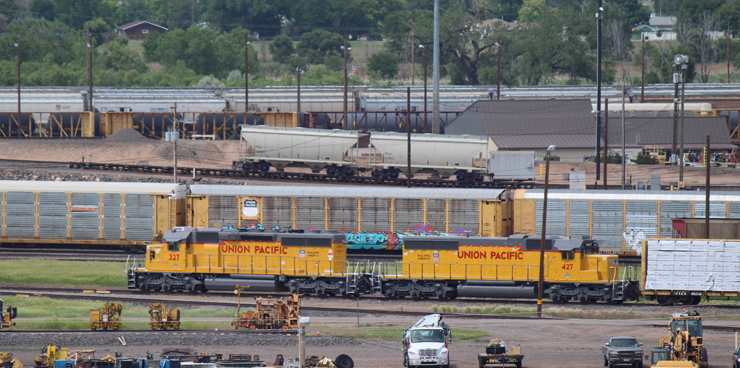
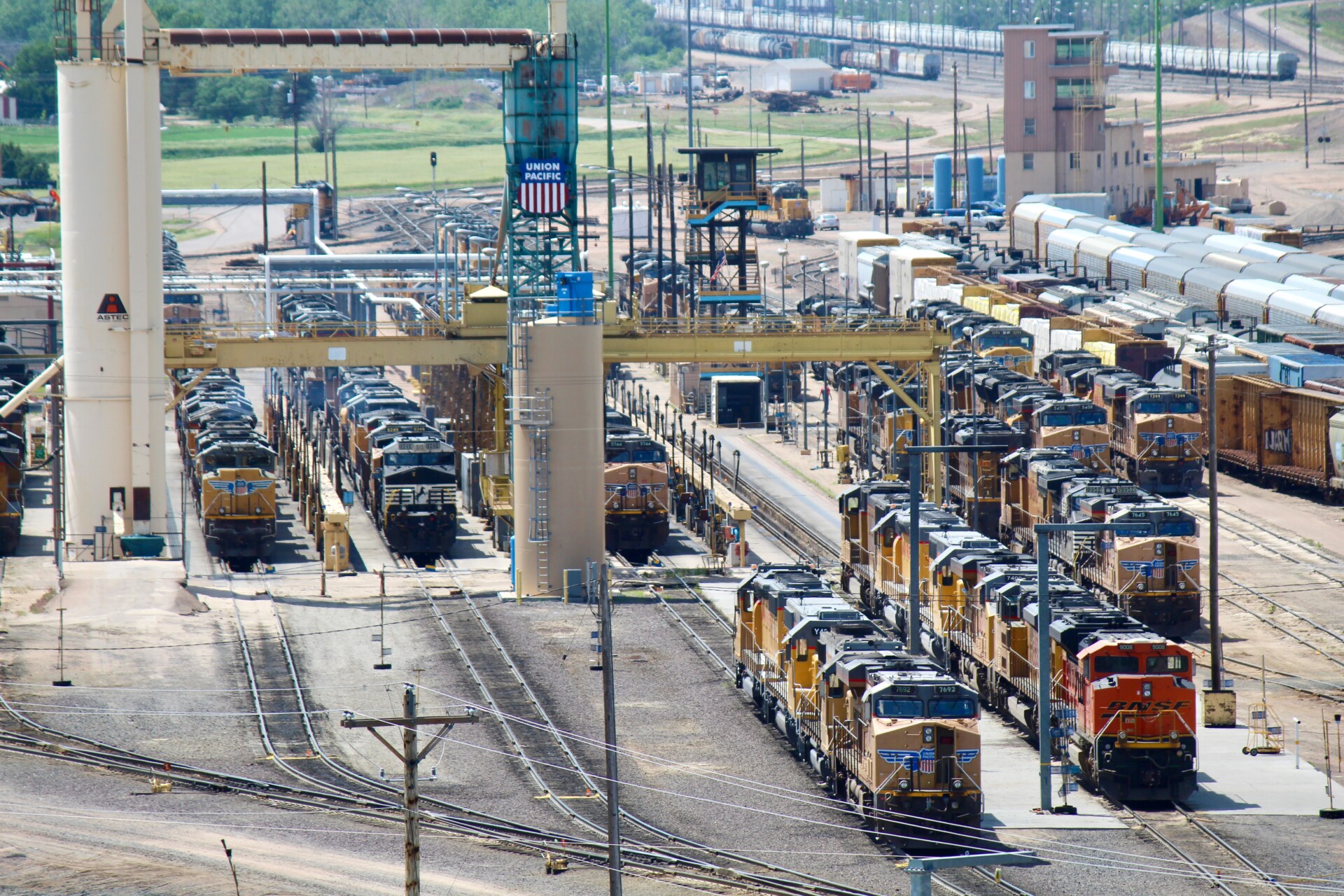
UP’s East Departure Yard at North Platte, Neb. — part of the largest freight classification yard in North America — was the subject of a focused inspection involving multiple FRA inspectors, who reported a car defect ratio of 22%.
The detailed inspection process effectively shut down the East Departure Yard. Routine FRA inspections typically don’t disrupt operations, former railroad executives and former FRA officials told Trains News Wire.
If the inspections do interfere with operations, local operating officials will meet with the FRA inspector and reach an agreement that allows operations to resume, they said. “Usually the responsible local mechanical manager would sit down with his FRA counterpart, review the findings, and agree on remedies. If FRA was satisfied they would generally leave with a clear understanding as to when they would return to audit progress,” a former UP operating official said.
That did not happen during the focused inspection in North Platte.
“The FRA inspectors received numerous calls from UP managers requesting FRA leave the yard, including the UP [managers of train operations], the terminal superintendent, and multiple car department managers in North Platte,” Bose wrote. “UP’s general director for mechanical called the district specialist and deputy staff director, requesting FRA to stop inspecting the East Departure Yard.”
As a result of the ongoing inspection, UP had to deadhead four train crews, use an extra crew to set out cars the FRA inspectors had bad ordered, and add a third-shift yard trim crew to retrieve cars from the bowl, Bose wrote.
It would not be unusual for a focused inspection to uncover more defects than a routine FRA inspection, the former railroad executives and safety officials said.
But rail labor leaders have complained that under Precision Scheduled Railroading, the large reduction in locomotive and car mechanics, along with a reduction in car inspectors, has hindered UP’s ability to properly inspect and maintain its equipment.
The number of mechanical shop employees on UP fell 42.6% between September 2018 — the month before UP adopted a PSR operating model — and July 2023, according to the latest Surface Transportation Board data. CSX Transportation and Norfolk Southern have made similar reductions in their shop workforces, the STB data show.
Union Pacific officials have said that a 30% reduction in daily train starts under its PSR operating model has enabled the railroad to move its tonnage with far fewer locomotives, which has in turn reduced the need for locomotive mechanics.
Bose wrote that the UP director of locomotive maintenance who covers shops in Hinkle and Albina, Ore., and Nampa, Idaho, disregarded FRA’s findings and violations. When asked why crews were using locomotives with safety defects, the manager said, “We haven’t been able to get to them yet.”
The FRA said it found defects on nearly 73% of the UP locomotives it inspected.
“UP has not displayed a sense of urgency to improve locomotive and car conditions,” Bose wrote. “With fewer qualified mechanical inspectors to inspect locomotives and cars, FRA expresses a genuine and urgent concern that compliance with Federal Regulations will continue to decline. Please advise me of your plans to address these systemwide mechanical safety issues.”
The railroad expects to officially respond to the FRA letter this week.
A former FRA official said the agency appeared to be sending a message by conducting the intensive inspections in a departure yard “rather than elsewhere on the property — and there are a lot of trains elsewhere in North Platte.”
A longtime railroad executive agreed.
“When FRA inspects inbound trains after the carrier’s inspectors have finished, the only disruption is the longer dwell in the receiving yard before the train is humped or switched. When an inspector wants to cause havoc, outbound trains are inspected, causing these trains to dwell in the departure tracks three or four times longer than normal, ultimately running the yard out of places to go with cars out of the Bowl,” the executive explained. “Production assignments must be used to switch the bad ordered cars out of the trains. At this point, the yard’s production must be stopped until trains finally depart and the trimming process can be resumed to make room for more cars in the bowl. Either process yields the same quality audit results with respect to mechanical condition of the equipment and quality of the inspection by the carrier. When FRA inspects outbound trains almost ready to depart, the pain inflicted on the operation is intentional.”
In the wake of East Palestine and increased scrutiny of railroads, the FRA has come under political pressure to tighten inspections and improve safety. Normally FRA would handle defects and violations through annual civil assessment meetings, not through a letter to railroad executives, a former FRA official said.
“Without more information on the nature of the defects and violations generated in this focused inspection period, it would be hard to comment on the letter’s assertion that higher than average defect ratios pose a safety risk to communities or railroad employees,” the official said.
Federal Railroad Administration officials did not respond to emails seeking comment on Saturday.