


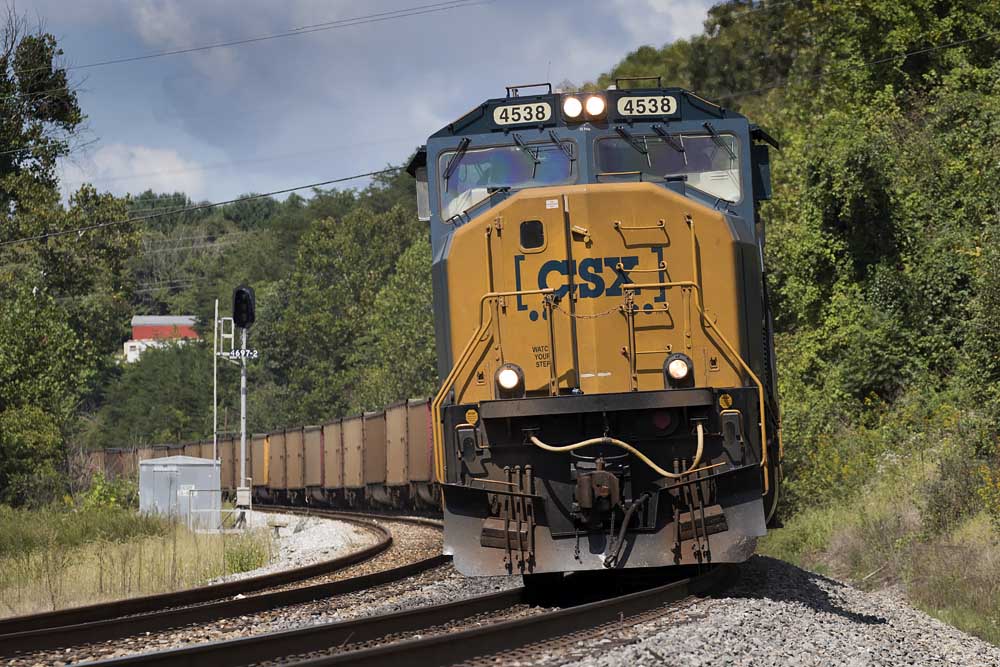
JACKSONVILLE, Fla. — CSX Transportation expects service to continue to improve throughout the year as its conductor and engineer ranks grow amid a hiring surge.
“We are pleased with our results this quarter, though we’re not yet satisfied with our service performance,” Foote told investors and analysts on the railroad’s earnings call on Wednesday afternoon.
The year got off to a rough start due to infections and quarantines from the Covid-19 Omicron wave, along with severe weather, but operating conditions began to improve in March and have continued this month. “We do see indications that this momentum is continuing,” Foote says.
The key is easing the railroad’s crew shortage, which began more than a year ago. In the first three months of this year, CSX had an average of 561 conductors in training, and the number of active train and engine employees rose every month of the quarter and into April.
The railroad’s lackluster service and ongoing crew shortage meant it could not capture all the traffic that wanted to move during the quarter, executives said. Volume, which was down across the board, declined 2% for the quarter.
Carload trip plan compliance was 64%, down three points from a year ago. Intermodal trip plan compliance stood at 87% for the quarter, a two-point improvement.
The railroad was sluggish in the quarter as train speed and terminal dwell deteriorated. Average train speed was down 15% compared to a year ago, while terminal dwell rose 4%. On-time train originations fell to 65% from 79% a year ago, while on-time train arrival declined 12 points to 57%.
CSX’s key performance metrics started to move in the right direction this month, although Jamie Boychuk, executive vice president of operations, said it was too early to call the bottom with any degree of certainty.
Boychuk expects the train and engine workforce to be up to full strength this summer, and CSX will keep up the pace of hiring throughout the year to ensure that it does not get caught short of crews again.
Foote said management aims to improve its relationship with rail labor as one way to make sure it has enough crews to meet demand. “The relationship between the railroads and the union workforce has not necessarily been one of mutual admiration. And we need to fix that,” Foote says.
Crews came to work every day during the pandemic, Foote notes, but as contract negotiations dragged on they didn’t get a raise.

“That’s wrong, in my opinion,” Foote says. “And that’s why we decided to do something about it unilaterally, without asking for some kind of giveback in the labor agreement. We just thought it was the right thing to do. So we made the offer, and that’s the change.”
The volume decline and operational problems did not stop the railroad from posting higher revenue and profits. For the first quarter, CSX’s operating income rose 16%, to $1.28 billion, as revenue rose 21%, to $3.4 billion. Earnings per share grew 26%, to 39 cents.
The railroad’s operating ratio rose to 62.4%, up from 60.9% a year ago, which CSX said was due to the impact of the acquisition of specialty bulk trucking company Quality Carriers.
Volume declined 2% for the quarter, with merchandise traffic down 2%, intermodal off 1%, and coal slumping 10%. Revenue per unit increased 24%, however, driven by a 54% jump in revenue per carload of coal.
CSX’s personal injury and train accident rates improved year over year and sequentially.
CSX provided a financial outlook for the year: It now expects double-digit revenue and operating income growth thanks to strong freight demand across all three business segments.
Share this article