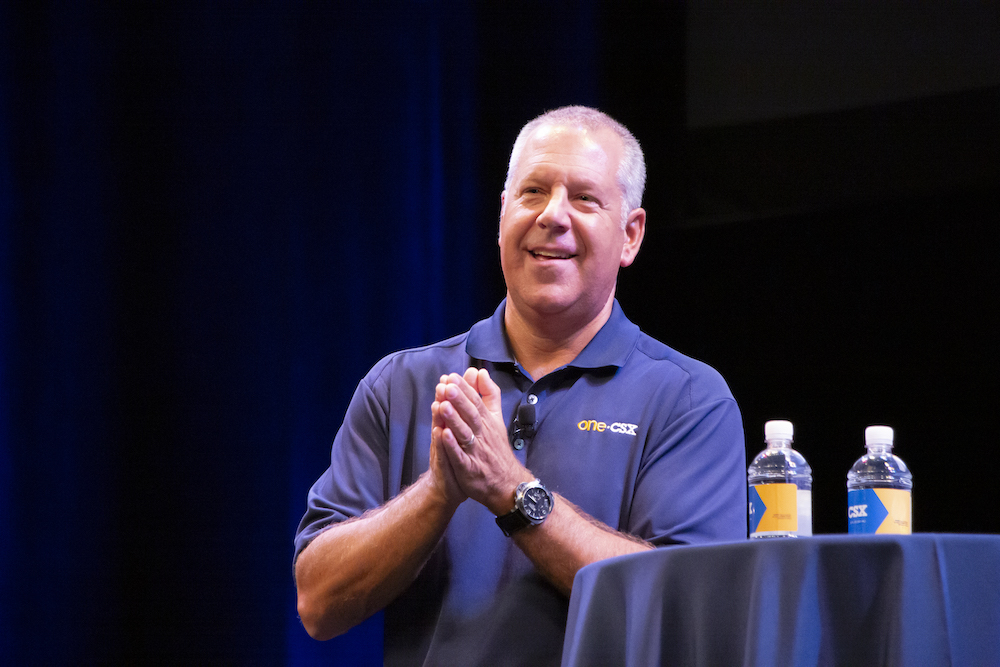
NEW YORK — CSX CEO Joe Hinrichs dished out some tough love for the industry last week while reflecting on his nearly 14 months at the helm of the railroad.
The former Ford Motor Co. executive has learned a lot about railroading in his travels around the CSX system but is puzzled by the industry’s lack of cooperation, low service standards, and the way it has treated its employees.
“One of the challenges of our industry, frankly, is how we work together,” Hinrichs told a packed house at the RailTrends conference on Friday, Nov. 17.
“I’ve been fascinated that oftentimes the railroads look at every single one of the other Class Is as competitors,” Hinrichs said in a 36-minute, off-the-cuff speech laced with humor and straight talk. “And the fact of the matter is that I don’t see the world that way, maybe because I didn’t grow up in this industry. But I don’t see any of the … Western railroads as competitors at all. We interchange. And roughly half of our business touches another railroad. So the customer experience is holistic. From my perspective, we’re all partners.”
The CSX boss says he doesn’t understand the industry’s not-invented-here syndrome and why railroads have not worked more closely together on technology and safety. The disastrous Feb. 3 Norfolk Southern hazardous materials derailment in East Palestine, Ohio, which has been blamed on the catastrophic failure of a wheel bearing, put a spotlight on hotbox detectors and how railroads use their temperature data.
“I was shocked that we all didn’t have the same system,” Hinrichs says, noting that CSX has been using trend analysis from its hotbox detector network since 2007.
“What in our DNA as railroads inhibits us from working together on stuff like that? It’s safety. We all feel the effects … of that. And all of us, of course, have derailments,” Hinrichs says. “So the challenge we have to give ourselves is how do we be better partners and how do we be part of the solution?”
Hinrichs has made a point of visiting other railroads’ headquarters and seeking partnerships with the other Class I systems, with the exception of rival Norfolk Southern. Discussions have revolved around how to better serve customers.
“At the end of the day even if CSX is running trip plan compliance … at a higher level, half of our business touches another railroad,” Hinrichs says.
As a Ford and General Motors executive and plant manager, Hinrichs had direct experience as a railroad customer and says it’s no surprise that railroads have lost traffic over the years.

“I lived on the other side of this relationship for a long time,” Hinrichs says. “I’ve gotten some blowback from people for being transparent and honest … but it’s true: when we in the auto industry sat around, we said we dealt with railroads because we had to, certainly not because we wanted to.”
When Hinrichs was the manager at a plant 25 years ago, it shipped engines and transmissions by rail. “We had loading docks. They don’t exist anymore,” he says. “They’re all trucks. Up and down I-75 all day long.”
Railroads offered attractive rates for hauling automakers’ freight, Hinrichs says, but they left the manufacturers no choice but to shift to trucks after late rail shipments shut down assembly lines.
The Surface Transportation Board has been pressing railroads to provide better service, and CSX has been striving to improve, Hinrichs says.
“The standards are too low in this industry for customer service,” Hinrichs says. “What we define as great most people would laugh at.”
If railroads provided better service, many of the industry’s image problems would evaporate, he contends. “The challenge we have as an industry is to set higher standards and expectations for ourselves,” Hinrichs says.
Customers say CSX is providing the industry’s best service today, Hinrichs says, and it’s the only U.S. Class I system to be set free from the expanded performance metrics regulators imposed last year amid widespread service problems. “We’re nowhere near satisfied. We shouldn’t be satisfied,” he says.
“We should want our customers to be enthusiastic about doing business with us, to be excited about doing business with us,” Hinrichs says. “The standards we set for that bar are too low in our industry.”
Hinrichs says the CEO of another Class I told him their railroad was running well. But when Hinrichs checked the service metrics, he found that the other railroad was only meeting customer commitments 60% of the time. “That’s not great,” Hinrichs says.
Neither is CSX’s 88% trip plan compliance figure for the year to date. “That’s not great. It’s good for an industry like ours. It’s not great. It’s better but it’s not great,” Hinrichs says. “We have to set ourselves to higher standards. If we don’t do it, the only one left to do it is the regulators.”
The Big Three automakers didn’t change on their own in the 1980s and 1990s, Hinrichs notes. They were forced to change by the onslaught of competition from Asian and European automakers.
“We don’t have that, so we have to drive ourselves,” he says of railroads. “We have to set ourselves to much higher expectations, higher standards. It’s OK for customers to demand more. They should. We should.”
Hinrichs says he and new CSX Chief Operating Officer Mike Cory came out of retirement because improving the rail industry “is worth doing.”
“We have to challenge ourselves not to just to be OK. That’s not motivating. I don’t want to come home to my Mom and say, ‘Man I got a 70 on my test. It’s great!’ That’s not great,” he says, prompting a round of laughter.
“We laugh at ourselves because we know it’s true,” Hinrichs says.
“Every single CEO that was here last year talked about growth. How’s that working? We’re a year later, how’s it working? I can tell you one railroad that’s grown merchandise volume this year, the only one. Three letters, starts with a C,” Hinrichs says. “Why is that? Because we delivered better service. We won business because of better service. I didn’t say great. I said better. Words matter.”
The fact that CSX’s merchandise business is up 2.4% through the first nine months of the year — in a down freight market and with flat industrial production — is proof that good service can lead to growth, Hinrichs says.
Hinrichs, who is on the board of Goodyear Tire & Rubber Co., recently visited the tiremaker’s Lawton, Okla., plant, which is the world’s largest. Although there are two spurs leading away from the factory, they dead end at a concrete wall. And not one of the 50,000 tires the plant produces every day is shipped by rail.
Rail offers shippers significant cost savings and environmental benefits. “And yet we cause people to put up walls on top of our rail spurs,” Hinrichs says. “Undoing that is going to be hard …This is the challenge we have.”
“Our view is we’re going to be up here talking about growth every year for the rest of our lives, and it makes us feel good,” Hinrichs says. “But if we don’t provide significantly better service to our customers it’s never going to happen. Because why would they trust us?”
Another challenge: Finding and retaining employees, particularly train and engine crews.
Third- and fourth-generation railroaders say there was such intense competition for rail jobs that they had to have their fathers or uncles put in a good word in order to get hired, Hinrichs says.
Now railroads have full-time employees trying to attract and hire workers, and workers leave scathing reviews on websites like Glassdoor.
“In a decade we changed this from being one of the most desired jobs to have, to people not recommending their sons, daughters, and nieces and nephews to even consider it,” Hinrichs says. “And there’s a huge cost to our business because of that.”
Part of the difficulty in hiring is generational, but Hinrichs says a big part of the problem is self-inflicted. “Remember, people join companies. They leave bosses,” Hinrichs says.
Railroads like to tout that train crew jobs pay extremely well. “It’s a lifestyle. It’s hard. But if it’s miserable it’s not worth it,” Hinrichs says, speaking of railroads in general. “We make it miserable for a lot of people.”
“What I don’t think people appreciate is the hidden costs that are the result of the morale and the retention issue we have with employees,” Hinrichs says. It takes six months to find and hire conductor trainees, and half of them fall out during training.
And new conductors aren’t as efficient as more experienced hands, Hinrichs says, and don’t work as safely. Some 40% of train accidents on CSX this year have involved crews who have been on the job two years or less, Hinrichs says.
The top factor holding back better service is crew availability, Hinrichs says. Railroads have high absenteeism due to the lifestyle of being away from home and an operation that runs seven days per week, he says.
CSX aims to create an environment where people are proud to be railroaders again, Hinrichs says of the railroad’s OneCSX program, which includes family events and demands that managers treat workers with respect.
“We can do a lot of great things. We just have to get out of our own way,” Hinrichs says. “So those are my reflections on 13-plus months. And I promise you: We at CSX will keep working hard to be part of the solution.”
RailTrends is sponsored by trade publication Progressive Railroading and independent analyst Anthony B. Hatch.
Share this article