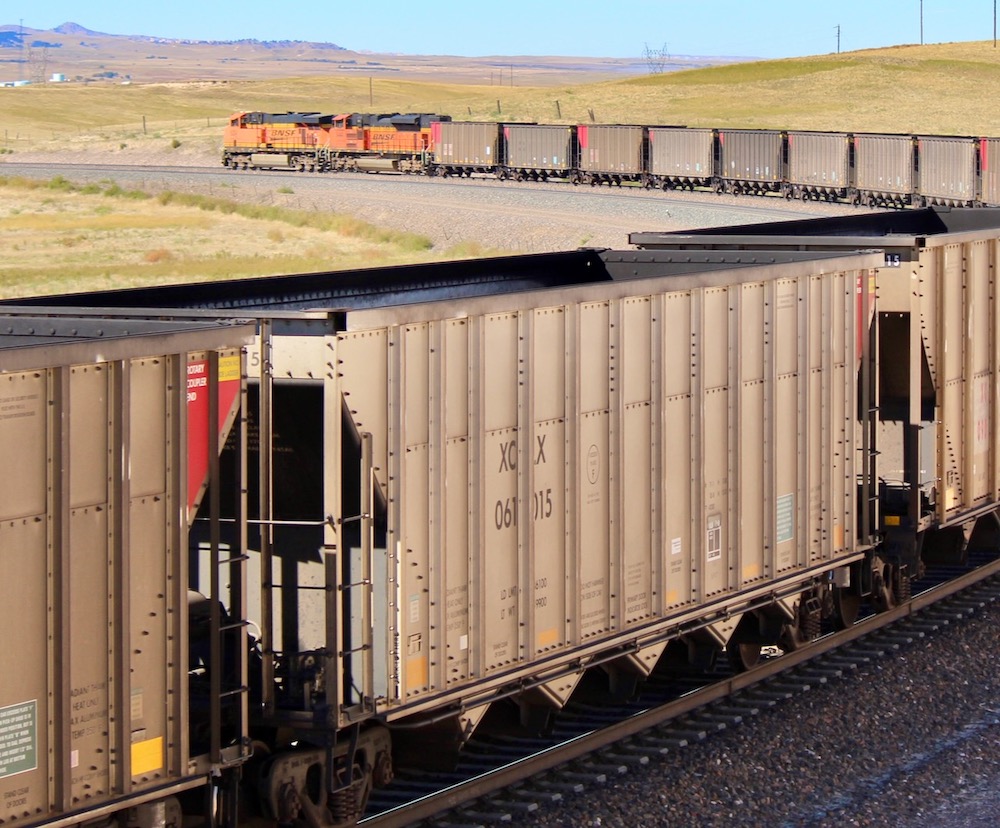
WASHINGTON — BNSF Railway is seeking a judicial review of the Surface Transportation Board’s preliminary injunction that orders the railroad to haul more export coal from a Montana mine to tidewater in British Columbia.
Last month in a 3-2 decision the STB ordered BNSF to handle 23 trains per month from Navajo Transitional Energy Co.’s Spring Creek Mine to the Westshore Terminal – and an additional six trains per month once there is sufficient crew and train set capacity.
BNSF this week asked the STB for a partial stay of the order while a judicial review is under way. The railroad said it did not object to the 23 trains per month or 4.2 million annual tons quota, but it did take issue with the requirement to handle an additional six NTEC trains per month. And so the railroad asked the STB to put a stay on the requirement to handle an additional million tons this year.
“The justification for that extraordinary order is exceptionally weak, and BNSF’s obligations under that order are exceptionally unclear,” BNSF told the board. “BNSF is likely to succeed on the merits of its petition in the court of appeals; it will be irreparably harmed in the absence of a stay pending its petition for review; NTEC will not be harmed by such a stay; and a stay would serve the public interest.”
The STB decision stemmed from a common-carrier complaint and emergency service order request that NTEC filed in April.
“The common-carrier obligation is a core tenet of the Board’s regulation of the freight railroad industry and is a pillar of the railroads’ responsibility to our country’s economy,” STB Chairman Martin J. Oberman said in a statement last month. “Today’s decision reflects the majority’s finding that the common carrier obligation requires a railroad to provide service on a customer’s request that is within the railroad’s capacity to provide.”
Oberman added that the board has previously noted that “The common-carrier duty reflects the well-established principle that railroads ‘are held to a higher standard of responsibility than most private enterprises.’”
NTEC sought to move additional coal this year due to favorable export coal prices. BNSF declined to meet NTEC’s targets, however, arguing that it lacked capacity to handle additional coal from NTEC and that increasing service for NTEC would mean taking it away from other coal producers who have contracts with the railroad. NTEC’s coal has been moving under tariffs rather than a contract.
But the STB said the record showed that BNSF could comply with the order while still providing service to other Powder River Basin coal producers.
The board also said NTEC prevailed on the four-part test for granting injunctive relief.
Board members Patrick Fuchs and Michelle Schultz dissented with separate expressions.
“BNSF recognizes that the Board majority has already taken the view that NTEC was entitled to preliminary injunctive relief on the merits. But Members Fuchs and Schultz disagreed, and their dissents cogently explain why the Board majority erred and why BNSF is likely to obtain appellate relief,” the railroad told the board.
BNSF also disagreed with the majority’s view of the common carrier requirement.
“It was not reasonable for NTEC to expect BNSF to unilaterally commit to providing long-term high-volume service at virtually unprecedented levels, especially without an obligation from NTEC to actually tender any coal for shipment,” BNSF told the board this week. “The Decision also erred in failing to assess the reasonableness of BNSF’s response to NTEC’s request. Even if NTEC’s request had been ‘reasonable,’ BNSF’s common-carrier obligation is not a mandate to provide all the service a shipper demands; BNSF’s obligation is to provide ‘adequate’ service under the circumstances.”
Share this article