Amtrak will square off against CSX Transportation, Norfolk Southern, and the Port of Mobile, Ala., during Surface Transportation Board hearings this month and next regarding proposed Gulf Coast passenger service.
Technically, this is about Amtrak’s disagreement with the freight railroads over starting a pair of daily round trips between Mobile, Ala., and New Orleans. But what’s really at stake is Amtrak’s right to access host railroads and how to determine what capacity projects are necessary to support passenger trains and ensure they don’t snarl freight traffic.
Amtrak and host railroads typically work out agreements on new or expanded service. They collaborate on a traffic study that helps determine what capacity improvements may be required. Amtrak picks up the tab, track improvements are made, and then service begins. Simple, right?
Except that none of that happened on the Gulf Coast despite years of study. So now Amtrak is at loggerheads with CSX, NS, and the port. Last year Amtrak pulled out of a much-delayed rail traffic control study and told the host railroads that it wanted to launch service on Jan. 1, 2022 – with or without capacity improvements. After CSX and NS said no, Amtrak last March hauled them before the STB. CSX and NS say at least $405 million in improvements would be required so that passenger trains would not interfere with freights. And now regulators have to sort out the mess.
The STB will get an earful of public comments on Feb. 15 and 16. (Among those on the agenda: Wick Moorman, former CEO of Norfolk Southern and Amtrak, who should provide a unique perspective.) Then on March 9 the parties involved – Amtrak on one side and CSX, NS, and Alabama port officials on the other – will make their case to the STB.
Perish the thought, but if I were on the STB here are the questions I would want answered.
For All Parties:

Q. It shouldn’t take six years to figure out what’s required to begin new passenger service. Why, exactly, are you before the board when you should have worked this out years ago?
Q. Pan Am Railways President David A. Fink has written to the board about how his railroad once butted heads with Amtrak and the Northern New England Passenger Authority over Downeaster service. Then he notes that Pan Am, Amtrak, and the passenger authority reached an agreement on track maintenance and how to handle new service proposals. Fink then adds a crucial point: “As a result, trains have operated fluidly and on time, necessary infrastructure has been constructed and both the intercity passenger and freight service have thrived. In short, negotiation among equals, rather than litigation between adversaries, has proven to be a successful model to allow intercity passenger and freight rail service to coexist.”
Do you believe negotiation, rather than litigation, should be a model for how passenger service can be introduced on host railroads? If so, why not settle this instead of having the board impose a precedent-setting decision that you may not like?
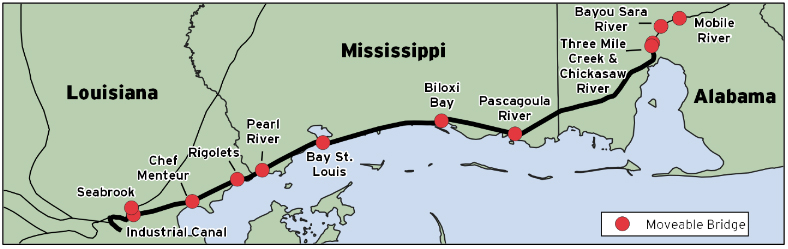
Q. There are seven movable bridges between Mobile and New Orleans, each of which is opened frequently to allow unscheduled marine traffic to pass. The rail traffic control study prepared for CSX and NS correctly notes that numerous daily bridge openings are a wildcard that would cause significant delays. Yet around the country railroads have reached agreements with the Coast Guard that give priority to approaching passenger trains. Certainly with just four passenger trains per day, and the support of U.S. Sen. Roger Wicker, R.-Miss., this could be accomplished. But the freight railroads’ traffic study does not consider this inexpensive option to increase reliability. And Amtrak apparently has not sought bridge agreements for Mobile-New Orleans service. Why not, especially when obtaining an agreement is a long and involved process?
For Amtrak:
Q. Today’s CSX New Orleans & Mobile subdivision is a railroad straight out of the 1950s. Nearly all of the passing sidings are short, feature low-speed turnouts at each end, and are unsignaled. So trains enter and exit the sidings at 15 mph. Today’s longer freights often run over siding length, which creates few if any places to stage meets. What’s more, the track joints on the seven movable bridges don’t support passenger-train speeds. Given all this, why launch service before capacity projects and track and signal improvements are made? Call me old school, but shouldn’t you do things the right way or not at all?
Q. The proposed Amtrak schedules are not competitive with the highway. The evening departure from New Orleans, for example, would take 3 hours and 23 minutes to reach Mobile. It only takes about 2 hours and 15 minutes to drive between the two cities via Interstate 10. How will you lure people out of their cars with service that’s 50% longer than driving? And how will you turn first-time passengers into return customers when it’s likely that, without capital improvements, your trains would arrive late more often than not? Is passenger service that’s slow and unreliable a winning combination?
For CSX:
Q. Host railroads typically show all their cards when negotiating with Amtrak. That means sharing daily train counts and schedules, which are key ingredients to the rail traffic control study that helps determine capacity needs. If the host railroad has capacity for X more trains on its line before passenger service is added, the expectation is that capacity improvements will be made so that the host railroad still has capacity for X more trains after Amtrak begins service. This level of transparency instills confidence in the process. Yet CSX (and NS) have opposed public disclosure of even limited train data. Railroads are an open factory, where anyone can watch operations and an internet search can yield all sorts of information – including daily train counts from the FRA grade-crossing database. And has CSX read its own Pan Am Railways merger application? It goes into great detail on its operations in New England and neighboring New York, including train symbols, types of traffic, and days of operation. Why not be transparent on the Gulf Coast, as the Department of Transportation and Federal Railroad Administration recommend? And shouldn’t you expect some level of public scrutiny when recommending that taxpayers fork out $405 million to support new passenger service?
Q. We hear all the time that Precision Scheduled Railroading creates capacity by moving freight on fewer but longer trains. CSX operates three or four road freights per day each way between Mobile and New Orleans. When trains are over siding length, CSX tends to run directional fleets. Westbound traffic is held at Mobile to await eastbounds from New Orleans and vice versa. Doesn’t this type of operation unreasonably delay freight traffic more than any four-car Amtrak passenger train possibly could?
For CSX and NS:
Q. The New Orleans gateway is notoriously unpredictable. The railroads’ own rebuttal filing with the board notes that, “Even if CSXT and NSR were to design a perfect timetable for operating this line, it would quickly be rendered moot by the randomness that characterizes freight railroading in the United States.” Considering this, how could any scheduled passenger operation unreasonably interfere with freight traffic that is, by definition, random? And would operating freight trains closer to schedule reduce the amount of capacity improvements that need to be made?
You can reach Bill Stephens at bybillstephens@gmail.com and follow him on LinkedIn and Twitter @bybillstephens
Share this article