

When Norfolk Southern CEO Alan Shaw outlined the railroad’s long-term growth strategy in December, he couldn’t have been more clear: Keeping train crews on the payroll during freight downturns would hurt the operating ratio over the short term. But not furloughing crews would pay off over the long term by enabling NS to maintain service levels and capture more traffic when volume returns. And providing consistent and reliable service year in and year out will allow shippers to build more of their supply chains around the railroad, which in turn will bring NS new traffic and higher revenue and profits.
It is, as Shaw says, a better way forward for an industry that has struggled to grow due to periodic service problems related to crew shortages.
So how did Wall Street react when the railroad announced ugly third-quarter results last week? The short-sighted analysts — who cannot see beyond the next quarter, much less years down the road — tossed darts at the long-term strategy after NS’s operating ratio went up 7.1 points to 69.1%.
The first four questions from analysts on the earnings call dealt with the operating ratio, resiliency costs, and profit margins.
The first wondered whether NS would be able to absorb higher costs and improve its operating ratio in the fourth quarter. The second noted that NS’s profit margins are six or seven points below that of rival CSX Transportation and asked why NS’s cost structure was so high. The third asked if NS needed to bring in more Precision Scheduled Railroading expertise and said he was confused about resiliency costs. The fourth asked whether NS could narrow the profit margin gap next year.
The questions are an indication that short-term investor patience already may be wearing thin with The Great Experiment, the term independent analyst Anthony B. Hatch applies to the no-furlough strategy that NS, Canadian National, and CSX are all following. “The questions were ridiculous,” Hatch says. Indeed.
The math behind the NS strategy is simple. Furloughing 5% of your crews during a downturn may save $35 million in the first year. But some of them won’t return when traffic rebounds, so you have to spend $10 million and at least six months to hire and train replacements. Meanwhile, service suffers and operating costs go up as much as $160 million for the year. Worse still: You miss out on $600 million in potential revenue as traffic hits the highway to avoid poor rail service. The bottom line is that furloughing crews to save $35 million actually costs you $770 million in the long run.
Norfolk Southern investors welcomed the strategy back in December, and analysts liked the long-term approach in theory. But some of them don’t like it in practice now that volume tanked and took revenue, profit margins, and earnings down with it. It’s as if the analysts know this is the cure for the railroad growth problem yet they don’t want to take the medicine because it tastes bad.
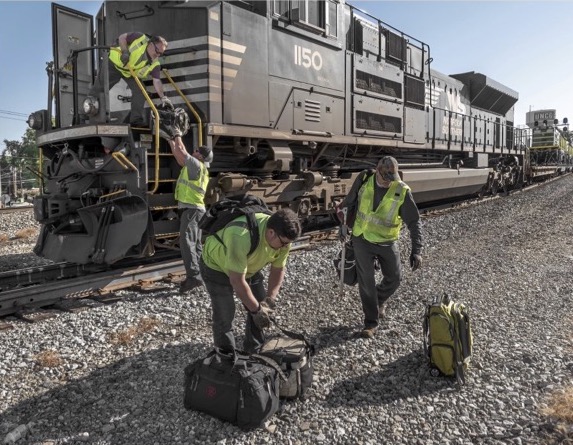
To their credit, Shaw & Co. stood their ground. They noted that NS has taken advantage of the lull in volume to train 250 conductors to be engineers as well as to qualify crews on additional territories. Both moves will help improve crew availability, operational flexibility, and service.
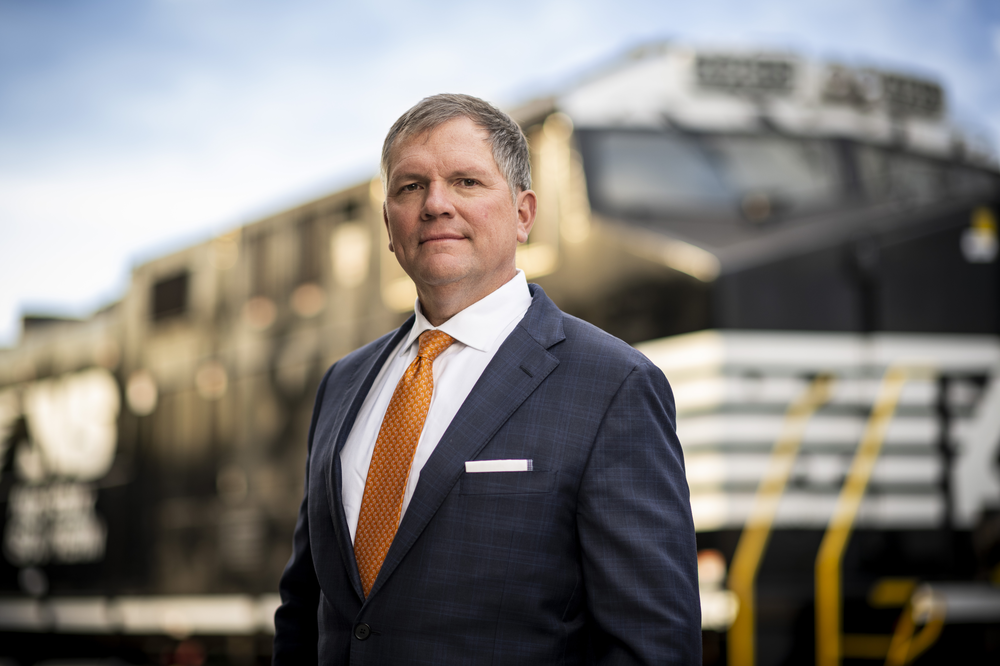
“Our investments in resiliency are investments in the elimination of service recovery costs. It’s also an investment in top-tier growth and in industry competitive margins,” Shaw says. “That’s our vision for the future. That is what we said we were going to do when we laid this out in December of last year.”
He adds: “We’re not going to chase short-term O.R. targets.”
The Great Experiment was always going to be a hard sell on Wall Street, Hatch says, and the analysts’ short-term questions are a reflection of their client base. Short-term investors are often the market’s loudest segment even if they aren’t in the majority, he notes.
This noise, of course, raises the concern that an activist investor may swoop in demanding change at NS. Ask former railroad CEOs Fred Green (Canadian Pacific), Michael Ward (CSX), JJ Ruest (CN), and Lance Fritz (Union Pacific) how that can work out. The good news, Hatch points out, is that there’s no obvious CEO candidate an activist could tout.

Better still, it appears that NS is gaining traction thus far in the fourth quarter, which may appease the short-term crowd for now. The railroad’s service and safety are improving and volumes have grown over the last four weeks to levels not seen for more than a year.
“We are making progress. We’re doing exactly what we said we’re going to do. And this is the better way forward for Norfolk Southern to drive long-term shareholder value,” Shaw says.
Wall Street’s short-term view threatens to jeopardize the industry’s long-term future. The quarterly results for NS and the other Class I railroads, as bad as they were, changed nothing: The days of major cost-cutting are behind us, and to continue providing investors with double-digit earnings growth the railroads will have to bring on more volume. And that will require providing better service, which in turn requires more resources.
NS remains on the right path. It was encouraging to hear Shaw defend the railroad’s approach. Yet it’s not clear how much patience investors will have with NS, which means the next few months will be critical for the railroad, its strategy, and perhaps even the industry’s quest for growth.
You can reach Bill Stephens at bybillstephens@gmail.com and follow him on LinkedIn and X @bybillstephens
Share this article