

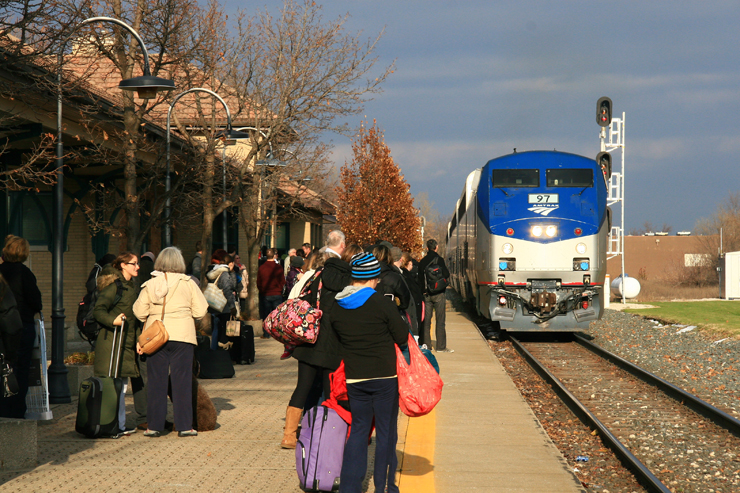
Thanksgiving-weekend travelers line the Holland, Mich., platform on Sunday, Dec. 1, 2013, for an extra Chicago-bound Pere Marquette.
Bob Johnston
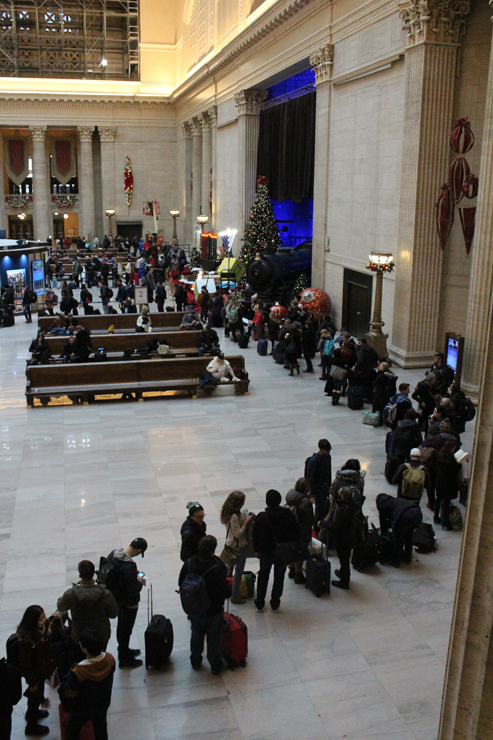
Passengers grouped by departure snake through Chicago Union Station’s Great Hall on the Wednesday before Thanksgiving in 2018.
Bob Johnston
CHICAGO — Amtrak has touted more Midwest coach capacity out of the Windy City around the upcoming Thanksgiving holiday [see “Amtrak begins preparations for Thanksgiving rush, urges early ticket purchases,” Trains News Wire Oct. 14], but the company won’t be operating extra Michigan round trips as it has in previous years.
On behalf of its state partners, Amtrak has petitioned host railroads Norfolk Southern, CSX, BNSF Railway, and Union Pacific to grant additional passenger train slots during a period when freight traffic is typically reduced. The hosts have always granted the holiday requests with the understanding that they were temporary and would not set a precedent for passenger trains at other times.
By manipulating schedules so some trains depart earlier and some later on the Wednesday before and Sunday after Thanksgiving, Amtrak was able to add midday round trips between Chicago and Holland, Mich., Bloomington-Normal, Ill., and Quincy, Ill., utilizing already-assigned equipment. That is happening again this year for the Illinois trains on Nov. 27 and Dec. 1.
In Michigan, however, the extra Holland turn on the Pere Marquette’s Chicago-Grand Rapids route and an additional round-trip between Chicago and Ann Arbor, Mich., that had filled morning eastbound and afternoon westbound departure voids on the normal schedules, won’t be running.
Amtrak spokesman Marc Magliari tells Trains News Wire that based on ridership data from last year, a decision was made to add cars to regularly scheduled Midwest trains rather than dedicate them to that extra frequency. Also, in recent years, demand has tended to spread out more evenly across more days than it had previously.
At least one additional coach will be added to the three Wolverine route consists from Wednesday, Nov. 27, through Sunday, Dec. 1, plus other trains before and after that window. One coach will also be added to two Lincoln Service Chicago-St. Louis round-trips, the Chicago-Carbondale Illini, and every Chicago-Quincy train.
Another factor weighing on the Michigan decision, including not running the extra round-trip to Holland, is Norfolk Southern’s recent poor passenger train handling between Chicago and Porter, Ind. In the quarter ending Sept. 30, Amtrak says freight train interference accounted for 58% of the 20,143 delay minutes incurred by all passenger trains. Train No. 352, the 1:20 p.m. Wolverine Chicago departure, accounted for almost a quarter of the delays in the six-train total.
“If we try to put additional trains on those tracks and delays occur, this could have a cascading effect delaying outbound trains because inbound equipment didn’t arrive on time,” Magliari says.