

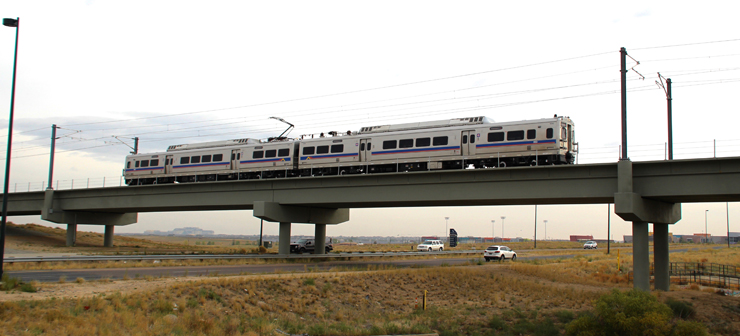
LOUISVILLE, Colo. — A private company’s pitch to build a long-delayed commuter rail line from Denver to Longmont, Colo., is receiving its first public airings and drawing both interest and skepticism, the Denver Post reports.
Rocky Mountain Rail has made an unsolicited offer to the Denver-area Regional Transportation District to build a 16-station line to Longmont for $1.1 billion, completing it by 2025. So far, the RTD has built just the first 5 miles of the proposed route, and currently estimates it could offer limited service over the entire route by 2042 and full service by 2050.
The company held one of a series of presentations last week at the Louisville Public Library. Its plan would provide 45-minute service to Longmont using battery-powered railcars charged by renewable sources, and would carry 64,000 passengers daily.
An RTD spokeswoman said the agency has asked Rocky Mountain Rail for more information, and is “open to any ideas out there that can build out transit.”
Use of a BNSF Railway line has been a stumbling block to the project for the RTD, but Rocky Mountain Rail says its plan would have BNSF relocate before building a double-track commuter line. Dave Ruble, chief engineer for Rocky Mountain Rail, told the Post that BNSF has not responded to its proposal.
Rocky Mountain Rail’ website says the company’s goal is to “become the leading passenger and local freight rail provider to the emerging Rocky Mountain Mega Region,” using existing Class I railroad rights-of-way as its foundation. It envisons a three-phase project which would begin with relocation of existing freight lines out of the Fort Collins-Trinidad Front Range reason, and end with Denver as a hub for a 17-state transportation system.