


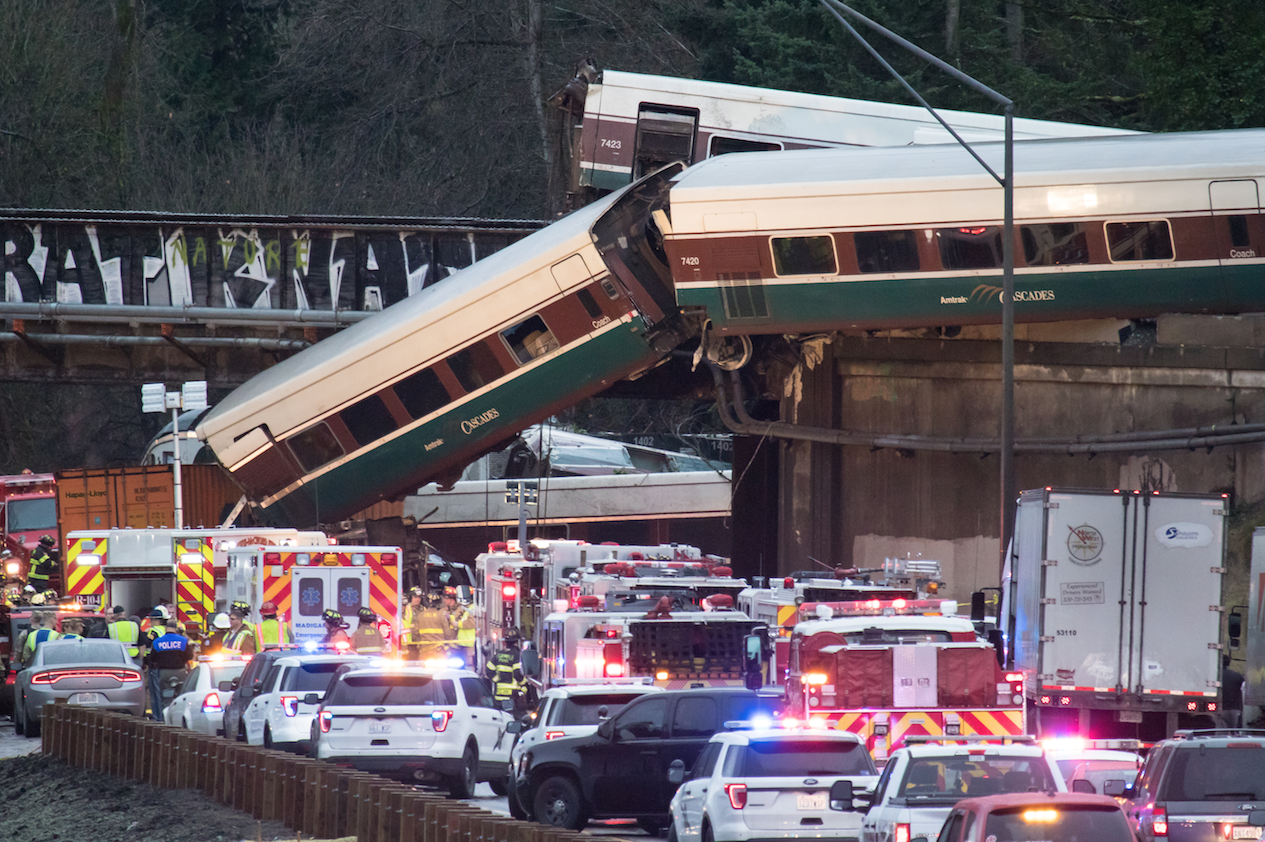
The National Transportation Safety Board concluded Tuesday that the Talgo equipment’s lightweight design was a factor in the severity of the crash, near DuPont, Washington, on Dec. 18, 2017.
However, the NTSB has investigated Amtrak and commuter train overspeed derailments in recent years involving conventional passenger train equipment that resulted in multiple fatalities. Talgo said that its equipment is safe and performed as expected.
Three passengers were killed when Amtrak Train 501, a southbound Cascades train from Seattle to Portland, Ore., entered a 30-mph-curve at 78 mph, at Milepost 19.86 on the BNSF Railway Lakewood Subdivision, also known as the Point Defiance Bypass.
NTSB investigators found that the Spanish-designed Talgo’s wheelsets became detached from the train. Fifty-seven passengers were injured, as were eight people in vehicles on Interstate 5, where part of the train landed.
Investigators described them as “projectiles” that crushed passenger car compartments and highway vehicles.
NTSB, an independent agency that makes recommendations but has no enforcement power, found that the Talgo cars’ structure were inadequate for protecting passengers in high-speed crashes.
“Had the rolling assembly not detached,” Chairman Robert Sumwalt observed, “we may not have had fatal injuries.”
But was the NTSB too quick to find flaws in the Talgo design when other high-speed crashes it investigated involving conventional equipment also resulted in fatalities?
Take for instance the derailment of Amtrak Train 188 in North Philadelphia, Pa., in May 2015.
The train entered a 50-mph-curve at Frankford Junction, on the Northeast Corridor, at more than twice that speed. Eight passengers were killed when the train, consisting of conventional Amfleet cars, jumped the tracks and became entangled with a catenary support.
NTSB also probed the December 2013 derailment of a Metro-North commuter train in the Bronx. That train, consisting of conventional cars, derailed on a 30-mph-curve at 82 mph. Four passengers were killed in the crash.
The DuPont, Bronx, and North Philadelphia derailments were all overspeed events that could have been prevented with positive train control, the NTSB concluded.
In DuPont and North Philadelphia, the trains’ engineers lost positional awareness, in the former due to unfamiliarity with the route, and in the latter possibly due to distraction.
The Bronx engineer was found to have an undiagnosed case of severe obstructive sleep apnea, a sleeping disorder that can cause drowsiness and fatigue.
For its part, Talgo said its Cascades trainsets are safe, the DuPont derailment was not attributable to their design and that they performed as well or better than conventional rolling stock.
“The events surrounding the accident produced forces on Talgo equipment far different from and in excess of any for which any railroad passenger equipment is designed,” it said in a statement. “Our expert analysis led us to conclude that the behavior of the Talgo equipment was far better than what would have been expected of conventional equipment in similar circumstances.”