


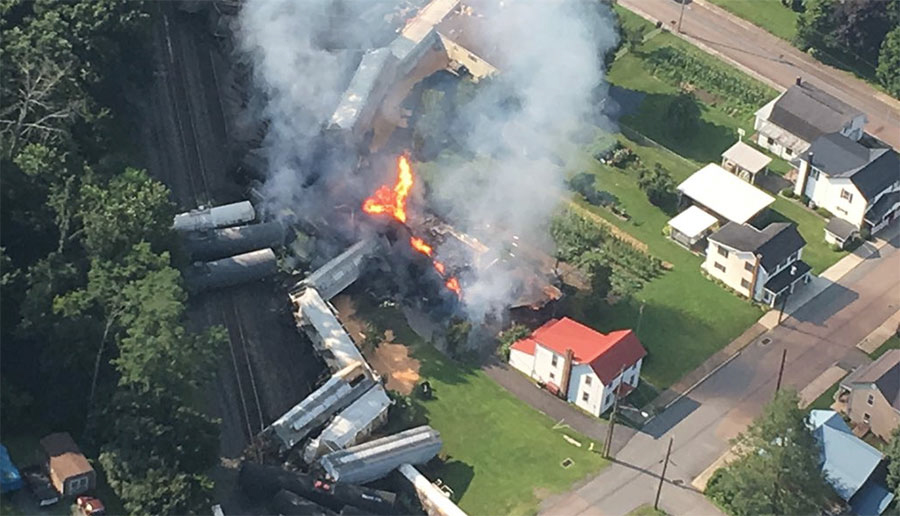
According to a preliminary report released today from investigators of the National Transportation Safety Board, CSX train Q38831 had 5 locomotives and 178 cars — 128 loaded and 50 empties — when it moved through Hyndman, Pa., on Aug. 2. Thirty-two of those cars derailed toward the head-end of the train as it moved from Chicago to upstate New York.
The shells on three derailed tank cars, one each hauling propane, asphalt, and molten sulphur, breached, with the propane and sulphur loads catching fire and forcing evacuation of the neighboring community of about 1,000 residents.
NTSB investigators write that two CSX crews touched the train immediately before the crash. The first crew stopped the train on a descending grade because of brake air line problems. That crew applied 58 hand brakes to secure the train and ran out of service hours while a railroad carman repaired the line. A second crew relieved the first and kept the handbrakes on believing that the train might still have problems with the brake air line. When the second crew could not pull the train, they released 25 hand brakes and began moving with 33 hand brakes set.
One car derailed on a curve shortly before the main derailment, which began at a highway grade crossing. Investigators write that wheels before and after the first derailed car had flat spots, built-up tread, and blued steel from the hand brakes keeping wheels from turning or turning normally.
The Federal Railroad Administration, CSX Transportation, the Brotherhood of Locomotive Engineers and Trainmen, the International Association of Sheet Metal, Air, Rail and Transportation Workers, and the Pennsylvania Public Utilities Commission are all parties to the derailment investigation.