

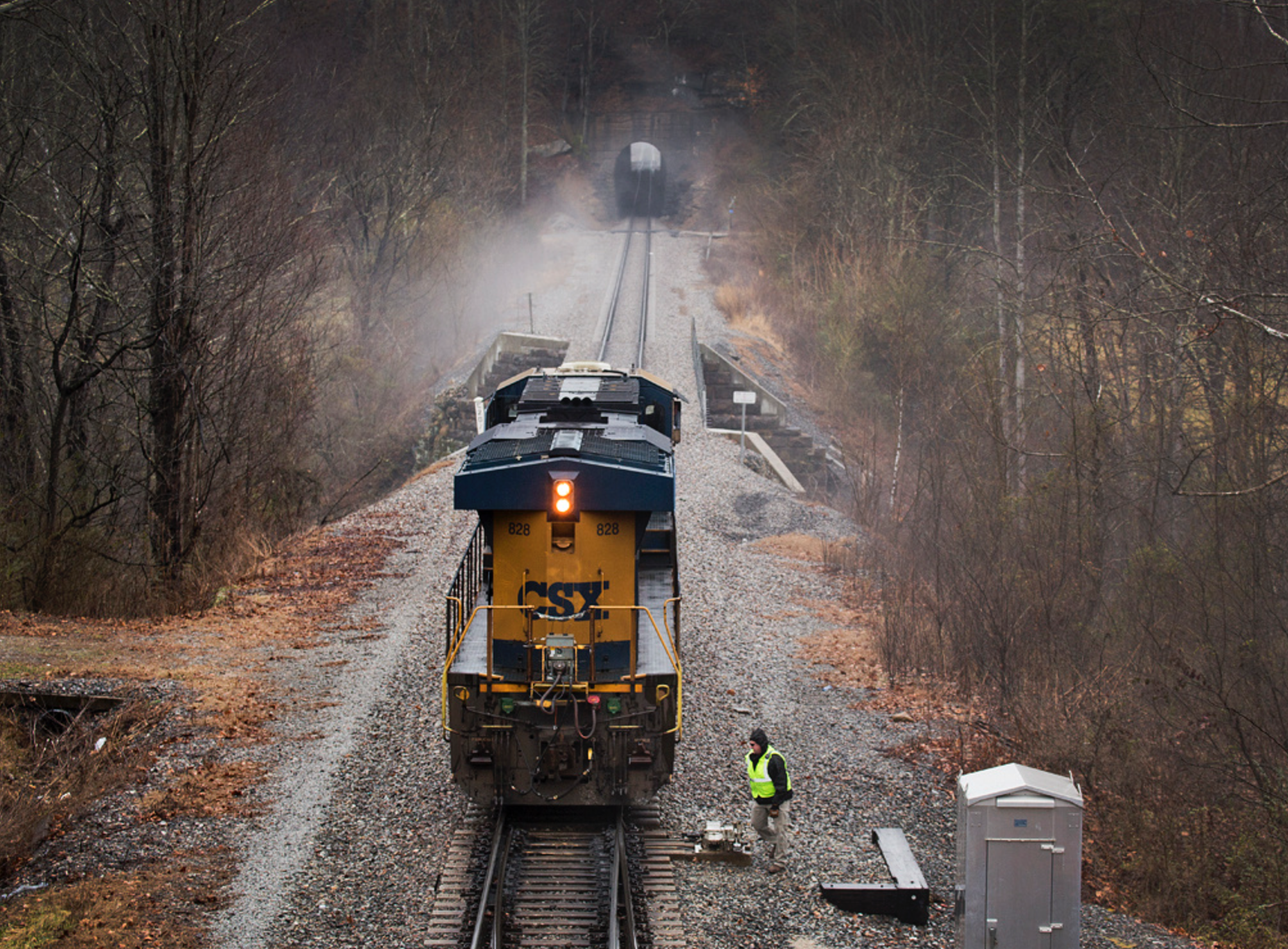
“Our office is being informed that the carrier has made the decision today to cut off all the pusher assignments on our property,” read the union’s post. Local 1162 represents CSX railroaders on the railroad’s former Clinchfield Railroad in eastern Tennessee.
In Cumberland, Md., about 400 miles northeast of Local 1162’s territory, reports surfaced this week that CSX had attempted to abolish pusher assignments across Sand Patch grade on the railroad’s famed Baltimore & Ohio mainline.
A CSX employee familiar with area operations tells Trains News Wire that pusher assignments in Brunswick, Md., have been abolished and the railroad tried to cut pusher assignments on Sand Patch this week out of Hyndman, Pa., and Connellsville, Pa.
The employee, who asked to remain anonymous, says the railroad got rid of pushers in Hyndman and Connellsville for about one day before realizing it created for a backlog of rail traffic across the Keystone Subdivision west of Cumberland.
The pusher assignments at Hyndman and Connellsville have been reassigned, but the Brunswick pusher jobs, which shove trains on the B&O’s Old Main Line Subdivision, are still abolished. The same source says CSX is taking a similar approach in abolishing pusher assignments on the railroad’s Mountain Subdivision out of Grafton, W.Va.
With the absence of pushers, local railroad managers are instructing train crews to double the hill or use the motive power of other trains in the area to assist.
Doubling a hill is an operational practice that divides a single train into multiple cuts, as opposed to taking the entire train across a grade at one time. Ideally, trains would have sufficient head-end power to tackle mountainous routes without the need for additional rear-end locomotives.
On the railroad’s former Chesapeake & Ohio territory in West Virginia and Virginia, unit coal trains have been operating at shorter lengths to ensure they can climb Alleghany grade into Virginia without needing the Ronceverte, W.Va., pusher.
Unit trains that once operated with two head-end locomotives, 150 cars, and one rear-end pusher based out of Ronceverte are now operating with three head-end locomotives and at shorter train lengths. Trains of 150 cars are typically running as 100-car trains amid declines and restructuring of the railroad’s coal business.
On routes with less rail traffic than primary corridors, such as the C&O in West Virginia, pusher jobs may be perceived to management as insufficient. On former B&O territories in Maryland, such as Cumberland, pusher locomotives actually serve a broader purpose one employee says.
“The Hyndman helpers are actually ‘district switchers’ so they relieve trains, yard trains, and work as needed,” the worker says.
The Hyndman assignment also assists downhill trains descending Sand Patch with additional braking capabilities when head-end locomotives are experiencing air or engine issues.
The worker believes due to the multiple roles played by the Hyndman assignment, it may lead to the continuation of the jobs.
Trains News Wire asked CSX to respond to reports about pusher assignments.
“As part of an ongoing comprehensive review of company operations, CSX continues to make changes across its network, including changes to operating rules, to improve safety, efficiency and service to customers,” CSX representative Rob Doolittle says. “As these operational changes are made, CSX managers are communicating with employees and any other stakeholders who may be impacted to implement changes safely and effectively.”
CSX pusher assignments are most common in coal-dominant rural sections of Appalachia on former C&O, B&O, Louisville & Nashville, Clinchfield, and Western Maryland territories.
Prior to CEO E. Hunter Harrison joining CSX, the railroad experimented with an operational strategy that replaced manned pushers on the C&O mainline with longer trains and mid-train distributed power units.
The DPU-equipped train made a single test run from Russell, Ky., east to Richmond, Va., last winter with two head-end locomotives, two mid-train DPUs, and 220 loaded coal hoppers. After experiencing delays and a broken knuckle enroute, CSX reduced the length of the trains to its normal 100 and 150-car unit trains through West Virginia and got rid of the unmanned DPU locomotives.