

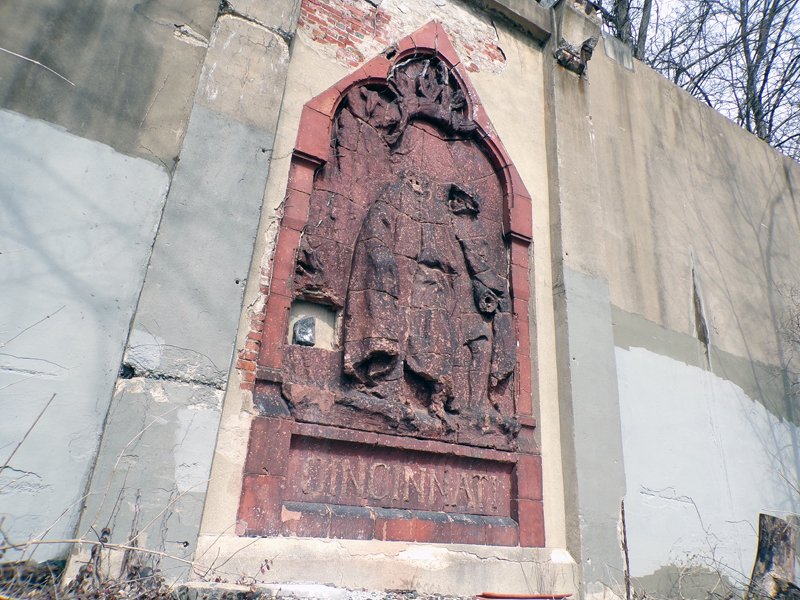
Torrence Road Station, located three miles east of downtown Cincinnati on the former Pennsylvania Railroad Oasis Line, was an ornate station originally built in the late 1880s that once saw up to two dozen passenger trains daily. The station was abandoned and torn down in late 1933 after the opening of Cincinnati Union Terminal closed several suburban stations around the area. But, an interesting piece of history can still be found at the site — an original sculpture from Philadelphia’s famed Broad Street Station.
Fire destroyed that train shed in 1923. Among its many features were ten terra cotta sculptures, representing ten important cities to Pennsy’s network. Among those cities were Philadelphia, Chicago, Boston, New York, Pittsburgh, Cincinnati, and Washington. After the fire, Pennsylvania’s President Samuel Rea offered the sculptures to the cities they represented. Cincinnati accepted the offer, and it was placed in the wall underneath the walkway overpass at Torrence Road in 1924. There it would remain, and after the demolition of most the Torrence Road station in late 1933, it was seemingly forgotten, left in what would become a retaining wall.
Today, the Oasis Line is owned by the Southern Ohio Regional Transit Authority, which purchased the line from Conrail in 1995 for a potential commuter rail service. Genesee & Wyoming’s Indiana & Ohio Railway operates freight traffic over the line.
That would likely be the end of the story if it weren’t for Brian Collins, owner of the Cincinnati Railway Co. The railway company began operating the Cincinnati Dinner Train over the Oasis Line in April 2009. Collins says he noticed the sculpture, buried in years of weeds, brush, and graffiti. He came out a few days later to clean it up and clear out some of the brush, and, after researching its history, began featuring it for his dinner train passengers.
“It’s like something out of the Mayan Temples,” he is fond of saying. “We stop the train there every Saturday and light it up and tell its story.”
The ten sculptures were thought to have been destroyed, and thus far, none of the others have been found, making Cincinnati’s the only known survivor. The years have taken their toll on it, but considering everything it has been through, its remarkable that it exists at all, and now it can be seen by the public for the first time in decades.
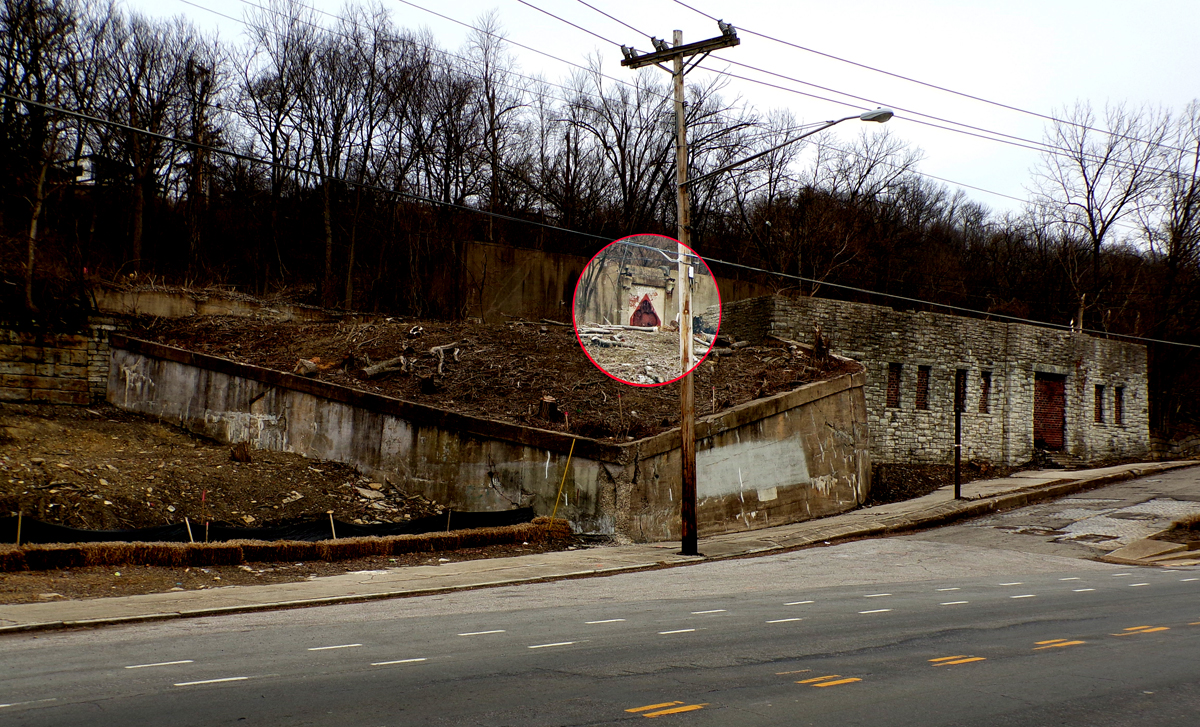
Until late 2018, the only way to get a look at the sculpture was to book a ride on the dinner train. But recent development work around the site has resulted in the clearing of all brush and trees out of the area, allowing the stone base and the sculpture to be plainly seen along Riverside Drive. This has resulted in a burst of interest in the site locally, and has also raised a lot of questions about the ownership of the sculpture and it’s future.
Paul Grether, SORTA’s director of rail services, says that the sculpture is part of the Oasis Line property, and that it is safe.
“We are aware of the sculpture and its historical significance. While there are no current restoration plans, it is also in no danger,” he says.
It is unclear what else could be done with the sculpture beyond preserving it in its current state. Restoration has thus far been deemed too expensive. Movement of the sculpture to another site is also not a viable option currently, due to its age and location in what is now a retaining wall.