

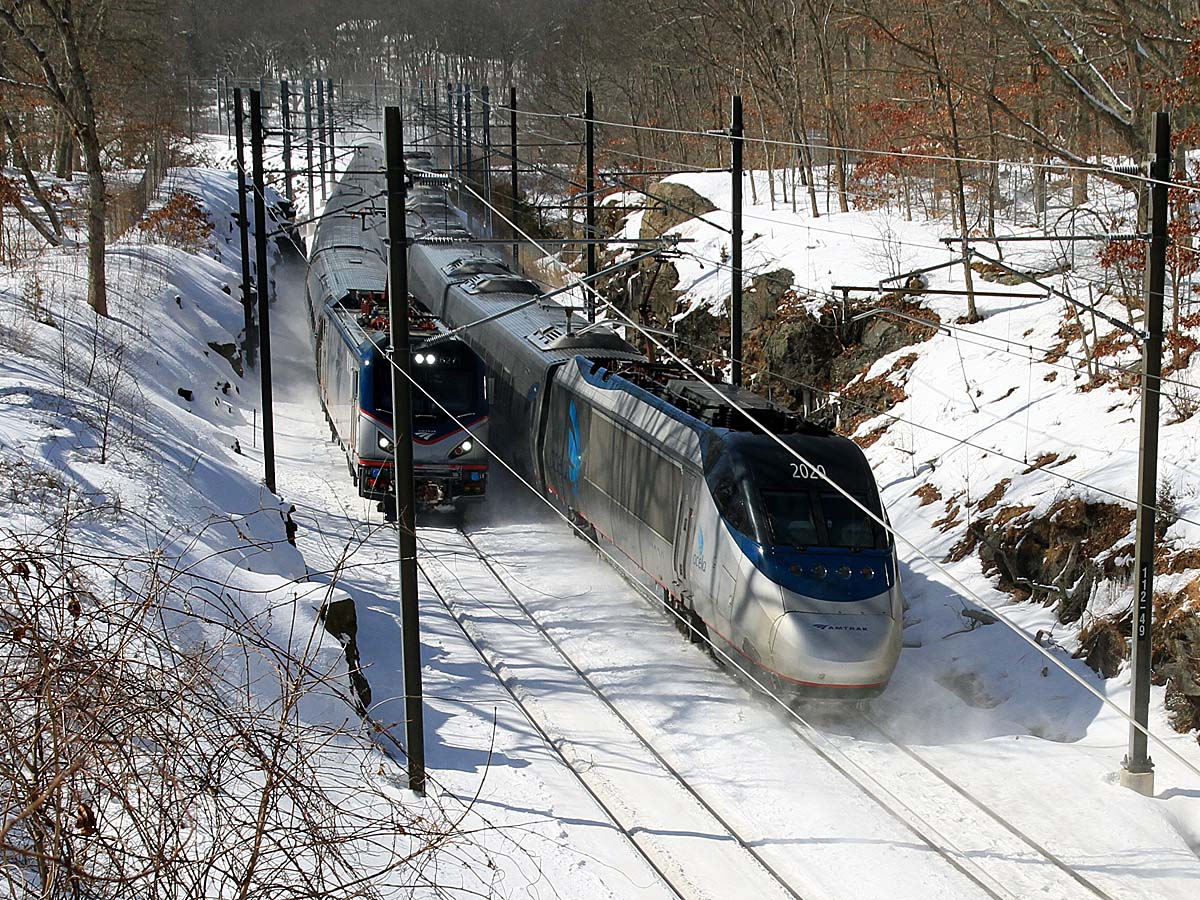
Eastbound train No. 162, left, meets Acela Express No. 2253 at Rocky Neck State Park in East Lyme, Conn., in March 2015. Amtrak hopes to add a fourth service level in 2021 when additional Acela equipment is available.
Robert A. LaMay
WASHINGTON – Amtrak announced another ridership record in Fiscal Year 2019, providing 32.5 million customer trips, a year-over-year increase of 800,000 passengers.
“We are growing and modernizing Amtrak. We have an industry-leading safety program and have invested billions in improving the customer experience, resulting in more people choosing Amtrak as their preferred mode of transportation,” says Amtrak Board Chair Tony Coscia. “These changes have put us on track to breakeven in 2020, which would be a first in Amtrak’s history.”
Amtrak recorded an operating loss of $29.8 million, an improvement of $140.9 million or 82.6% compared with the previous year. However, it does not break out revenue by route as it has does in the past.
“I would characterize 2019 as a solid year for Amtrak, marked by steady improvement, steady and consistent improvement on all measures and activities across the railroad,” says President and CEO Richard Anderson.
There had been a $1.6 billion investment on capital assets, including interior renovations for the Acela Express and Amfleet II coach fleets, technology upgrades in the mobile app, and the introduction of assigned seating for Acela and Business Class passengers. Additional work on the Northeast Corridor improved overall reliability and performance, and customer benefits overall including station upgrades and enhanced lounges increased revenue and ridership. Capital spending in FY2019 was 9.4% higher than the previous year.
One change on the horizon is additional service on the Northeast Corridor when the new Acela Express equipment enters service in 2021. This would provide four service tiers on the Corridor, mirroring passenger offerings in Europe. That includes more non-stop Acela trains; traditional limited-stop Acela trains; Northeast Regional service; and a low-cost, all-stops local service with new multiple unit equipment. Anderson says such a change will enable the carrier to serve as many people as possible and would not compete with existing commuter rail operations.
Senior Executive Vice President, Chief Operating and Commercial Officer Stephen Gardner spoke about expanding service in under-served intercity markets elsewhere in the country. Amtrak has identified markets where customer-driven demand could increase train service without citing specific examples.
Anderson noted full PTC compliance on Amtrak-owned track, with 91% installed on the rest — more than 17,000 route miles. By year-end, Amtrak will be operating at full PTC compliance or an equivalent level of safety through other technology and operating capabilities. ADA compliance was also mentioned with Amtrak having spent $78 million and completed ADA-focused construction improvements at 40 of its stations during the year.
In FY2019, Amtrak was the first major U.S.-based railroad to implement a Safety Management System, a proactive approach to managing safety, resulting in significant improvements.