
Downtown Milwaukee on the original MR&T
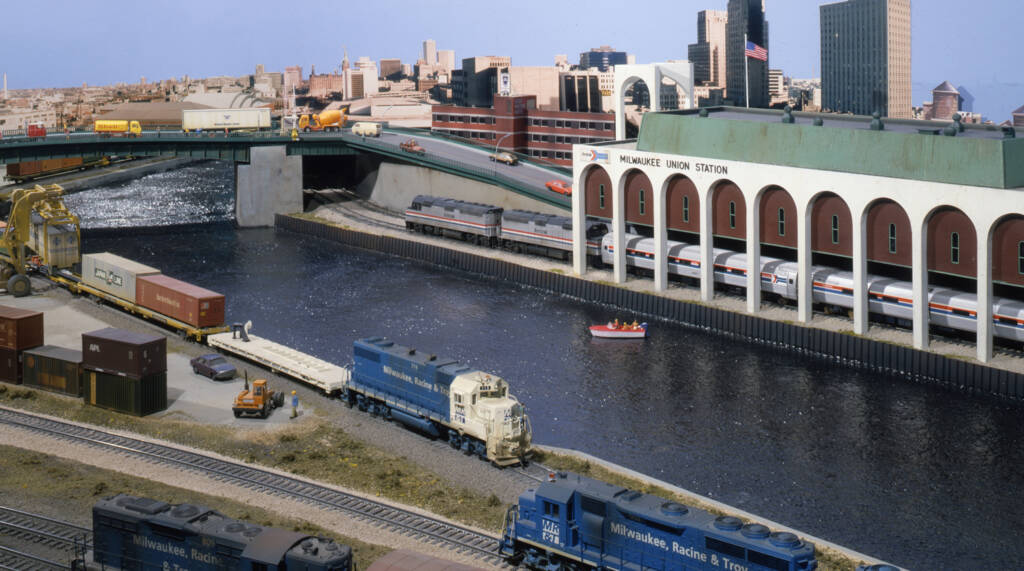
Over the first dozen or so years of of its existence, the original HO scale Milwaukee, Racine & Troy underwent many changes. Among these was the installation of a freestanding backdrop on the downtown Milwaukee section, which resulted in the scenic challenge shown below. Already in place was the Port Marquette Yard, the MR&T’s eastern […]

Read More…

Creeping speedwell

plant with mushroom houses nearby

Common name: Creeping speedwell Latin name: Veronica repens Plant type: Groundcover Plant size: 1″ high, spreading 6-12″ USDA Hardiness Zones: 2-8 Cultural needs: Normal or sandy; well drained, moist soil; full sun to part shade Dwarfs and dwarf trees won’t be obscured when surrounded by this mat-forming creeping speedwell. Here, in full bloom during June […]

Read More…

The Waukesha County Gandy Dancers: A Model Railroad Club on the Move

Wide shot of layout under construction

For many model railroad clubs, the word “move” can trigger stress and uncertainty. When you don’t own the space you reside in, the possibility of having to pack up and relocate is always present. The Waukesha County Gandy Dancers Model Railroad Club (WCGD), located in Waukesha, Wis., knows this feeling all too well. “No power!” […]

Read More…

How to install roadbed at a turnout

Headblock tie pad made out of cork.

Learning how to install roadbed at a turnout, a place where tracks meet or diverge, is a valuable skill for all model railroaders to have. Installing strips of cork or foam roadbed for straight or curved tracks is a straightforward process. Mark the center line, split the roadbed sections into flexible strips, and glue them […]

Read More…

Should you go with code 100 or code 83 track?

scale graphic

Track selection is among the first decisions you’ll have to make when you get started in model railroading, second only to scale. In HO (1:87.1), the two most commonly used track sizes are code 100 and code 83. “Code” refers to the height of the rail, measured in thousandths of an inch. For a lot […]

Read More…

The N scale Buffalo & Pittsburgh layout

The second page of the track plan for the Buffalo and Pittsburgh layout

Facts and features Name: Buffalo & PittsburghScale: N (1:160)Size: 27 x 31 feet plus 14 x 14 feetPrototype: Buffalo & PittsburghLocale: western New York and PennsylvaniaEra: 1988Style: multi-deck walk-inMainline run: 187 feetMinimum radius: 16″Minimum turnout: No. 5Maximum grade: 2.5%Benchwork: open grid and modularHeight: 44″ to 62″Roadbed: cork over plywood and extruded-foam insulation boardTrack: Atlas code […]

Read More…

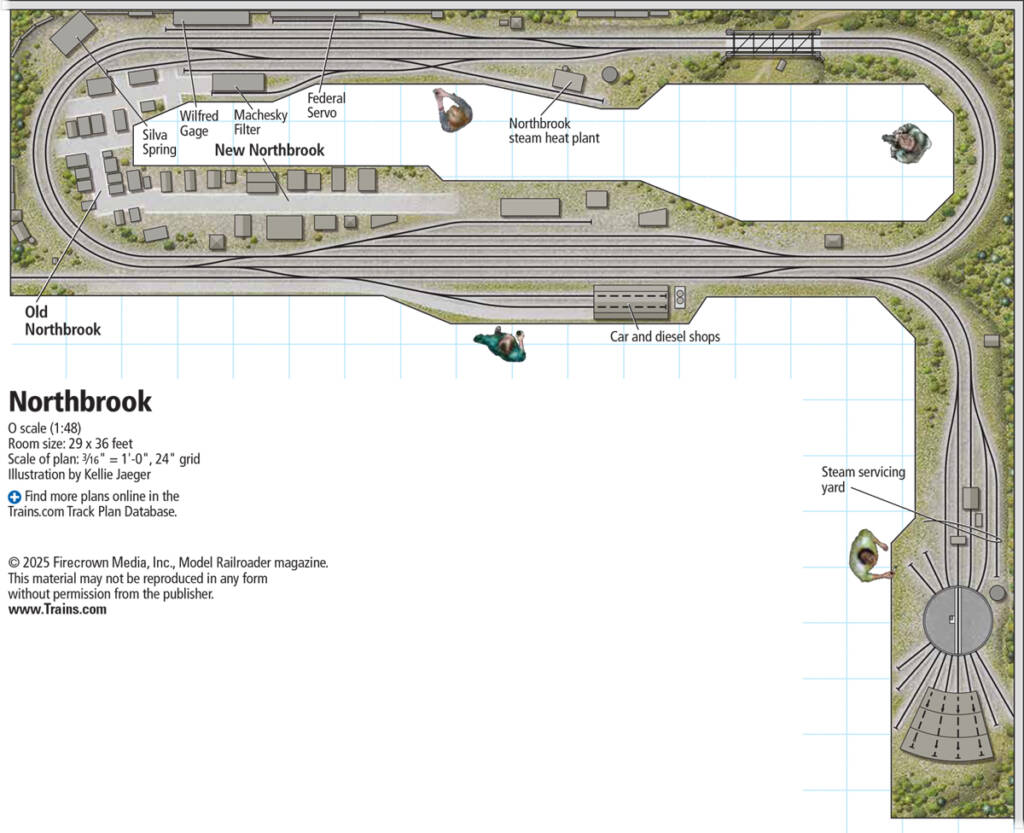
The O gauge Northbrook layout

The track plan for the Northbrook model railroad layout

Facts and features Name: NorthbrookScale: O gaugeSize: 29 x 36 feetPrototype: freelanceLocale: Northeast and Midwest U.S.Era: 1956Style: donutMainline run: 155 feetMinimum radius: 45″Minimum turnout: No. 5Maximum grade: noneBenchwork: open gridHeight: 42″Roadbed: corkTrack: Atlas O three-railScenery: painted extruded-foam insulation boardBackdrop: painted 1∕8” tempered hardboardControl: Lionel TMCC and Legacy; Sound Traxx Blunami Click the link to download […]

Read More…

Why I collect Marx

red, silver, and yellow model diesel locomotive model

I’ve been collecting Marx since the 1990s. Growing up with American Flyer S gauge and Lionel, I had largely not gotten to know Marx. Eventually I started to take interest, especially in the plastic locomotives and cars. Plastic molding is something I like to look at and study. I did have a Marx plastic set […]

Read More…

Cork vs. Foam Roadbeds

Two types of roadbed laid out

For model railroaders choosing a separately applied roadbed for laying track, two popular options dominate: cork and foam. Each has its own strengths and weaknesses, as well as impacting factors such as ease of installation, durability, and realism. Let’s dive into the details and help you make an informed decision on cork vs. foam roadbeds. […]

Read More…

Modeling seasons on your layout

Color photo of steam engine pulling freight train through snow-covered scenery.

Back in 2010, I was part of a group of contributors to Scenery by the Seasons by Kalmbach Publishing Co. The 98-page book featured stories on modeling seasons on your layout. Among the topics covered were spring backdrops; lily pads, cattails, and pond scum; easy autumn trees; and ice and snow. Though the title is […]

Read More…