
How do I add Kadee couplers to a Lionel Flyer steam engine?

Classic Toy Trains magazine logo

I recently bought a Lionel No. 2121060 American Flyer Baltimore & Ohio 4-6-2 Pacific locomotive and tender and would like to install Kadee couplers. I see holes on the bottom of the S gauge tender for mounting a scale coupler adapter, but I don’t know which adapter will fit there and how to mount it. […]

Read More…

A look back: prewar American Flyer stations

screenshot of magazine page with model stations

The Winter 1989 issue featured an 8 page (!) article on prewar American Flyer stations (96, 104, and 237). This comprehensive article included variation charts for each of the versions, photos of the different bases, catalog art, and more. It’s a great reminder that CTT has been the authority for toy train history for more […]

Read More…

Small numbers on MR&T diesels

Color photo of blue-and-white HO scale diesel with small number next to herald.

Q: When I was looking at pictures of the Milwaukee, Racine & Troy locomotive fleet, I noticed small numbers near the herald on some diesels. Were those numbers tied to the control system used on the layout, or did they have another meaning? — Jason Trew A: Those single- and double-digit numbers near the herald on […]

Read More…

How do I safely remove the shell of a postwar Flyer freight car?

red model boxcar

Do you have any suggestions for easily and safely removing the pins that hold the plastic body shell on various American Flyer freight and passenger cars from the postwar era? Using a pair of pliers has not worked. — Robert Lawrence You have to wedge a screwdriver or another tool between the body shell and […]

Read More…

Lionel’s No. 671 Pennsylvania RR S2 Steam Turbine

vintage black model steam locomotive

Lionel’s No. 671 Pennsylvania RR S2 steam turbine is one of the classic O gauge locomotives of the postwar era. Lionel released it for the first full product line of the post-World War II era in 1946. But the brilliant minds in the Engineering Department at Lionel were almost certainly taking their first steps in […]

Read More…

Improve sound in your steam locomotive

close up of model steam locomotive

Steam locomotive manufacturers and aftermarket sound companies have come a long way in producing realistic sound, to a point. These systems usually have a single speaker mounted face down in the floor of the tender. Projecting sound downward and bouncing it off the track and ballast results in heightened bass and low definition between the […]

Read More…

How to color brick structures

A group of HO scale brick buildings along an urban railroad track

A question many readers want an answer to is how to color bricks. Structures have been built with brick for millennia and material was very popular from the start of the industrial revolution through the advent of structural steel and reinforced concrete construction. Most railroads will pass by and serve multiple brick-built factories and warehouses, […]

Read More…

How do I remove black marks from tubular track?

Sections of track on the table

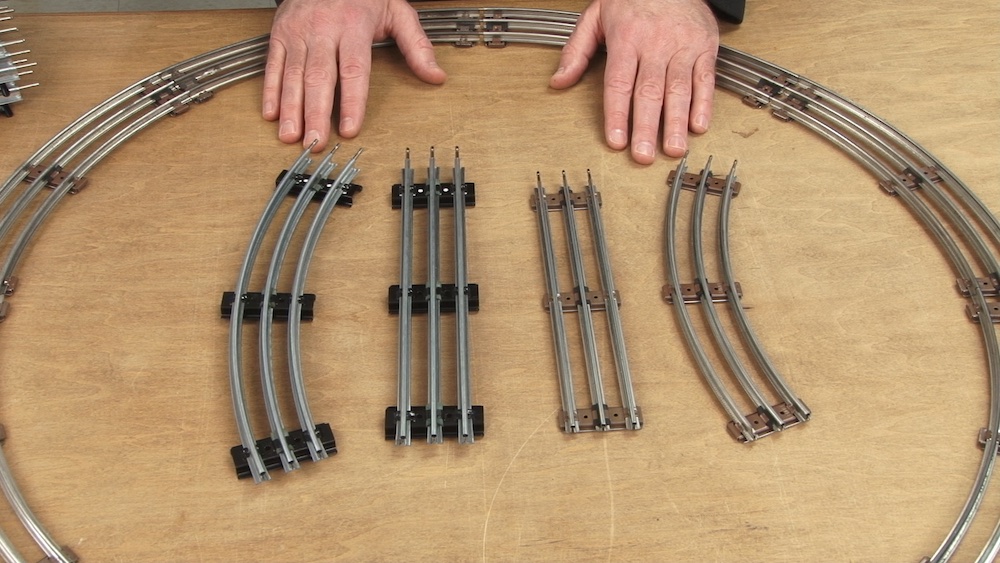
I recently took out my old toy trains that have been packed away for about 25 years. The tubular track sections that were brand new back then now have black marks on them. How do I clean them and get them usable again? — Joe Rampe If it’s just dry corrosion, a Scotch-Brite pad will […]

Read More…

Can you prevent Lionel and MTH trains from running in reverse?

Classic Toy Trains magazine logo

Are you aware of any kind of commercial device that can prevent Lionel and MTH trains from running in reverse? Whenever any of my young grandchildren try to run a freight train in reverse, the cars inevitably derail and ruin our fun. This is an interesting problem to have! I can’t think of any device […]

Read More…

Legs and bracing for the East Troy Industrial Park

Two white males, one with a full beard and one with a balding head, hold wood furniture legs to a bare wood rectangular frame and attach support boards to keep the legs vertical using black, blue, and yellow bar clamps.

Once we had the L-girders built, it was time to turn our attention to adding the legs and support bracing for the layout. We constructed the legs as simple subassemblies with their own cross bracing. It all bolts to the L-girder frames using ¼” carriage bolts, wing nuts, and washers.  We used more dimensional lumber […]

Read More…

A closer look at feed mills

Color photo showing portion of a feed mill with red siding, conveyors, and cyclone vents.

Q: In your special issue Best of Industries, Harold W. Russell wrote about the R.B. Crowell & Son Grain Co. He stated that the rail-served industry received grain in bulk loads, but in the photos and drawings it seems to me that they would ship grain instead of receiving it. What are your thoughts? — […]

Read More…