
Sound-deadening subroadbed

Color image showing sound-deadening material attached to medium density fiberboard layout surface.

Excessive track noise was one of the main reasons I decided to rebuild my HO scale Daneville & Donner River layout. I hadn’t paid much attention to the noise level until I started using locomotives with sound decoders. That’s when I recognized how the wheel noise from rolling freight cars nearly overpowered the sound of […]

Read More…

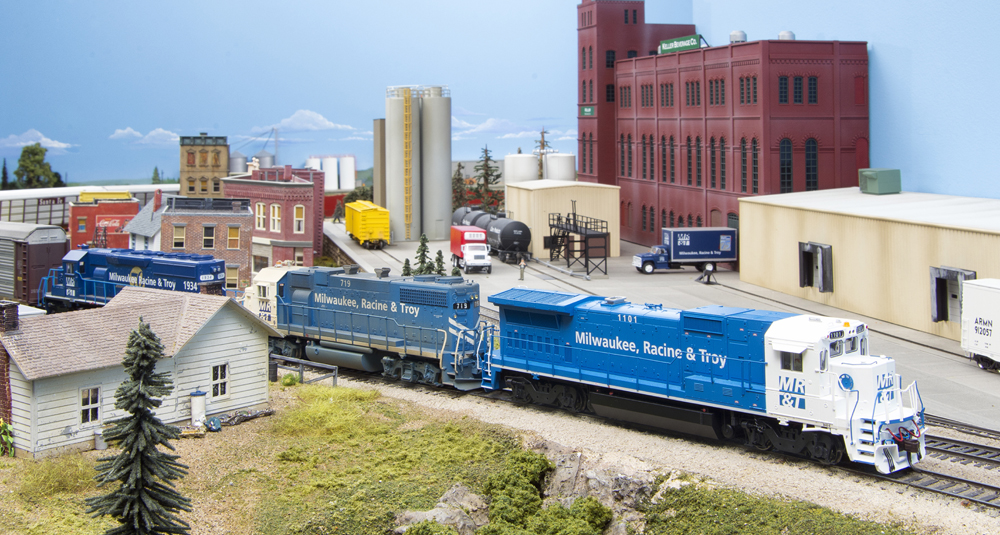
A new era for the Milwaukee, Racine & Troy

new era Milwaukee Racine Troy: A model train led by three blue and white locomotives proceeds through a town

When Kalmbach Publishing Co. moved from Milwaukee to the western suburb of Waukesha in 1989, the Milwaukee, Racine & Troy had a blank slate. The ink-stained concrete floor; large, drafty windows; and sun-faded scenery were in the past. “Our new layout room is a beautiful place, an open, rectangular space with a tile floor, drop […]

Read More…

Tips and tricks for improving reach around your layout

Tape measurer on layout tabletop

Reach, in model railroading terminology, is how far you can comfortably stick your arm into a scene without damaging the layout. Planning for reach is essential when designing a layout, as eventually you will need to dust, fix, change, or maintain one or more scenic features once it is built. The maximum depth the average […]

Read More…

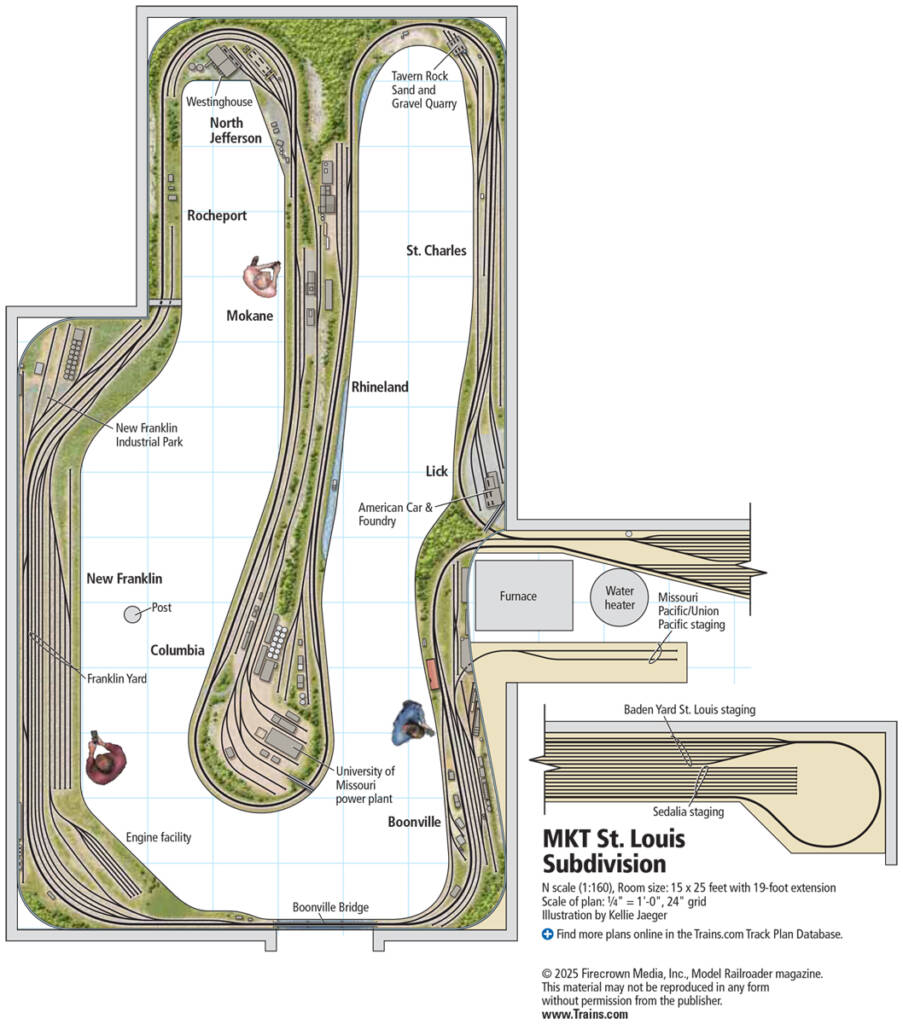
The N scale Missouri-Kansas-Texas RR St. Louis Subdivision layout

Facts and features Name: Missouri-Kansas-Texas RR St. Louis SubdivisionScale: N (1:160)Size: 15 x 25 feet with 19 foot extensionPrototype: Missouri-Kansas-Texas RRLocale: central MissouriEra: 1984Style: walk-inMainline run: 135 feetMinimum radius: 24″Minimum turnout: No. 6Maximum grade: 3% on Columbia BranchBenchwork: L-girder with 1 x 4 box modules on perimeterHeight: 53″ to 60″Roadbed: AMI Instant Roadbed on main […]

Read More…

Locomotives we love: Lionel No. 773 4-6-4 Hudson steam engine

black model steam engine on layout with fall foliage

The Lionel No. 773 4-6-4 Hudson steam engine and tender from 1950 did much to revive the passion dedicated O gauge modeler Walt Urban Jr. has for toy trains. He reminds us that hobbyists who grew up during the 1950s will remember the annual holiday shopping season as being particularly nostalgic. Like him, many of […]

Read More…

Build an animated sawmill and storage shed

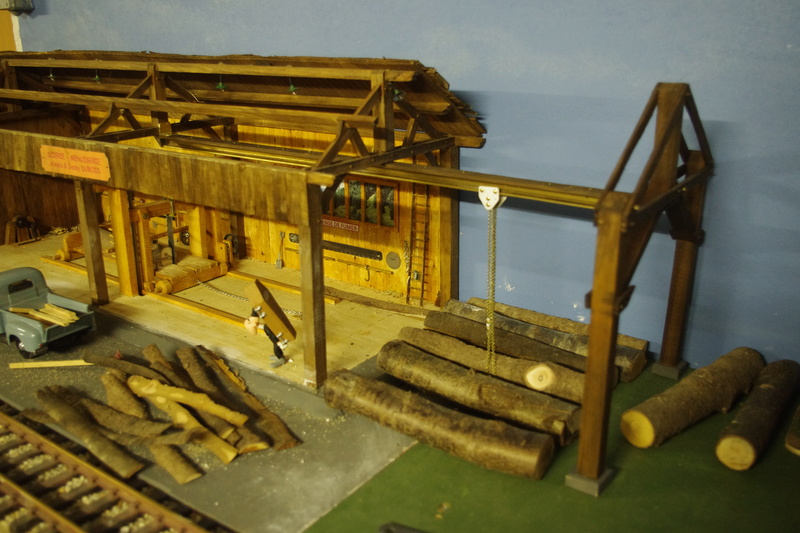
end of model sawmill with crane

It’s nice to have structures on our railways. You can often see coaling towers, sand stations, water towers, and sometimes a sawmill.  A sawmill can also be a source of additional industries, such as a lumber store for cut planks or a log storage area, featuring an overhead crane. You might add animated features to […]

Read More…

The N scale Danforth, Hadley & Northern layout

The track plan for the N scale Danforth, Hadley and Northern RR layout

Facts and features Name: Danforth, Hadley & NorthernScale: N (1:160)Size: 38 x 52 feetPrototype: freelanced, based on Northern PacificLocale: central MontanaEra: 1955Style: walkaroundMainline run: 400 feetMinimum radius: 24″ (main), 20″ (branch)Minimum turnout: No. 5 (main), No. 4 (industrial spurs)Maximum grade: 1.5% (main), 2.25% (branch), and 3% (logging)Benchwork: L-girder, with Homasote and spline roadbedHeight: 52″ to […]

Read More…

Trackage rights in the timetable era

Scan of a railroad employee timetable with town names, times, train numbers, and other information.

Q: I’m currently planning a layout that features several railroads, including a mythical short line that has to use running rights with the larger railroads. How would these running rights work in regards to timetables and train orders? And how would clearance cards be issued? Would there be a clearance card issued by each road, […]

Read More…

Woodworking power tools for model railroaders

Once you’ve decided you’re going to build a model railroad, it won’t take you long to realize there are a few tools you’ll need to get the job done. Some of the more common hand tools may already be knocking around your workshop. However, unless you do a lot of woodworking projects, you likely don’t […]

Read More…

Why I collect Gilbert American Flyer

wall of toy trains on shelves

What do I collect? I collect S gauge Gilbert American Flyer, as it’s the scale and brand with which I entered the model railroading hobby. I have always enjoyed S gauge, as the size is nice and Gilbert American Flyer enjoys a great history and loyal, albeit somewhat small, following. When did I start collecting? […]

Read More…

Measuring locomotive speed

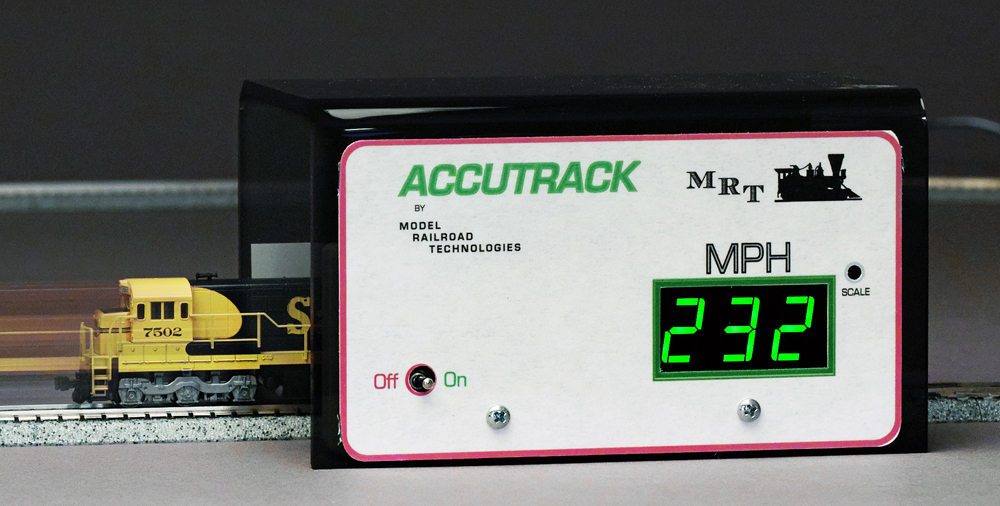
Color photo of blue-and-yellow diesel locomotive on track passing under speedometer.

Q: In Model Railroader product reviews, locomotive speed is often measured and compared with the prototype. I was wondering how this is done so I can run my trains at prototypical speeds. — George Smitton A: When we test locomotives at the workbench, we use the Model Railroad Technologies Accutrak II train speedometer for measuring […]

Read More…