Regulatory Paragraph in Presidential Emergency Board report stokes controversy

Paragraph in Presidential Emergency Board report stokes controversy

By Bill Stephens | August 18, 2022

| Last updated on August 6, 2025


Rail workers dispute contention that they played no role in creating the industry’s record profits

Email Newsletter

Get the newest photos, videos, stories, and more from Trains.com brands. Sign-up for email today!

Men holding picket signs
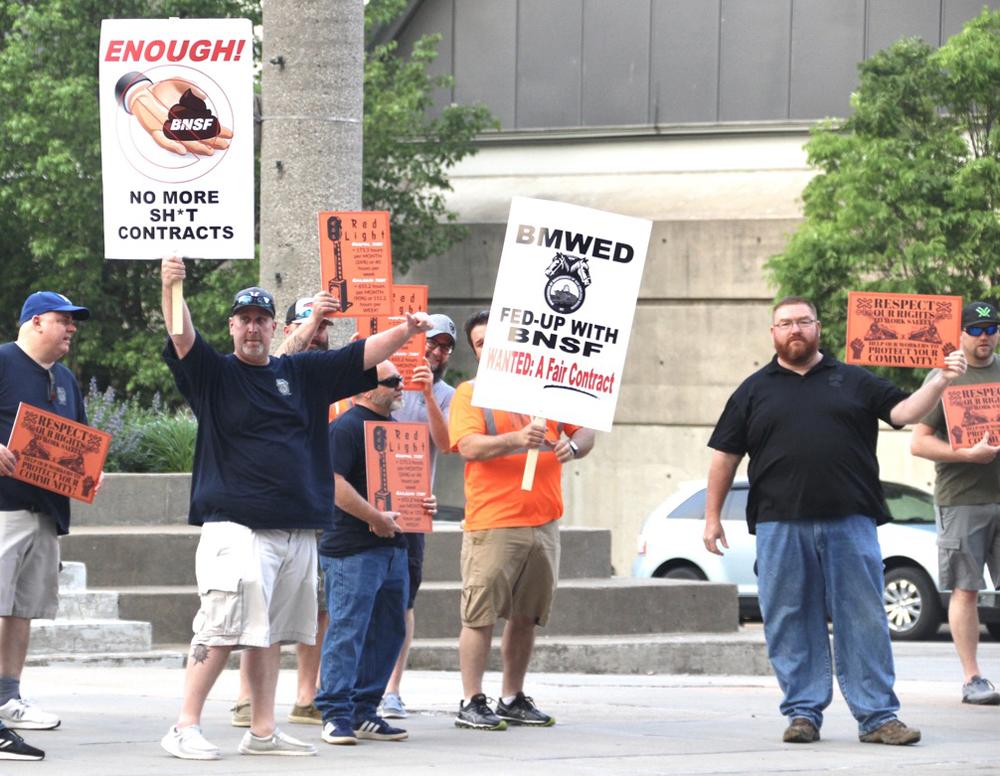
Railroad employees picket outside the North American Rail Shippers conference in Kansas City on May 10, 2022. Workers have objected to a paragraph in the Presidential Emergency Board report saying railroads feel workers have not contributed to their record profits. (David Lassen)

WASHINGTON – Rank-and-file members of rail labor are critical of a paragraph in the Presidential Emergency Board report that says railroads believe their workers have not contributed in any way to the industry’s record profits.

The Presidential Emergency Board, whose duty was to help settle the contract impasse between unionized workers and the U.S. railroads, this week summarized the positions of railroads and labor unions in its report outlining its contract recommendations.

“The Carriers maintain that capital investment and risk are the reasons for their profits, not any contributions by labor. The Carriers further argue that there is no correlation historically between high profits and higher compensation, either in the freight rail industry or more generally. To the contrary, one of the Carriers’ experts maintained that the most profitable companies are not those whose compensation is the highest. The Carriers assert that since employees have been fairly and adequately paid for their efforts and do not share in the downside risks if the operations are less profitable, then they have no claim to share in the upside either,” the report says.

Railroaders objected to the notion that they don’t help produce profits, as well as the assertion that they don’t share in downside risks. The paragraph, shared widely on social media, drew immediate reaction from railroaders who worked through the pandemic and have not had a raise since 2019. Some of their responses:

“Here’s what the carriers think about our contribution to their success.”

“Man, we went from essential to completely useless in a short amount of time.”

“Let’s all stop working and test this theory.”

“Don’t share in the downside? What do you call furloughed employees? I guess having to find another way to feed your family until the upside comes back, doesn’t count?”

“Last I checked ‘capital investment and risk’ isn’t moving their freight.”

“This should be printed out and hung in every depot….so nobody forgets what management REALLY thinks of us.”

The Association of American Railroads, CSX Transportation, Norfolk Southern, and Union Pacific declined to comment and referred questions to the National Railway Labor Conference, which is the industry’s contract negotiations arm. BNSF Railway did not respond to a request for comment.

“The railroads value employees’ significant contributions to moving the nation’s freight. Rail employees work hard, and the railroads’ presentation to the PEB repeatedly emphasized that employees should receive compensation increases that appropriately reward those contributions,” the National Railway Labor Conference said in a statement.

The Class I CEO’s typically begin quarterly earnings calls by thanking employees for their contributions. And at an investor conference yesterday, NS CEO Alan Shaw called employees the railroad’s “most precious resource.”

The three-member Presidential Emergency Board, working under a 30-day timeline, sifted through 10,000 documents the railroads and labor unions submitted as part of the process. The board’s summary misconstrued some of the points the railroads made, including the fact that railroaders are the heart of the industry and deserve fair compensation, according to a person familiar with the matter.

The crux of the dispute over raises, the industry says, concerns how “fair compensation” should be defined.

The board recommended a 22% wage increase, along with $5,000 in service recognition bonus payments, over the five-year life of the contract retroactive to Jan. 1, 2020. That was below the 28% increase the unions sought, but above the railroads’ 16% proposed wage hike.

The unions have argued that a wave of layoffs that began when U.S. railroads began implementing Precision Scheduled Railroading operating models in 2017 means that remaining workers should receive compensation in line with their increased workloads.

The railroads argue, however, that the increases in productivity are the result of capital investments in technology and changes to operations such as moving more tonnage on fewer but longer trains, which requires fewer locomotives, shop workers, and train crews. There was not, the railroads say, a corresponding increase in skills of employees that would justify a productivity-based raise.

Chart matching railroad traffic and employment
Railroad traffic and employment have generally been closely linked — until the last two years. (Jason Miller)

Rail workers also disagreed with the railroads’ contention that workers aren’t exposed to downside risk and therefore shouldn’t be rewarded when profits rise. Railroaders note that they are furloughed when traffic goes down and therefore are exposed to downside risk.

“I find the idea that employees somehow aren’t exposed to fluctuations in demand is inconsistent with the data,” says Jason Miller, an associate professor of logistics at Michigan State University.

Miller compared Bureau of Transportation Statistics data for carloads and intermodal loads with rail employment data from the Bureau of Labor Statistics. The data show that rail employment typically rose and declined in line with traffic volume — until 2020.

“When we calculate labor productivity as this weighted carload and containerload index over employment, we can see a tremendous surge of labor productivity since the pandemic hit,” Miller explains. “However, this labor productivity surge differs from in the mid-2000s or in 2018. Those two productivity surges occurred because volumes grew yet employment remained relatively the same. In contrast, the 2020-2022 labor productivity boom has occurred despite weighted output not reaching 2018 levels; rather, it is due to employment having been cut so much.”