





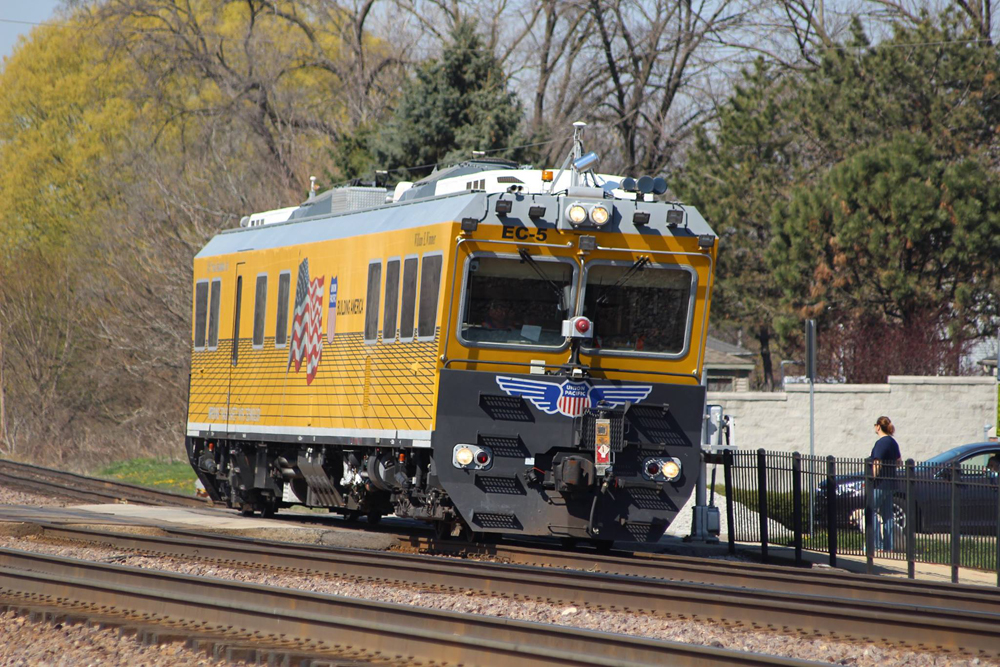
WASHINGTON — In the latest in a recent series of rail safety bills, U.S. Sens. Tammy Baldwin (D-Wis.) and Josh Hawley (R-Mo.) announced on Wednesday, March 4, that they would introduce legislation requiring railroads to maintain visual track inspections in conjunction with automated track inspection systems.
U.S. Rep. Dina Titus (D-Nev.) is leading the companion legislation in the House of Representatives.
The Secure Tracks Act will require all track designated as Federal Railroad Administration Class 3 or higher — that is, track with speed limits of 40 mph or more for freight and 60 mph or more for passenger — to receive visual track inspections twice a week. It also requires all track classifications to receive automated inspections at specified frequencies, using the Track Geometry Measurement System.
The bill would also require any defect to be corrected or otherwise addressed immediately upon detection, and requires inspectors to immediately initiate action to address such defects. And it prohibits the secretary of transportation from granting any waiver of safety regulations if the proposed alternative method of inspection or monitoring fails to identify all conditions recognized as unsafe under FRA regulations.
“Safety must be our top priority when it comes to our nation’s railroads,” Hawley said in a press release. “Technology can help us monitor our railways but there is no substitute for in-person inspections conducted by railroad professionals. … Technology must serve workers — not the other way around.”
Said Baldwin, “I am all for using technology to keep our trains on the tracks and communities safe from derailments, but what we have learned is that technology can’t do it all alone. It misses things that humans see and hear, and if we want to make sure our railroads are safe, we need both technology and real people who have the experience and knowledge.”
The complete bill is available here. Ten rail labor organizations have endorsed the measure.
The senators say in the press release that automated inspection can detect only 26% of all track defects, with the remaining 74% detected only by a human being.
The Association of American Railroads, in a statement today (March 5), disputed the premise behind the bill.
The bill joins other legislation introduced in the last two weeks, including the latest version of the Railway Safety Act in the Senate [see “Senators introduce new version …,” Trains.com, Feb. 24, 2026] and the Railroad Safety Enhancement Act in the House [see “House members introduce …,” Feb. 26, 2026].
— Updated at 12:18 p.m. CT with AAR statement. To report news or errors, contact trainsnewswire@firecrown.com.
Share this article
That UP EC-5 universal track inspection vehicle in the article photo is built by Plasser & Theurer…
Railroad unions are some of the best friends the trucking industry has.
This still applies:
“A central theme of this book is that railroads, throughout their history, were so important to the US economy that politicians could not leave them alone, and when governments did intervene in transportation markets, they usually made a mess of things. Government regulation distorted consumer choices, found awkward and costly ways of subsidizing competing modes of transportation, taxed or regulated away profits needed for reinvestment and capacity expansion, and—while generally contributing to greater safety—typically fell far short of stimulating optimal safety performance for all transport modes.”
Gallamore, Robert E.; Meyer, John R.. American Railroads: Decline and Renaissance in the Twentieth Century (p. 17). Harvard University Press. Kindle Edition.
The statistics are questionable, and an “immediate” repairs standard is almost always unreasonable absent further definition. And when it comes to a management position versus a labor position, the answer is almost always somewhere in the middle.
What scientific study proved that automated inspections can only detect 26% of defects?
That stat just seems plain incorrect. I would like to know how many defects were missed by visual inspections that the automated equipment found. And then the opposite way. Automated missed that visual found.
Safety is good but is the answer micro-management by Congress?
Require all railroads to show that they are indemnified against the worst-case cost of any/ all incidents. Then let the railroad risk management section and the insurance companies to sort out how to avoid the expense of claims. With input from labor.
We all want 100% safe railroads. Some people want federal legislation written by the rail unions. Some people do not.
Congress, and this case Mr. Hawley and Ms. Baldwin, have to do something to show they are actually doing their jobs, but fixing the Healthcare/Medicare and Immigration messes would be a better user of their time than mandating that a hi-rail vehicle rides the rails and extra two times a week which won’t really make anything safer since a lot of railroads are going to locomotive mounted ATI anyway and that will see the rails more times than this law..