Regulatory New York MTA sues as federal government moves to end Manhattan congestion tolling (updated)

New York MTA sues as federal government moves to end Manhattan congestion tolling (updated)

By David Lassen | February 19, 2025

| Last updated on August 6, 2025


U.S. DOT revokes permission for program, which transportation secretary calls ‘backwards and unfair’

Email Newsletter

Get the newest photos, videos, stories, and more from Trains.com brands. Sign-up for email today!

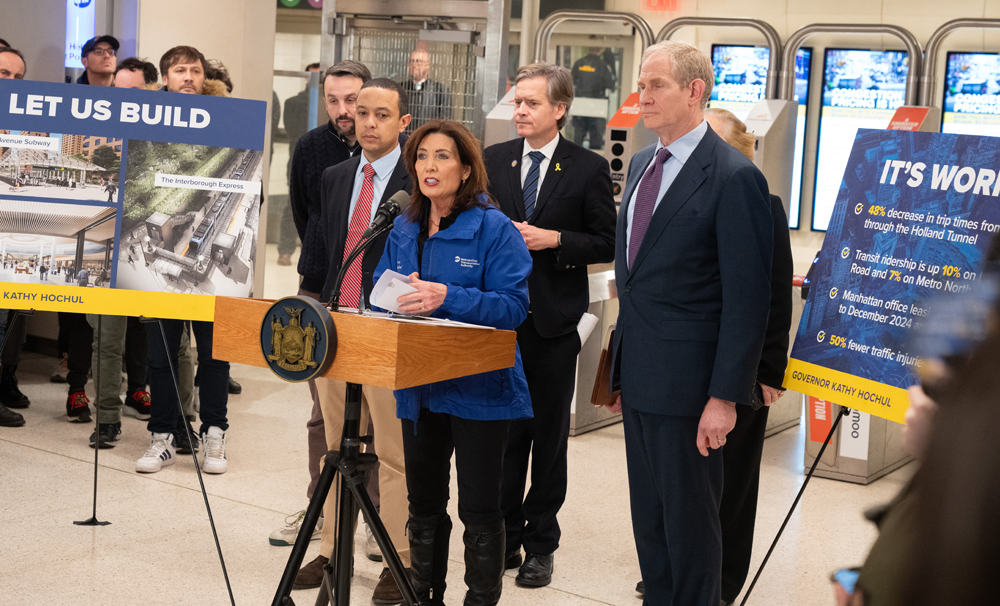
Woman at podium surrounded by several men
New York Gov. Kathy Hochel addresses the federal decision to withdraw approval for Manhattan congestion pricing on Feb. 19, 2025. Among those with her is MTA CEO Janno Lieber (right). Office of Gov. Kathy Hochul

NEW YORK — The Metropolitan Transportation Authority has quickly filed a lawsuit today in an effort to block federal government revocation of its permission for Manhattan’s congestion tolling program.

The move, announced by Transportation Secretary Sean Duffy, makes good on a campaign promise of President Donald Trump, who last year said he would end congestion pricing during his first week in office.

Duffy notified New York Gov. Kathy Hochul of the revocation in a letter today. Duffy’s letter notes that Congress created an exception to the general prohibition on tolls on federally funded roads in 1991, but says he has concluded the New York program does not qualify under that option because it does not allow a toll-free option, and because the program “appears to driven primarily by the need to raise revenue” for the MTA rather than to reduce congestion. Duffy did not immediately end the toll program or set a date to do so, saying the Federal Highway Administration would contact New York’s Department of Transportation “to discuss the orderly cessation of toll operations.”

Duffy was far more blunt in a press release, calling the program “a slap in the face to working class Americans and small business owners,” “backwards and unfair,” and that it “impedes the flow of commerce into New York by increasing tolls for trucks, which in turn could make goods more expensive for consumers.”

Trump, in a social media post, wrote, “Congestion pricing is dead. Manhattan, and all of New York is saved. Long live the king!’” That drew a sharp response in a statement from Hochul, who cited the program’s benefits and said, “We are a nation of laws, not ruled by a king. The MTA has initiated legal proceedings in the Southern District of New York to preserve this critical program. We’ll see you in court.”

She later addressed the situation in a webcast, saying “The commuters of our city and our region are now the roadkill on Donald Trump’s revenge tour against New York.”

MTA CEO Janno Lieber said in a statement that the agency’s filing is to “ensure that the highly successful program … will continue not withstanding this baseless effort to snatch [its] benefits away from the millions of mass transit users, pedestrians, and especially, the drivers who come to the Manhattan Central Business District.”

New Jersey Gov. Phil Murphy, who led a legal effort to block the New York plan and wrote Trump on his first day in office asking that it be killed, issued a statement thanking Trump and Duffy.

“While I have consistently expressed openness to a form of congestion pricing that meaningfully protects the environment and does not unfairly burden hardworking New Jersey commuters,” Murphy said, “the current program lines the MTA’s pockets at the expense of New Jerseyans.”

Hochul, in her webcast, noted Duffy had cited New Jersey’s opposition in his letter, and took exception to that fact: “Ignoring the will of the people who live here, their elected leaders in Albany, all of a sudden, the Trump Administration is citing, ‘New Jersey isn’t happy.’”

Congestion pricing was originally set to debut in June 2024, but was delayed by Hochul, who cited concerns over the cost. It was eventually revived in November with lower toll rates, and launched Jan. 5 following approval by the Federal Highway Administration [see “New York congestion pricing plan gets federal approval,” Trains News Wire, Nov. 23, 2024]. At the time, New York officials indicated they believed it would be more difficult to kill the program if it was already in place.

The program provides funding for MTA capital programs. The agency has released statistics from its early weeks of operations showing that subway, commuter rail, and bus ridership has increased, while traffic and travel times have decreased in the tolling zone [see “New York rail ridership up …,” News Wire, Jan. 30, 2025].

— Updated at 5:21 p.m. CT with additional information.