

WASHINGTON — The U.S. Department of Transportation’s rail-related spending — including billions of dollars in funding for Amtrak — appears to be affected by President Donald Trump’s order freezing spending on thousands of federal assistance programs.
However, the freeze itself is now on hold following a ruling from a federal judge staying the order while further litigation moves forward.
The Trump administration on Monday issued a vague, two-page memo ordering government agencies to temporarily suspend all federal assistance payments except for Social Security and Medicare. The administration today clarified that the freeze does not apply to any form of direct benefits to individuals.
Politico reported today that the Office of Management and Budget has asked federal agencies to provide information by Feb. 7 about programs and related spending through March 15. The pause in funding “will provide the Administration time to review agency programs and determine the best uses of the funding for those programs consistent with the law and the President’s priorities,” Monday’s memo says.
U.S. District Judge Loren AliKhan blocked the freeze today (Tuesday, Jan. 28) just minutes before it was to take effect, saying “there is the specter of irreparable harm.” The ruling — which does not address the legality of the freeze — places the stoppage on hold until Feb. 3 at 5 p.m. ET; disbursement of any congressionally appropriated funds cannot be suspended until then, Politico reports. The judge also set a hearing that morning for further arguments, NBC News reports.
The request for spending program information, detailed in a 52-page spreadsheet, asks DOT to identify and provide details about rail-related programs the agency currently funds – meaning the they potentially could be on the administration’s chopping block.
Among them:
- Grants to Amtrak that would fund the acquisition of new equipment and route expansion
- Capital assistance to states for intercity passenger rail service
- High speed rail corridors and intercity passenger rail service
- Federal state partnership for intercity passenger rail
- The Passenger Rail Investment and Improvement Act
- Consolidated Rail Infrastructure and Safety Improvements (CRISI) Program
- The Railroad Rehabilitation and Improvement Financing Program
- Grade crossing elimination programs
- Grants for railroad safety technology and research and development
- Rail line relocation programs
It also appears that the Treasury Department is being asked to provide information about the 45G tax credit that short line railroads rely on to fund track maintenance.
Representatives for Amtrak and the Federal Railroad Administration, which administers rail-related grant and loan programs, did not respond to requests for comment.
A spokesperson for the DOT, however, said the agency is working to supply the information the White House has requested. “The Department is and will continue to abide by existing statutory directives that require obligated disbursements while engaging in this review. Recently confirmed Secretary Sean Duffy has stated his intent to ensure taxpayer dollars are spent effectively and efficiently,” DOT said.
The Association of American Railroads noted the spending freeze does not apply to the Class I railroads’ annual capital maintenance programs. “As reminder, railroads privately fund the overwhelming majority of our infrastructure projects to the tune of more than $23 billion a year,” the AAR said in a statement. “Those investments will continue moving forward to enhance the safety and reliability of the national rail network regardless of the status of federal funding disbursements.”
The American Short Line and Regional Railroad Association says that while it’s unclear how the various spending programs will be judged, the CRISI and rail crossing elimination programs do not appear to be in conflict with the administration’s priorities.
For now, however, shortline funding programs appear to be on ice. “Short line project grantees are definitely affected, at least temporarily,” ASLRRA President Chuck Baker says.
It’s unclear how the programs will be reviewed, Baker says. Will CRISI and crossing elimination grants be judged at the program level or at the individual project level? “If every single project has to be reviewed and reconsidered, that could be a lengthy delay,” Baker says. “There are hundreds of projects just in those two programs, and spread across the whole government the number of projects would likely run well into the tens of thousands.”
Baker adds that he expects Duffy — who was confirmed this afternoon — to “approach this with considered common sense and get projects reviewed and approved quickly.”
“We do believe that it would be a bad precedent to set to allow a new administration to cancel or even unnecessarily delay projects that have already been selected by the previous administration under the statutory criteria at the time, as long as the grantee is keeping up its end of the bargain,” Baker says. “It’s one thing to change the criteria going forward or to make different types of selections in the next round than the previous administration would have made, that is their right and the expected consequence of an election. But to undo prior grants risks making the whole program less effective and predictable and that uncertainty would make building infrastructure more expensive.”
Trump’s funding freeze order, which is scheduled to go into effect at 5 p.m. Eastern today, has caused a stir in Washington.
Democrats are calling Trump’s order an illegal violation of Congress’s authority, and the attorneys general of several states plan to challenge the order in federal court. The judge’s ruling today placing the freeze on hold was in response to a group of nonprofit and public health groups that argued that it could have serious impacts on those relying on federal funds for services, as well as the workers who provide them.
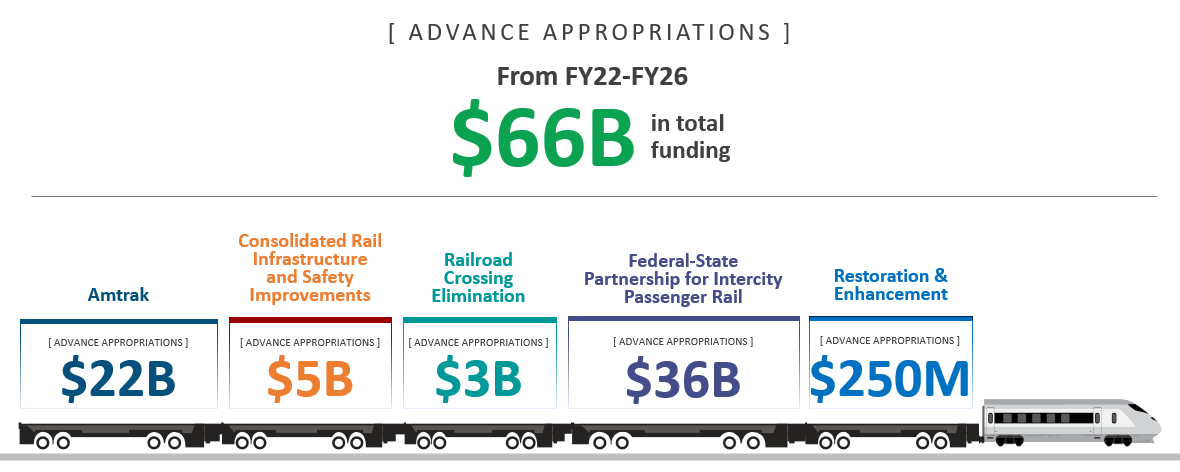
They argue that a 1974 law requires the executive branch to spend money that has been authorized by Congress and signed by the president. Programs that would fall into this category include funding authorized under President Biden’s Bipartisan Infrastructure Law – which included $66 billion in rail spending.
Included in that total through fiscal year 2026: $22 billion for Amtrak, $5 billion for CRISI grants, $3 billion for railroad crossing elimination, and $36 billion in federal-state passenger partnerships.
In a statement released on Tuesday afternoon, U.S. Rep. Rick Larsen, the ranking Democrat on the House Transportation & Infrastructure Committee, said, “I look forward to working with Secretary Duffy in a bipartisan fashion to stem the chaos created by recent Executive Orders, bring clarity to project sponsors and to guarantee completion of infrastructure projects across the country—protecting the jobs of hardworking women and men in transportation and keeping the recent historic investments in transportation going. Supporting safe and efficient mobility and opportunity for all should not be controversial.”
Note: Updated at 3:37 p.m. Central with comment from the Department of Transportation and U.S. Rep. Rick Larsen. Updated at 4:53 p.m. CT with judical ruling. Trains Senior Editor David Lassen contributed to this report.