Passenger Light Rail Toronto set to open long-delayed Eglinton Crosstown light rail line

Toronto set to open long-delayed Eglinton Crosstown light rail line

By David Lassen | February 7, 2026

Free rides, but no major ceremony, planned for Sunday’s first day of operation

Email Newsletter

Get the newest photos, videos, stories, and more from Trains.com brands. Sign-up for email today!

Black and white light rail trainset on track with construction work visible in background
An Eglington Crosstown trainset conducts testing on the  line set to open on Sunday, Feb. 8. Toronto Transit Commission

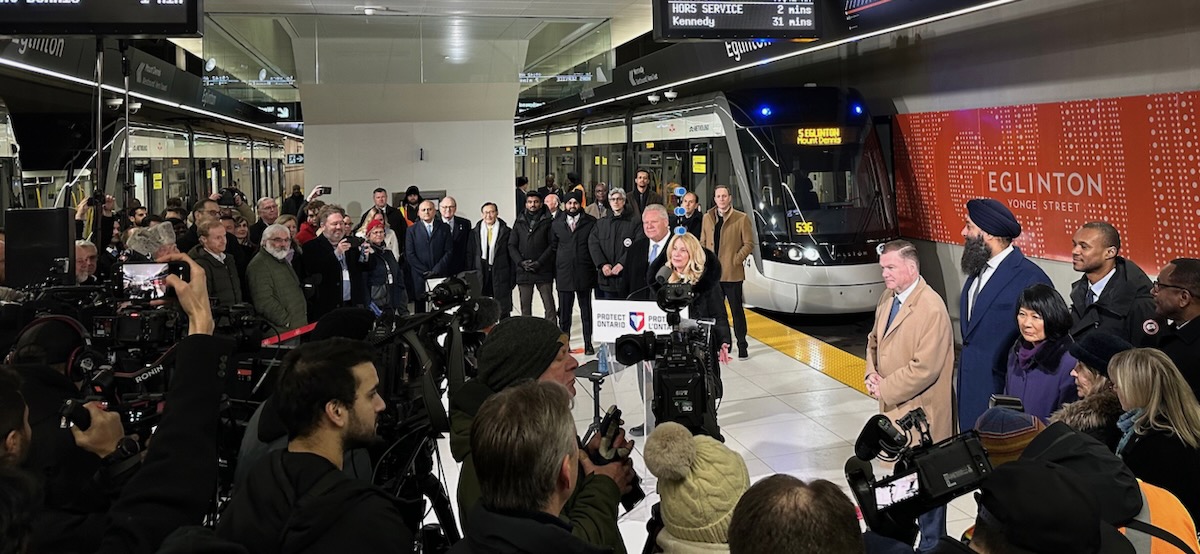
TORONTO — The Eglinton Crosstown, a long-delayed 25-station, 19-kilometer (11.8-mile) light rail line connecting east and west Toronto, is slated to open this Sunday, Feb. 8, following a press conference to mark the occasion on Friday, Feb. 6.

A phased “soft opening” of the route on Sunday will include free-first day rides. The Toronto Transit Commission says no event to mark the launch is planned, but a formal celebration will be held at a future date.

Initial service will see operations on weekdays from 5:30 a.m. to 11 p.m., Sundays from 7:30 a.m. to 11 p.m., and holidays from 5:30 a.m. to 11 p.m. Trains will initially operate every six to eight minutes, increasing to every 4 minutes and 45 seconds during peak periods. In six months, peak frequencies are set to increase to every 3 minutes and 30 seconds; eventually, hours will be extended to 1:30 a.m.

The service is projected to cut the end-to-end travel time along Eglinton Avenue to 50 to 55 minutes, compared to current bus service of 105 minutes or more.
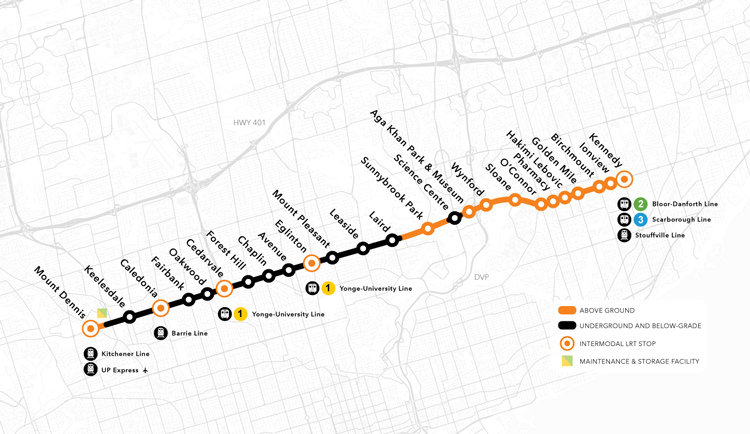
Map of Toronto light rail line.
The above-ground portion of the Eglinton Crosstown line is shown in orange; below-grade and underground is in black. Metrolinx

The route will open some six years late and more than 15 years after construction began. It will be far beyond the original estimate of Ca$4.6 billion and more than Ca$1 billion over the more recent budget, with the overall cost estimated at Ca$13 billion ($9.5 billion U.S.). That has led to some calls for a government inquiry into the project, but Ontario Premier Doug Ford said at Friday’s press conference that he plans no such action.

“I’m the first to come out and acknowledge the mistakes, but I’m not going to waste time on inquiry and all the nonsense,” Ford said in remarks reported by the Canadian Press. “It would be different if we didn’t acknowledge it. But yeah, has it been a nightmare for all of us? One hundred per cent. The good news is we’re moving.”

More than half of the line is underground. It will connect to 68 bus routes, three subway stations, and two GO Transit commuter rail lines. It opens as construction continues on a westward extension of an additional 9 kilometers (5.6 miles).

First-train departure times are available here. More information on the project is available here, at the website of provincial transit agency Metrolinx. More on its operation is here, at the Toronto Transit Commission website. The fact that Metrolinx handled construction and then handed the line over to the TTC is considered to be one factor in the construction issues.

— To report news or errors, contact trainsnewswire@firecrown.com.

4 thoughts on “Toronto set to open long-delayed Eglinton Crosstown light rail line

  1. In the 1950’s, Toronto could afford actual subways (as did New York, Boston, etc., way back when). Six or seven decades later, construction costs have skyrocketed, disabled access is now required, so we get light rail. It is what it is.

    People posting on these pages have made the case that all modes are subsidized – highways, commercial aviation. I respect those people, but even so I must point out the vast difference in accounting methods.

    When I buy a ticket on United Airlines, there may be a degree of tax subsidy, but by and large the air fare (added to the airport parking fees) includes capital costs. The control tower, the gate, the baggage claim, the hangar. the parking garage, the runway, the airport roadways, and of course the aircraft itself are pretty much covered by the combination of air fare and the cost of parking. And for all that, the net profit/ loss of companies like United Airlines, over the decade, stands at about zero.

    When I buy a ticket for any sort of train, capital improvements are completely off the books. In other words, no one even pretends that the bridges, the tunnels, the tracks, the stations, the layover yard, or the rolling stock, are covered in the ticket price. Rail can’t come close to covering its day-to-day O&M. If capital amortization were disclosed to the rail patron, you would see the true subsidy.

    So let’s circle back to Toronto’s new light rail. If the amortization billions of Canadian loonies of capital costs were disclosed to the patron, you would see what that train ride really costs.

    1. Dear Mr. Landey,
      Thank you for “respecting” those of us who do not agree with your mistaken viewpoint that “air fares (added to the airport parking fees) include capital costs”. I’m sorry you -drank the cool aid- served by the airline industry, resulting in your continued narrative of their delusional propaganda! Airlines DO NOT PAY for the construction, operation and maintenance of airports in the United States! Our airports are quasi-government entities known as Airport Authorities. They exist as independent organizations to build, operate and maintain large and small airports, and coordinate with local, state and federal governments to fund those tasks. Airport Authorities are essentially real estate developers and managers, as verified by my friends who work at a major Airport Authority, and who have explained its function and its financing.
      .
      Yes, airlines pay landing fees, rent ticket offices and rent baggage handling space from Airport Authorities. However, these rental payments are a VERY SMALL amount of revenue for the Airport Authority, compared to the hundreds of millions of dollars needed to build, operate and and maintain a single airport! Contrary to your misguided view, airline ticket sales DO NOT build airport terminals, or build control towers, or build parking lots, or build roads in, around or to/from airports. Airline ticket sales DO NOT build bridges, walkways or people movers at airports. Airline ticket sales DO NOT build the restaurants, bars, and other ancillary services used by passengers. Airline ticket sales DO NOT mow the grass, maintain the landscaping, pickup the trash, clean the restrooms or remove snow at airports. ALL of this is done by the Airport Authorities using money they get from Federal, State and Local TAXES, which are supplemented by the small amount of income generated by landing fees, office rentals and parking fees. Major airport construction projects are funded by the Federal Aviation Administration, the U. S. Department of Transportation and by State Departments of Transportation.
      .
      Long before airports existed, railroads built their own tracks, bridges, tunnels, freight terminals and passenger terminals, without help from Federal or State Governments, aside from land grants to spur westward development. When passenger trains were operated by the individual railroads, the cost of passenger operations were a part of doing business, along with freight operations. The same tracks, bridges, tunnels dispatching offices, signal systems, communication networks, etc., were used for both passenger and freight services. Their costs were covered by revenue generated from the company’s overall operations. Large passenger terminals, serving major railroads, were jointly funded by those individual railroads, usually as a separate Terminal Railroad to share the costs of operation.
      .
      It’s interesting to note that even today, major freight railroads annually announce their “capital budgets” in the billions of dollars, for track, bridge and tunnel repairs, expansions and upgrades. This is a cost of doing business. I haven’t seen an airline make an announcement about spending billions of dollars on airport construction or on the upgrade of the FAA Air Traffic Control System.
      .
      Only since the creation of Amtrak have Federal and State Governments opted to spend money on railroad infrastructure, such as the CREATE Project in Chicago, the Northeast Corridor, highway grade-crossing improvements and short-line refurbishments to maintain local rail traffic.
      This has only happened after the massive amount of federal and state money being spent on airport and highway construction and maintenance.
      Yes, airlines buy new airplanes and airlines modernize older airplanes, all with money earned from ticket sales. But airline tickets and parking fees DO NOT build, operate or maintain ANY airports in the United States, nor do those sales pay for the FAA Flight Control Network or TSA Security System, both of which costs billions of dollars each, funded by taxpayers. Please stop spreading delusional propaganda to the uninformed public!

    2. As an example of the Federal funding allocated toward airports, google the Feb 9, 2026 news story “$25 Million Secured for Yeager Airport Terminal Upgrades”.

You must login to submit a comment