San Jose-area transit agency officials question future of light rail

San Jose-area transit agency officials question future of light rail

By Trains Staff | February 25, 2022

| Last updated on August 6, 2025


Long-term outlook debated as need to replace equipment fleet approaches

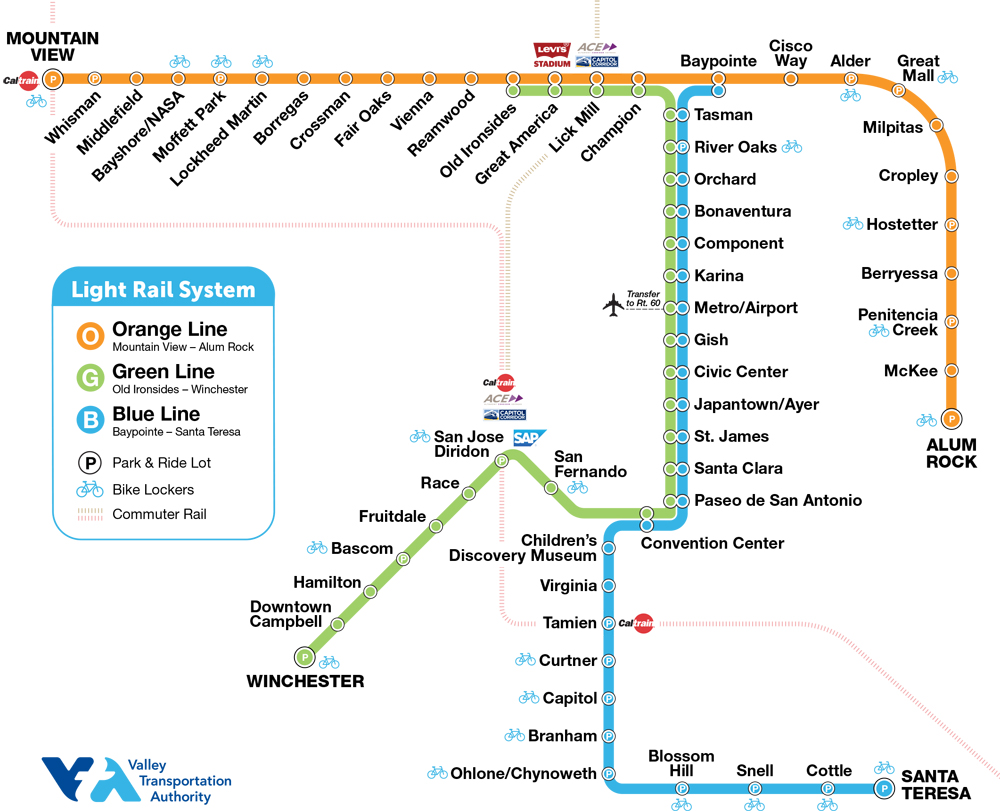
Map of Santa Clara Valley Transportation Authority light rail system
The Santa Clara Valley Transportation Authority light rail system. Some VTA board members are questioning the future of the agency’s light rail operation. Santa Clara VTA

SAN JOSE, Calif. — As it approaches the point of needing to order replacements for its light-rail vehicle fleet, the transit agency serving the San Jose area is considering a more existential question: whether its light rail system even has a future.

The San Jose Spotlight reports that at a recent meeting of the Santa Clara Valley Transportation Authority board of directors, board members discussed the agency’s issues with high operating costs and low ridership for the light rail system, with San Jose Mayor Sam Liccardo asking “Are we riding the right horse here? … I think we need to ask bigger questions because marginal improvements aren’t going to change this picture at all.”

Data developed by an agency planner shows VTA has the highest operating costs per revenue in the nation, and that light rail costs three times as much as a bus to operate, while most agencies see a ratio closer to two to one, and that the agency has the nation’s highest cost for parts and materials.

At the same time, replacing the entire 81-track-mile, 42.2-route-mile light rail system with bus routes would take 60 years to provide a return on investment because of the initial cost of replacing track with concrete. A better option may be operating more one-car trains and shortening their periods in service which would extend their lifespan, planner Jason Kim said.

At the current rate of use, VTA will face replacing its its fleet of 100 Kinki Sharyo light rail vehicles in three ot seven years.

Some board members noted light-rail ridership could be helped by the Caltrain electrificiation project, which aims to increase commuter-rail frequency, and the extension of BART into San Jose, where it will connect with light rail. The BART extension, however, may not be complete until 2034 [see “News report: FTA says BART extension to San Jose likely to be delayed by years,” Trains News Wire, Feb. 21, 2022].

And other board members said the agency needed to communicate with the cities it serves before making other changes, with board member Glenn Hendricks of Sunnyvale, Calif., noting that city is considering a 20,000-home development near light rail. “I would hate to be in a spot where Sunnyvale’s planning for a lot of housing near light rail and then all of a sudden light rail service is not what we thought it was going to be,” Hendricks said.

Share this article