Why closing an East River tunnel causes Penn Station congestion headaches: Analysis

Why closing an East River tunnel causes Penn Station congestion headaches: Analysis

By Bob Johnston | May 30, 2025

| Last updated on August 6, 2025


Schematic diagram of tracks at New York's Penn Station, and the tubes of the East River tunnel to which they connect
A schematic diagram shows the tracks at New York’s Penn Station, and the tubes of the East River Tunnel those tracks can access. Walter Peters

NEW YORK — Lost in the debate between Amtrak, New York Gov. Kathy Hochul, and transportation advocates over the plans to close Amtrak’s East River tunnel for repairs — and the resulting service reductions, especially for Empire Service trains to and from Albany-Rensselaer, N. Y. — are the limited track routing options that exist between Penn Station platforms and the tunnels that feed trains to them.

As depicted in the schematic diagram above, developed by retired Amtrak operations strategist Walter Peters, not all tracks have access to all East River tunnels. The numbers on the right side of the diagram of  each of Penn Station’s 21 tracks show which tunnel that track can access via a series of ladder tracks east of the station. Deterioration caused by Hurricane Sandy’s saltwater intrusion in 2012 has prompted the company to close and rehabilitate the “Line 2” tunnel first.

On the east end

If all tubes were available to serve every track, closing Line 2 would be less of an issue. But only three tracks have such all-tube access.

Line 2 typically hosts westbound through trains from Boston or Springfield, Mass., and deadhead Amtrak and NJ Transit equipment moves from Sunnyside Yard in Queens. But Line 4, the other westbound tunnel route, can only feed trains to tracks 14 through 21. The only direct East River tunnel option for tracks 5 through 13 is Line 1, normally handling only eastbound traffic. With Line 2 closed and Line 1 handling trains for those tracks in both directions, trains must now wait for opposing traffic, which is not normally the case. The result is a reduction in the total number of trains tracks 5-13 can handle in any given hour.

Photograph of track diagram in dispatching center
The track configuration at the east end of Penn Station platforms has ladder tracks connecting East River Tunnel Lines 3 and 4 to platform tracks 14 through 21 (top left) but not 5 through 13. Tunnel Lines 1 and 2 only serve tracks 5 through 16 (middle). If Line 2 is out of service, moves involving track 5-13 in both directions must utilize Line 1. The lower right part of the photo, taken during an afternoon rush hour, shows a westbound train utilizing Line 2 is close to crossing Line 3 to get to the lower numbered tracks as another train continues east on Line 1. Bob Johnston

The image above, photographed in 2008 at Penn Station Central Control for a Trains feature on station operations [“Penn Station: How do they do it?,” January 2010], shows how platform and tunnel tracks are linked. The lower part of the photo also depicts how  westbound Line 2 crosses eastbound Line 3, so that trains from both parts of the station wind up facing the same direction east of the river. This further complicates “wrong way” moves on Line 1 at Sunnyside and through Harold Interlocking.

Given this track plan and the fact that Long Island Railroad trains lay over between rush hours in the Hudson Yards west of the station, most LIRR trains use the high-numbered tracks.

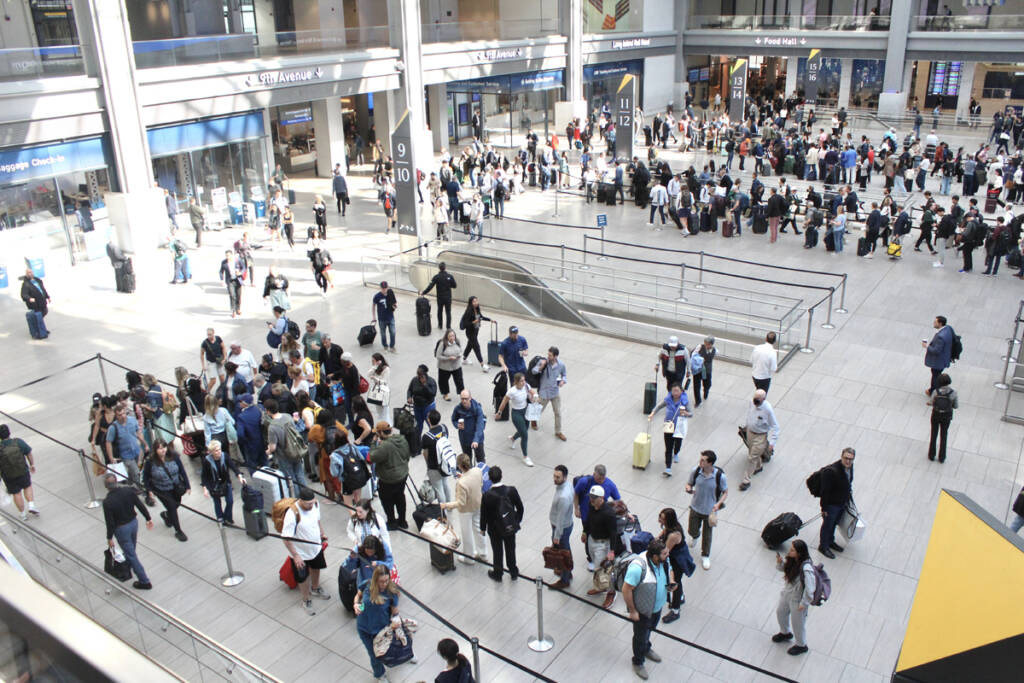
People in station waiting room lined up to board trains
Passengers in the foreground at Penn Station’s Moynihan Train Hall are lining up to board an Empire Service train on the track 7-8 platform on May 8, 2025. Those trains only have a direct path to tracks 1 through 9. In the distance, separate boarding lines have formed at platforms serving tracks 11-12 and 13-14, where Washington-Boston Acelas traveling in opposite directions will be stopping. Putting a Washington-bound Acela on track 14 means it can utilize Line 4 from Boston. Note that the higher numbered tracks, which primarily handle Long Island trains, do not have Moynihan Train Hall entrances. Bob Johnston

On the west end

A compounding challenge for Empire Service trains and the Lake Shore Limited is that they enter the station south of the twin Hudson River tunnels. Limited space for ladder tracks means they can only make direct moves to tracks 1 through 9. Of these, only tracks 5 through 9 connect to the East River Tunnel Lines 1 and 2. Tracks 1 through 4 can accommodate push-pull Amtrak Keystone and NJ Transit trains able to forego servicing at Sunnyside. The push-pull Empire Service trains can also use these tracks. With Line 2 out of service for an extended period, this puts a severe track-capacity strain on Penn Station’s ability to handle a full schedule.

Trains to and from New Jersey have access to any track; the fact that Long Island’s West Side Yard equipment moves have a direct path to the higher-numbered tracks means there is seldom any interference with through Amtrak trains. Track capacity varies from eight cars (tracks 1 through 3) to 17 cars (tracks 11-12). Tracks without direct tunnel connections can be utilized, but this involves tying up ladders at either the east or west end of the station for train repositioning, further adding to congestion and delays.

Photograph of dispatcher's track diagram at Penn Station
Trains from the Empire Connection route from Albany enter the Penn Station complex on the lower left, as seen in this Aug. 10, 2009 track diagram photo. Given the limited space between the tunnel’s entrance and the platforms, trains can just access tracks 1 through 9. Only tracks 5 through 9, however, have East River tunnel access; stub tracks 1 through 4 have no eastern connection. The layout is designed so that the twin Hudson River tunnels (middle, left) are linked to all tracks. The separate upper left track diagram shows New Jersey Transit’s Secaucus Junction station. Bob Johnston

Some of these details may have changed because of platform and track construction since a detailed Trains analysis was completed in 2009, but Penn Station’s basic layout has not. If no significant changes are made to expand trackage and switching options, the value of NJ Transit-Long Island Rail Road run-through trains is questionable in light of existing constraints. Such run-through operation is frequently cited by advocates as a way for Penn to handle more traffic without a major track expansion project [see “‘Through running’ concept not enough …,” Trains News Wire, Aug. 6, 2024]

With these constraints, it’s understandable why Amtrak management opted to reduce Empire Service arrivals and departures, and to convert many of those trains to push-pull operation. Still not satisfactorily explained, however, is why timings for the Montreal-bound Adirondack and eastbound Maple Leaf from Toronto couldn’t have been adjusted. Those trains are now combined between Albany-Rensselaer and Penn Station, leading to layovers exceeding 90 minutes for the northbound Adirondack and the southbound Maple Leaf. Given that the tunnel rehabilitation is slated to continue into 2027, there is still time to come up with better solutions.

Share this article