





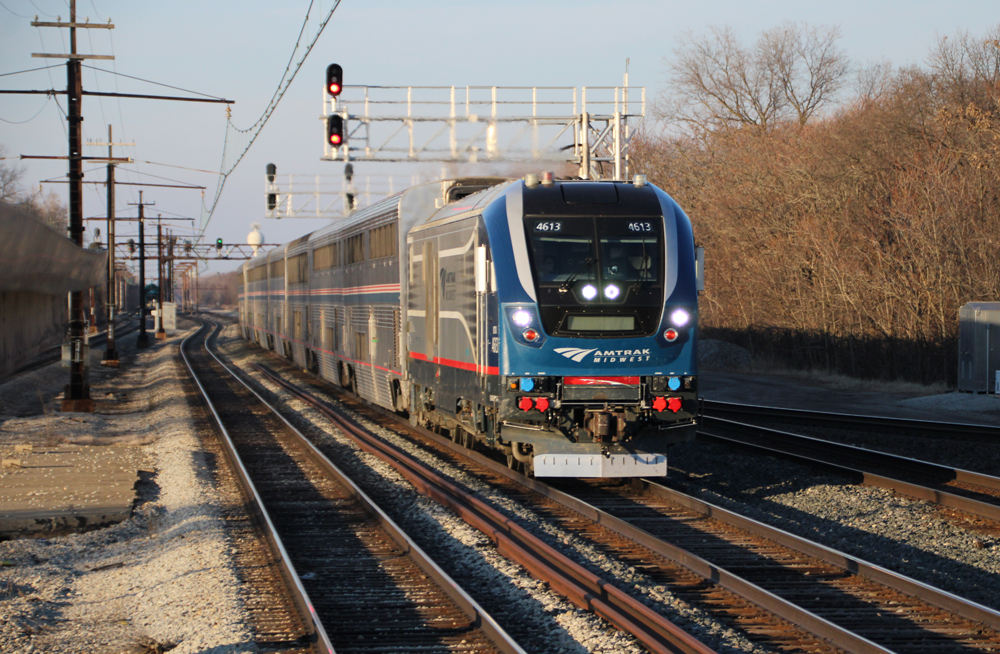
SPRINGFIELD, Ill. — A bill introduced in the Illinois legislature would establish “aspirational service frequencies” of every four hours or less on 18 regional or long-distance passenger routes radiating from Chicago.
HB4279, the Passenger Rail Planning Act, was introduced in January by state Reps. Rita Mayfield (D-Waukegan) and Kam Buckner (D-Chicago). It does not include funding for expanded service or infrastructure, but seeks to define the plan for more frequent operations.
Among other aspects, the bill also require the state’s Department of Transportation to detail progress toward those goals when it updates state rail and transportation improvement plans, and gives the DOT the ability to nominate corridors for the Federal Railroad Administration’s Corridor Identification and Development Program.
“This isn’t about bringing us forward,” Mayfield told the Our Quad Cities news site. “It’s about bringing us back to where we were. Passenger rail used to be the centerpiece for transportation across the country, and it’s time we recognized the importance and dependability once again.”
The bill calls for hourly service between 5 a.m. and 10 p.m. on 11 routes including Chicago-Milwaukee, Chicago-St. Louis-Kansas City, Chicago-Rockford, and Chicago-Champaign, as well as such long-distance routes as Chicago-Detroit-Toronto and Chicago-Indianapolis-Cincinnati. It calls for every-two-hour service on three other routes, including Chicago-Moline and Chicago-Peoria, and every-four-hour operations on four more lines.
The full text of the bill is available here. It is currently assigned to the House Transportation Committee.
— To report news or errors, contact trainsnewswire@firecrown.com.
Share this article
Dream on!
This bill, and legislators such as the two who introduced it, are a significant part of why I moved out of Illinois.
I don’t think the freight railroads have capacity for this level of service, even if they wanted to provide it.
Only the Northshore line had hourly service Milw.-Chicago w/a combination of local & express runs, i.e. “Electroliners.” The Milw. Rd. and CNW had more staggered schedules, again w/a mix of non-stops and locals. The Hiawathas ran 65 minutes for the 85 miles start to stop.
Rep. Mayfield says we are going back to what it was. I’m not sure any of those routes ever had hourly service in their full lengths.
Cost???? Would building fast reliable passenger rail corridors around the country be any more expensive than the $26 BILLION for the new advanced air traffic control system is “estimated” to cost? How about as expensive as the $200 BILLION & growing HTF debt that is being siphoned from general fund of the U.S. Treasury (taxpayers). Add all that to Trumps BBB which contains a $3.5 BILLION handout each year for the next four years to oil companies on top of additional tax breaks for oil companies also added in the bill. I’m so tired of this right wing parroting on this site that spending taxpayer dollars on aviation & highways is an “Investment” but any similar spending on passenger rail or transit is a “Subsidy” we can’t afford. If we don’t have the money for one mode we don’t have money for any of them!
Back from a week in Switzerland… hourly service or even more frequent EVERYWHERE. 99% electrified. Clean trains inside and out. Reasonable fares. Post busses to rural communities. Great light rail and bus transit in urban areas. Very little over the road trucking as a policy.
Instead, the US and Canada have a few crap trains, generally filthy. Lousey bus service. Highways choked with semis. Everything high cost. Air traffic system is junk compared with East Asia or Gulf carriers.
Government ownership works will in countries that aren’t run by corrupt kleptomaniac politicians and Wall Street vultures.
This is only for a planning study. Isn’t this corridor idea what is suppose to be the concept of what a successful & competitive passenger rail system entails? Yes, we don’t have the money but that hasn’t’ stop them (hwy builders/planners) from building & expanding more roads with outdated plans that were developed before Covid drastically changed travel patterns. We don’t have the money for the new air traffic control system ($26 BILLION) they plan to install. Did the Govt cover the cost of the freight RR’s with the mandated unfunded PTC? NO. If we don’t have money for one we don’t have the money for any of these projects. But I know American are very myopic about their needs which are always seen as more legitimate.
Galen, if highway counts are going down, so are commuter rail counts.
A road could shrink as much traffic as a parallel railroad has, and no one would notice.
Freeways are rebuilt not for increased traffic, but because they are unsafe, worn out, and can no longer be maintained. FHWA hasn’t funded increased highway capacity for decades.
Paying off CPKC for one more train pair CHI-MKA-MKE has cost real money and many years, resulting (if the new train pair even happens) in well short of hourly schedules. How much would five more train pairs cost? Now, compare CPKC’s main CHI-MKA-MKE with the other, less favorable, routes such as Chicago to Detroit to Toronto. Chicago to Detroit to Toronto has one choke point after another after another. Starting with Chicago Union Station which is already pretty much maxxed out on the south concourse.
I’m always taken aback by the anti-passenger rail growth bias expressed on a supposed railfan site. This proposal may be ambitious, but it’s a step in the right direction.
THOMAS – The late president John F. Kennedy said, optimistically, “A journey of a thousand miles begins with a single step.” To wish I say, “A journey of a thousand miles begins with the wherewithal to go a thousand miles.”
THOMAS and GREGG – Yes, we’ve all been on train routes than run hourly and run well. Some of us in Switzerland. Some of us in Netherlands. Some of us in England. Some of us on METRA BNSF. (I’ve done three of those four.) You walk to the next station, no timetable, you just wait for the next train. Transportation Heaven on Earth.
Go to Blue Water, which is Port Huron in Michigan, Sarnia in Ontario. One train on the US side, two trains on the Canada side, no international trains through the CNR tunnel linking the two nations, haven’t been for years.
Go to the Detroit River – Detroit in Michigan, Windsor in Ontario. A single-track railroad west toward Chicago on the Michigan side. The Essex Terminal Railway on the Canadian side. This isn’t Switzerland. A long way to go for hourly service.
This is either crazy or profoundly significant (I can’t say which immediately). Illinois is currently in the forefront of medium-range rail service (Chicago to St. Louis, Quincy, Carbondale)–to the consternation of many if most Illinois taxpayers, of course–and this will hopefully bring the experiment to an end, one way or the other.
What nonsense. How can anyone vote for this tripe? Let TRAINS MAG readers know when you come up with the money.
These people are embarrassing.
One of these routes is currently tri-weekly. Some of these routes currently have no trains at all. Wish and hope for hourly service.
If wishing and hoping did any good in the Illinois legislature, they could wish and hope for no murders in Chicago, fully funded public sector pensions statewide, the Obama monument in Chicago actually paid for with private donations as the politicians claim instead of a billion dollars hidden taxpayer subsidy, and all schoolchildren in Chicago learning how to read and write at grade level.