Passenger Intercity Houston-New York service gets highest ranking in FRA long-distance report

Houston-New York service gets highest ranking in FRA long-distance report

By David Lassen | January 21, 2025

| Last updated on August 6, 2025


Final report ranks 15 routes by complexity in launching, public benefits, operating costs, but says ranking is not for prioritizing funding

Email Newsletter

Get the newest photos, videos, stories, and more from Trains.com brands. Sign-up for email today!

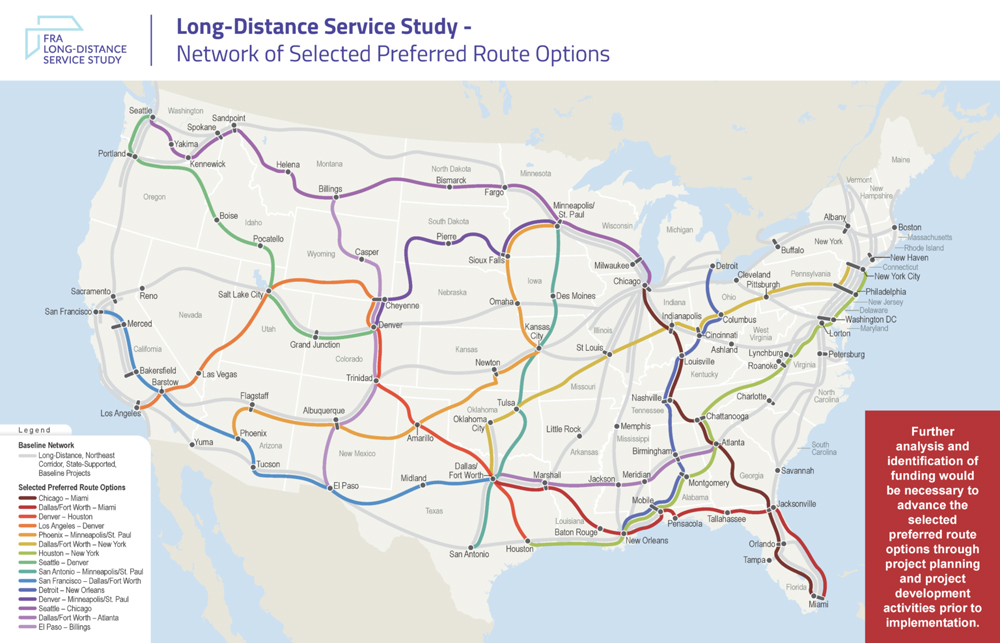
Map showing 15 proposed long-distance routes from FRA study
Fifteen routes have been identified as “preferred options” in the FRA Long-Distance Service Study. Existing route are in gray. Federal Railroad Administration

WASHINGTON — A Houston-New York route received the highest preliminary ranking in the Federal Railroad Administration’s newly released Long-Distance Service Study final report, which considers 15 previously identified routes for new or restored Amtrak service.

However, the report says the rankings “do not reflect prioritization for implementation funding,” but may “provide guidance on future priorities for the next phase of project planning.”

Chicago-Miami, Dallas/Fort Worth-New York, Detroit-New Orleans, and Phoenix-Minneapolis-St. Paul received the next highest rankings. In a separate section, the report also recommends expanding the currently triweekly Cardinal and Sunset Limited to daily service.

The 15 routes had been identified in a preliminary report issued last June [see “FRA long-distance study seeks to quantify …,” Trains News Wire, June 21, 2024]. They are ranked according to three factors, which are weighed in importance based on stakeholder input:

— Level of complexity in implementing a route, based on railroad use and some, but not all, capital project requirements (40%)

— Level of public benefits from the route (50%)

— Estimated operating cost (10%).

The highest possible ranking under this system is 15 points, while the lowest is three. The resulting rankings for the preferred routes:

— Houston-New York, 14 points;

— Chicago-Miami, 11;

— Dallas/Fort Worth-New York, 10;

— Detroit-New Orleans, 10;

— Phoenix-Minneapolis/St. Paul, 10;

— Denver-Houston, 9;

— Dallas/Fort Worth-Atlanta, 8;

— Dallas/Fort Worth-Miami, 8;

— Denver-Minneapolis/St. Paul, 8;

— Los Angeles-Denver, 8;

— San Antonio-Minneapolis/St. Paul, 8;

— Seattle-Denver, 7;

— El Paso-Billings, 6.

The Seattle-Chicago North Coast Hiawatha route, along with daily Cardinal and Sunset Limited service, were not considered because of their selection last year in the FRA’s Corridor Identification and Development Program.

As in the earlier preliminary report, the 133-page final document offers a range of estimated startup costs for each route, including equipment needs, station and maintenance facility costs, and estimated infrastructure improvements; those figures include a 35% contingency to address “unknown factors such as site conditions, environmental conditions, and other factors. More planning and analysis would be required for further development and refinement of accurate total cost estimates.”

Those preliminary estimates are considerable. The Denver-Twin Cities route alone, which includes a substantial segment in South Dakota where track would require significant upgrades, is estimated to cost up to $5.83 billion for infrastructure improvements, more than the next two most expensive routes combined. Overall, the costs range from $9.29 billion to $12.02 for rolling stock; $17.15 billion to $23.96 billion for stations and maintenance facility costs; and $17.95 billion to $23.05 billion for infrastructure. The total cost for the entire package: $44.39 billion to $59.03 billion.

The report says the 15 routes would add 23,200 route-miles, serve an additional 39 million people, and increase the number of possible city pairs served by long-distance trains by 157,600 pairs, or 87%. Some 32,000 city pairs would receive more direct service.

A document accompanying the report calls it “a crucial early step in a comprehensive process” to expand service. It notes that there is currently no sustained financial report or program to advance the selected routes, although some may be eligible for additional planning funds through the Corridor ID program.

Congress ordered the FRA study as part of the Infrastructure Investment and Jobs Act of 2021, and called for specific attention to routes discontinued since Amtrak’s launch in 1971. Eleven of the 15 routes would at least partially restore service that has been discontinued.

Map showing discontinued routes that would regain service from the FRA's preferred routes.
Highlighted lines represent discontinued Amtrak routes that would regain service through the FRA’s preferred route options. FRA