

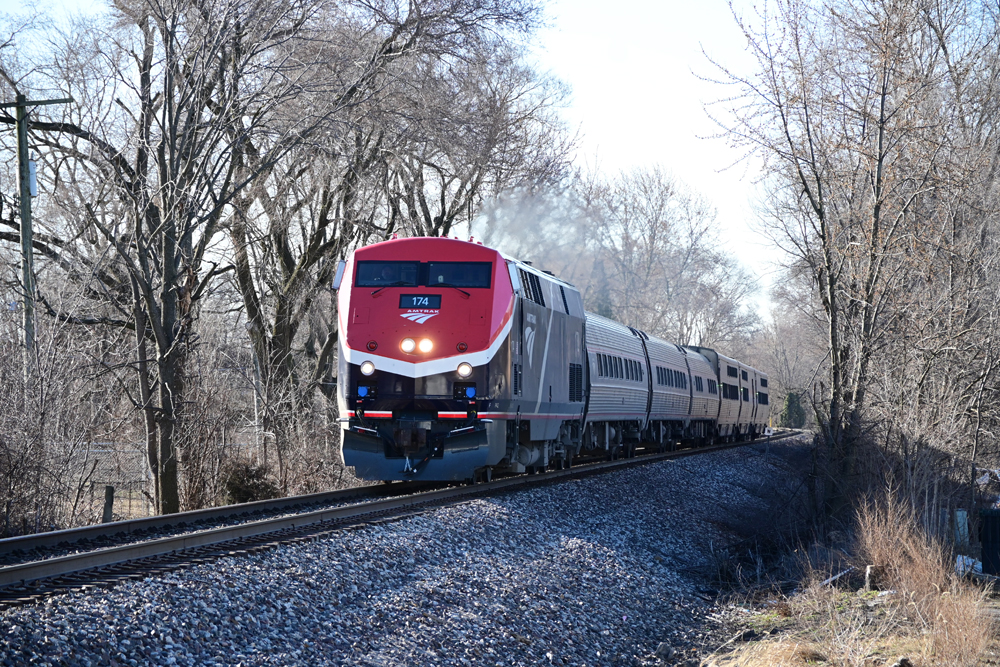
WASHINGTON — There is a lot to unpack in the Federal Railroad Administration’s latest long-distance route update, as discussed at six regional meetings held between June 4-13, 2024.
These were the fourth round of meetings in a planning exercise mandated by a provision of the Infrastructure Investment and Jobs Act of 2021. The latest report ambitiously attempts to move from theoretical lines on a map to practical considerations by developing “conceptual schedules” and categories of costs for 15 routes selected at the last round of workshops [see “FRA releases long-distance study interim report …,” Trains News Wire, Feb. 19, 2024]. A “final” report is to be delivered to Congress later this year; no funding is currently committed to act on the report’s findings.
Costs and benefits
The schedules for once-a-day service are designed to serve the largest population at projected intermediate stations during daylight hours while taking into account arrival and departure times at end points. No actual schedules appear, only ballpark estimates such as “early morning” or “late afternoon,” and schematic maps showing if a stop occurs at night.
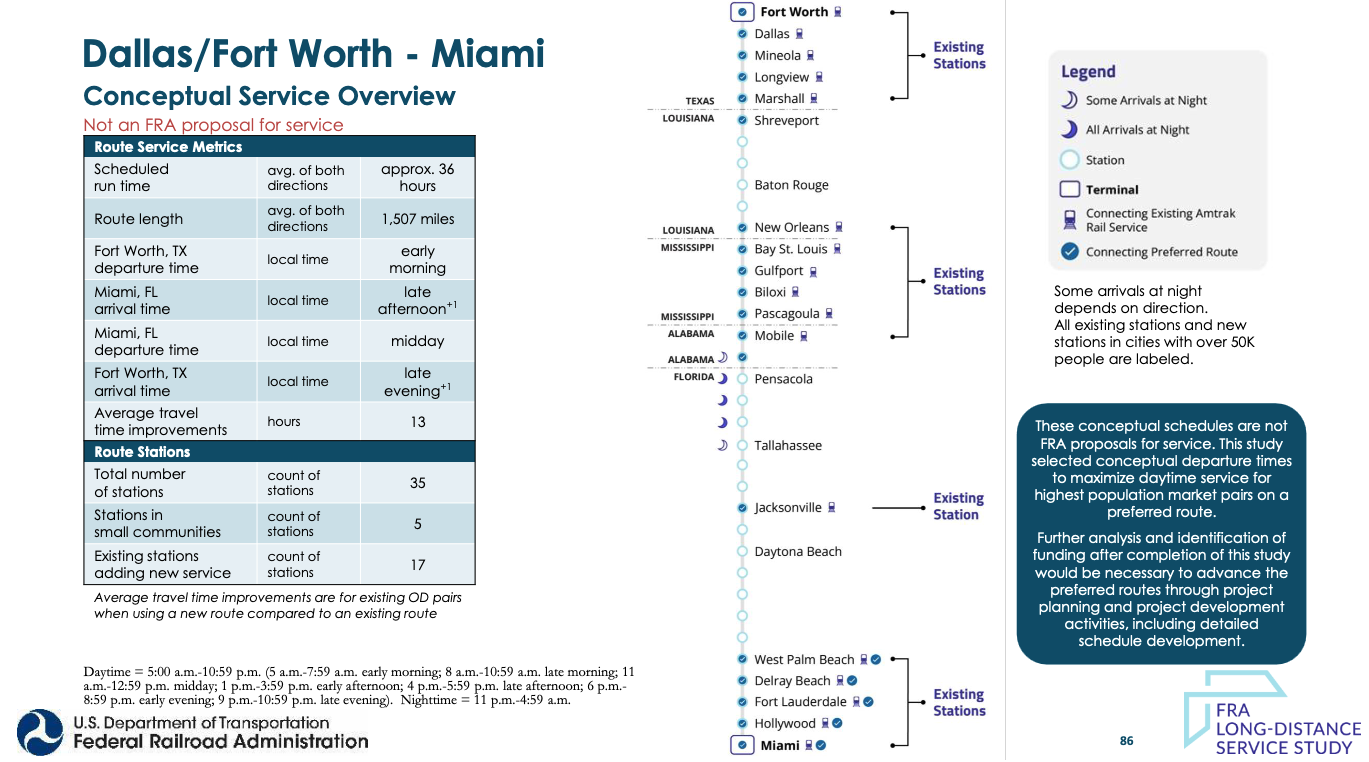
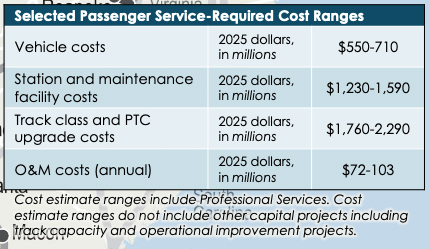
Based on those timings, start-up costs are estimated for each route. These include:
— Cost of upgrading all track to at least Class 4 (79 mph) standards.
— Positive train control installation expense, as needed on segments without PTC.
— Cost of establishing stations and terminals where none currently exist.
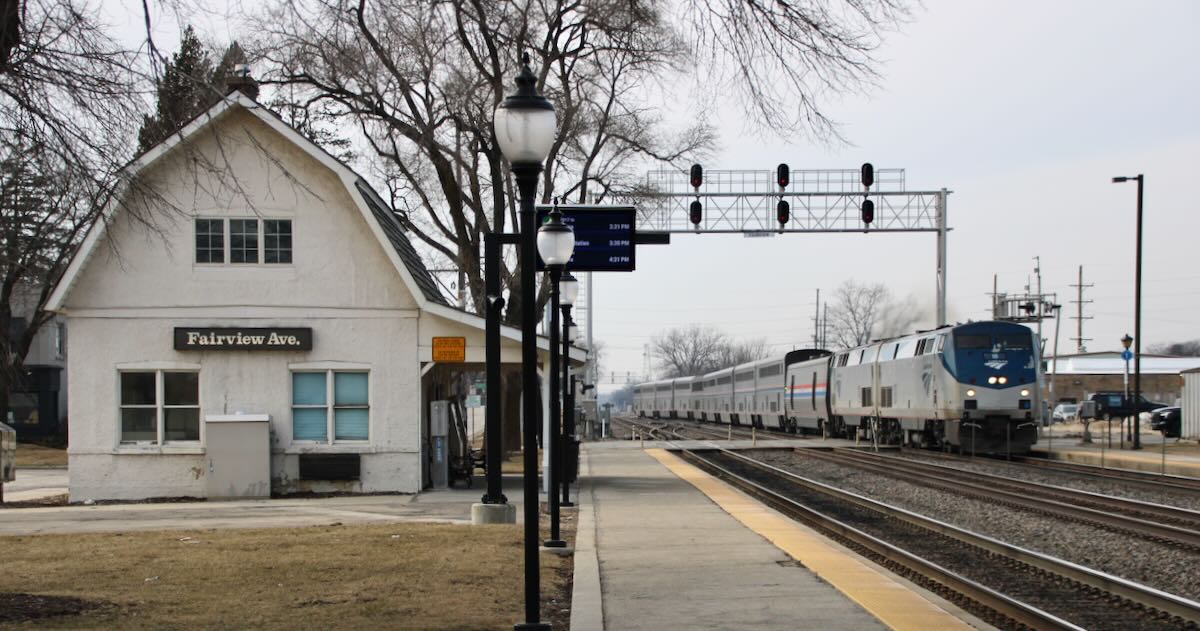
— Vehicle cost, the estimated cost of additional equipment needed to operate the service. Multi-level Superliners are projected to be used on all routes except two from Texas destined for New York City.
Annual operating and servicing expense is also estimated by route.
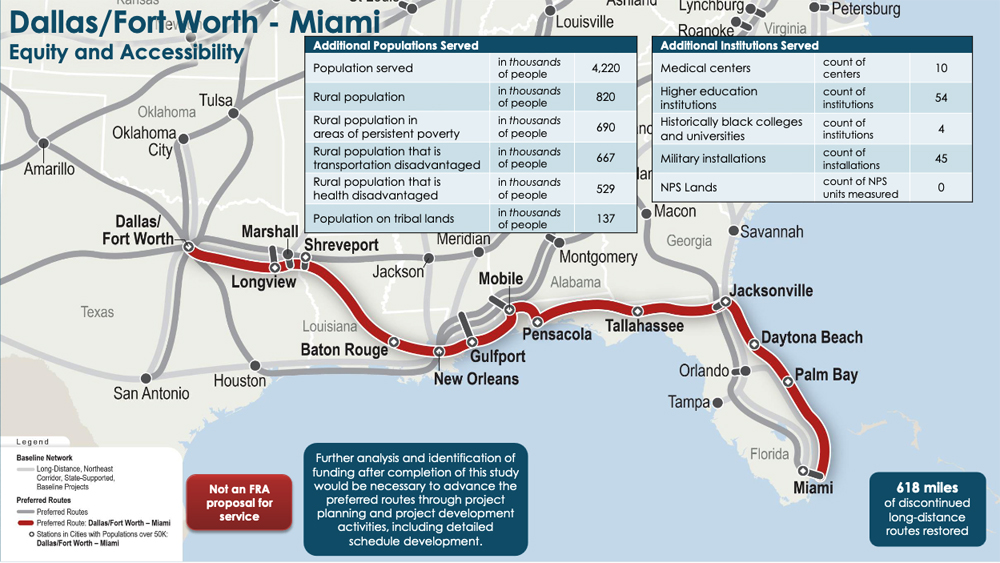
Additionally, public benefits are listed. These include rural population; the number of medical centers, universities, and military installations served; and job creation attributable to the launch of service. No attempt is made to estimate potential ridership and revenue. Those numbers are almost impossible to project because they would depend to a large extent on connectivity to other routes.
Decision factors
Any quantification attempt of this nature must necessarily rely on equally-applied yardsticks, so each route can be evaluated utilizing standardized criteria.
However, some “one size fits all” assumptions appear to miss the mark, such as assuming all trains will operate with one dining car, a lounge, three sleeping cars, and at least three coaches; “two-night” trains would warrant a fourth coach and a transition sleeper. The only Superliner-equipped Amtrak trains (aside from Auto Train) that currently — or have ever — regularly operated with consists of this size are the Empire Builder, Coast Starlight, and the California Zephyr.
To be sure, the current Amtrak long-distance network suffers from insufficient capacity; even in peak season, the Cardinal carries only two Amfleet II coaches, one Viewliner sleeper, and one Viewliner II baggage-dorm. Certain segments of the train are always sold out, stunting its usefulness and relevance to the communities it serves.
But even assuming the company will be able to acquire the necessary multi-level rolling stock, adding more cars to a route whose ridership wouldn’t require them unnecessarily inflates costs. Building equipment expense into the equation is necessary, but it was one of the factors in a 2009 report Amtrak presented to Congress that killed restoration of the Sunset Limited east of New Orleans after its Hurricane Katrina-induced suspension. (Equipment for new routes will not be addressed by the complicated Request for Proposals currently awaiting responses from Siemens and Alstom; that is designed only to re-equip current operations.)
Setting priorities
The report’s extensive data sets the stage for prioritizing the routes under consideration, which may or may not be a part of the final report. Adding together an average of each route’s costs for stations, track and signaling, and equipment, Fort Worth-Atlanta via Shreveport, La., and Meridian, Miss., is the cheapest route to implement. This is primarily because it is the shortest (855 miles) and can serve many existing stations currently served by the Texas Eagle, City of New Orleans, and Crescent.
The service modeled, though, is not an extension of the Crescent, which has already been studied enough by Amtrak, the Southern Rail Commission, and the I-20 Corridor Council for those entities and cities along the route to have applied for several federal grants. Instead, the proposed overnight train evaluated here arrives in Atlanta in the morning and departs for Fort Worth in the evening. Running another round trip that would include a Crescent appendage, if money could be found to do that, would give travelers two daily options at stations from Fort Worth to Marshall, Tex., and from Meridian to Atlanta, on nearly 500 miles, or 58% of the route.
At this stage, the report makes no judgment about which routes have the most potential to be implemented. Yet the highest priority has to be elevating the Sunset Limited and Cardinal from tri-weekly to daily status, because the stations and crews are already there and the trains suffer financially from three days of revenue spread across seven days of route costs.
Not studied is an Amtrak plan from 2010 to make the Texas Eagle a daily Chicago-Los Angeles train with a separate New Orleans-San Antonio connection that, as proposed at the time, could have been accomplished with existing Superliner equipment instead of requiring four additional trainsets.
Another dilemma: the fate of prime population centers Amtrak no longer serves like Las Vegas, Nev., Nashville, Tenn., and Columbus, Ohio, are tethered to routes with possible built-in challenges. Columbus is on Detroit-New Orleans and Dallas-New York City routes that would need significant track and signal upgrades nowhere near the Ohio state capital. Nashville, on a key Chicago-Miami route, could be victimized by the thorny issues of finding a suitable station site in Chattanooga, Tenn., and an agreeable Atlanta-Jacksonville, Fla., host railroad.
Key disclaimers like this frequently appear: “Further analysis and funding after completion of this study would be necessary to advance daily Cardinal service through project development activities, including fleet procurement.” Every table notes, in bold lettering on a red background, “Not an FRA proposal for service,” lest any of them are published somewhere without the proper context presented in the entire report.
The latest long-distance study has graduated from “wish list” status by putting numbers against challenges that must be accounted for. The final report promises “preferred route options” that hopefully will also address the financial and political realities necessarily in play with each alternative.
Share this article