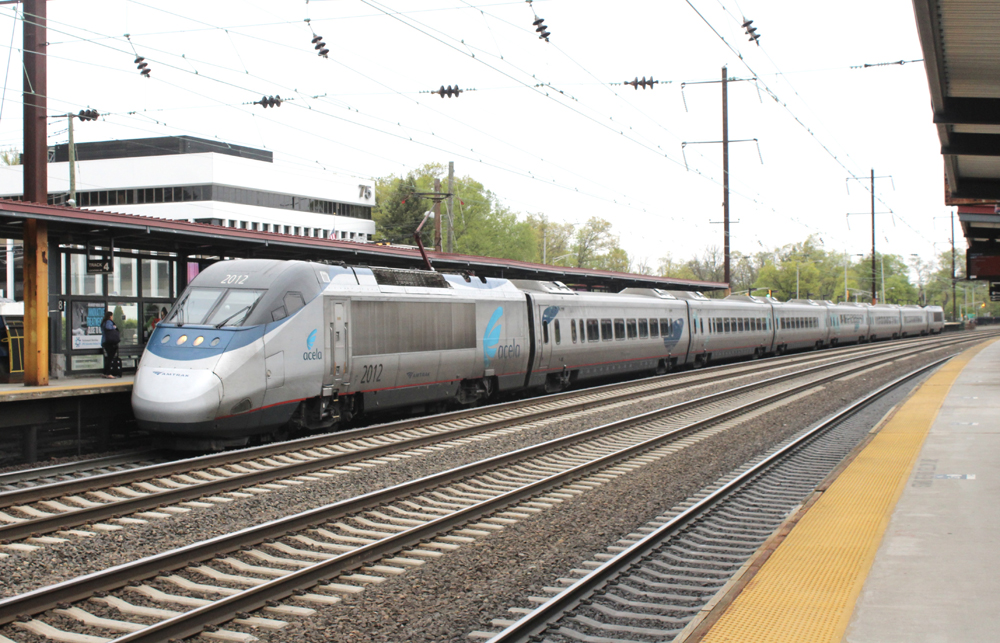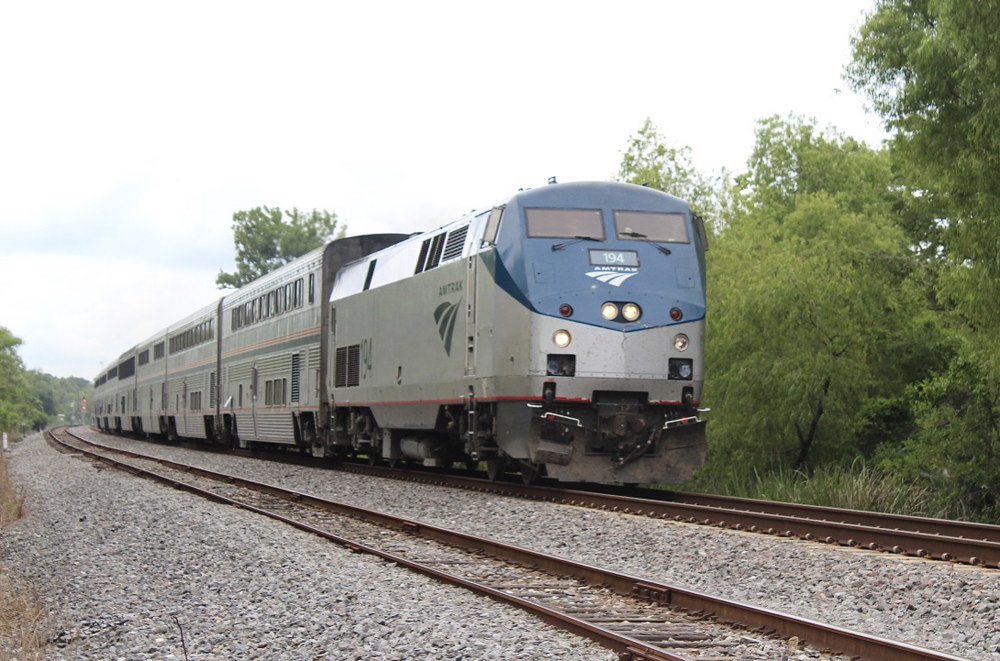


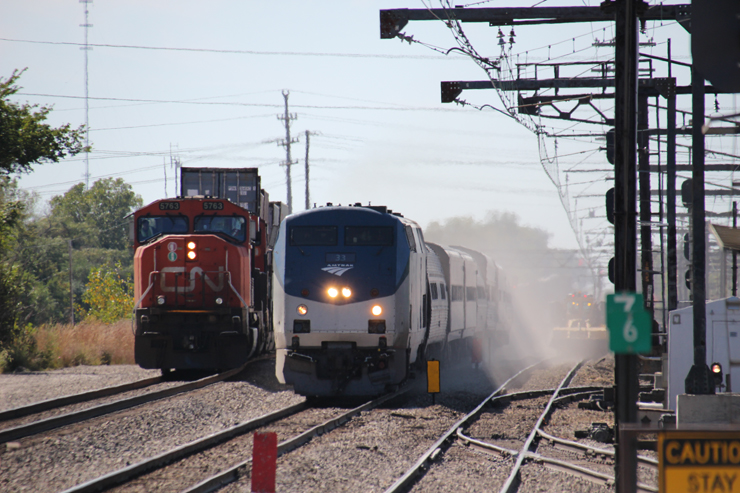
Ride Amtrak outside of the Northeast Corridor and there’s a good chance you’ll arrive late because freight traffic delayed your train — despite the law that gives passenger trains preference. Amtrak is challenging host railroads Union Pacific and Norfolk Southern with a pair of high-profile on-time performance cases that aim to put teeth into the 1973 preference law.
But what about delays that Amtrak’s right of preference inflicts on freight trains?
This question puts the shoe on the other foot for Amtrak. Canadian National, in its long-running operating agreement dispute with Amtrak, argues that it should be reimbursed for costs that arise when its freights have to wait for meets with passenger trains. And now federal regulators have asked CN to tally its 2024 Amtrak-related freight delay costs.
The request, made this month, signals that the Surface Transportation Board is considering a dramatic expansion of what Amtrak is required to pay host railroads. The case could have wide-ranging implications for Amtrak’s existing service, its plans for new routes, and its goal of reaching operational profitability.
Since its creation in 1971, Amtrak has been on the hook for so-called incremental costs – defined as expenses the railroad could avoid if Amtrak wasn’t running. Traditionally this has meant paying host railroads a per-mile fee to cover Amtrak’s share of track maintenance.
But CN contends that there’s a cost to the right of preference, too, because it has to keep its freights out of Amtrak’s way. And so CN wants compensation for those delays.
This is not exactly news: The dispute has dragged on for an astonishing 12 years. So you can be forgiven for not following or remembering the twists and turns in a case that has moved at a glacial pace. After CN and Amtrak were at loggerheads over a new operating agreement, Amtrak in July 2013 asked the STB to set terms and compensation for its use of CN lines. Six years later, the STB decided that incremental costs could include those related to freight train delays. These include extra crew, fuel, and locomotive and car-hire expenses, so long as CN can pinpoint them with data that can be quantified and verified.
The 2019 STB decision didn’t endorse CN’s proposed freight delay cost formula. But it did open the door to alternatives, like a higher per-mile charge. Either way, if the STB ultimately adds freight delay costs to the new operating agreement, the impact could be significant.
CN says Amtrak delayed its freights 680.48 hours in December 2019. The cost? A total of $219,691 in extra labor, fuel, and locomotive and car expenses. If that’s a typical month, Amtrak’s tab would be $2.6 million annually for its direct impact on CN’s freight operations.
The other Class I railroads are watching closely. If the STB allows CN to recoup delay costs, they all would want the same treatment.
Last year Amtrak paid host railroads $248 million. CN ranks fifth among Amtrak hosts with 1.4 million annual passenger-train miles, putting it way behind leader BNSF Railway (6.7 million passenger train miles), UP (6 million), CSX (5.5 million), and NS (2.8 million) – all of which handle Amtrak trains on far busier routes than CN’s. And that means a greater potential for Amtrak-related freight delays on the big four U.S. systems.

You don’t have to be a math whiz to realize this could blow a hole in Amtrak’s plan to erase its annual operating deficit, which last year was $705 million. It also would put Amtrak’s long-distance trains further into the red and make state-supported routes more expensive. Would states reduce service or absorb the higher cost?
Naturally, Amtrak favors the status quo. Its lawyers argue that Congress never intended incremental costs to include those associated with providing Amtrak trains with preference. Amtrak also points out that CN alone controls factors affecting the performance of its freight trains, including the growth in freight traffic, the single-tracking of the Illinois Central main line, and the operation of long trains that don’t adhere to their schedules. In other words, if CN tolerates delays of its own making, why force Amtrak to pay?
With government efficiency czar Elon Musk calling for the privatization of Amtrak, and Transportation Secretary Sean Duffy said to support the concept, the prospect of having to pay for freight train delays is the least of Amtrak’s worries. But the CN case, which may be decided this year, bears watching.
You can reach Bill Stephens at bybillstephens@gmail.com and follow him on LinkedIn and X @bybillstephens
Share this article