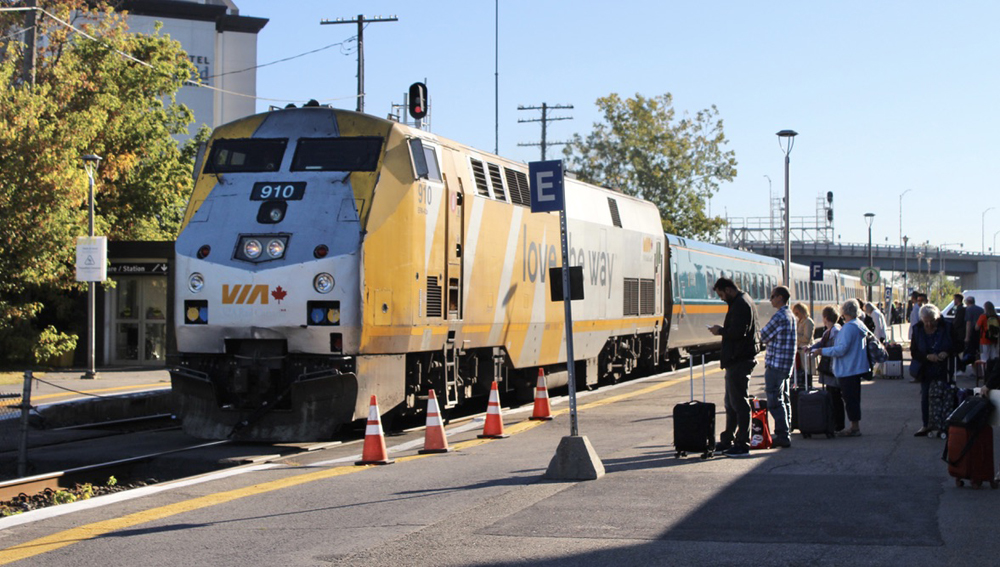
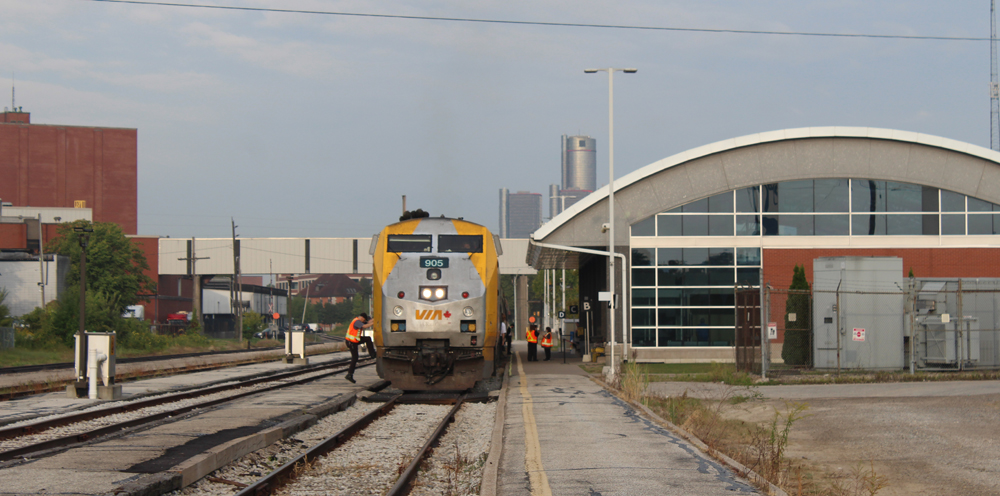
WINDSOR, Ontario — The mayor of Windsor, Ontario, released a “fact sheet” to local media last week which outlines a $44 million plan to convert a daily Wolverine Corridor Amtrak round trip and a Southwest Ontario VIA Rail Canada round-trip from Toronto into a Chicago-Toronto train.
First reported in an interview with radio station CKLW and later picked up by other outlets, Windsor Mayor Drew Dilkens told listeners Amtrak and VIA Rail Canada are paying for the project and are hoping to have approvals, track upgrades, and a joint customs facility built at VIA’s Windsor station. The document, labeled “Windsor Fact Sheet-November 2023,” reads, “Once funded, the cross-border could begin as soon as late 2027 with one daily Amtrak round trip.”
However, VIA spokeswoman Jamie Orchard would not confirm those details.
In an email to Trains News Wire, she writes, “VIA did not release this document and we believe it is premature to be holding this discussion in the public sphere. We can confirm that we are in private discussions with different partners, including Amtrak, to evaluate the possibility and estimate the potential costs of a project of this kind.”
Orchard adds, “No funding requests have been made and VIA has not committed to financing this project. Of course, we will be communicating with the community in due course if any decision is made regarding this project.”
Amtrak, in a Nov. 15 statement, said it is “in conversations with local, state, and provincial officials about a proposed service,” and that the document in question “is conceptional and drawn up to assist the parties in our discussions for a possible future service.”
The plan

Instead of serving Amtrak’s current Detroit station on Canadian National rails in the New Center area at Woodward Avenue and continuing on to Pontiac, Mich., the fact sheet says trains from Chicago would serve a new platform constructed adjacent to Michigan Central Station. The massive former office complex is undergoing a $740 million rehabilitation a “Global Innovation Hub” largely bankrolled by the Ford Motor Co.
Detroit’s Michigan Central once hosted New York Central’s Chicago-New York Wolverine and an Amtrak New York-Buffalo-Detroit daytime round-trip from Oct. 31, 1974, to Jan. 31, 1979. The station is situated next to tracks leading directly to CPKC’s tunnel under the Detroit River. Many trains once also stopped at Canadian Pacific Windsor station just east of the tunnel, but that was eliminated after Amtrak service ceased. Because VIA acquired Canadian National’s former route into the area that had been abandoned, trains from Toronto terminate about 3 miles north at Walkerville, named for the nearby Johnny Walker distillery.

Linking the two routes is the Essex Terminal Railway, an unsignaled industrial short line. The $44 million — unconfirmed is whether this amount is in U.S. or Canadian dollars — would presumably be spent on substantial track upgrades, signaling, and powered switches to facilitate a faster trip for the passenger train. Even so, Amtrak trains from the U.S. would essentially be backtracking to serve the VIA Windsor station.
The fact sheet says trackage modifications and a joint border security facility housing both U.S. and Canadian customs personnel will be constructed at the Windsor station. Presumably this would take the place of hour-long onboard inspections that currently plague the Toronto-bound Maple Leaf at Niagara Falls and the New York City-Montreal Adirondack at Rouses Point, N.Y.
Extensive delays contributed to the demise of Amtrak’s Chicago-Toronto International. It ran between 1982 and 2004 on the current route of the Blue Water between Chicago and Port Huron, Mich., then continued through CN’s Port Huron-Sarnia tunnel. VIA has since discontinued what had been the old daytime schedule’s second Sarnia-Toronto round-trip.
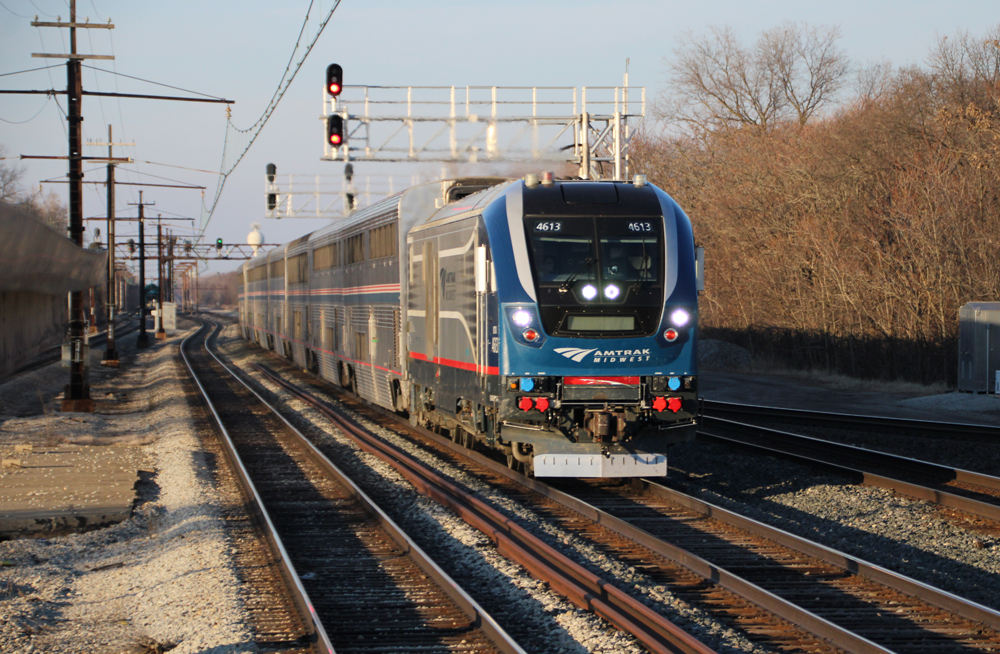
Establishing a joint facility at Windsor/Walkerville means that Amtrak and VIA would not necessarily have to share equipment; the Amtrak train from Chicago could simply reverse at Windsor for the late afternoon return to the Windy City as it does now at Pontiac, Mich. In that case, passengers would transfer.
On the other hand, serving both the current Detroit station without a new platform at Michigan Central would involve a convoluted back-up move; two Detroit stations for three Wolverine round-trips would be confusing and spread the additional station expense over the same number of trains.
Current Amtrak and VIA schedules make a taxi transfer between Walkerville and Amtrak’s Detroit station possible, but not convenient. Eastbound train No. 350 is scheduled to arrive at 1:25 p.m., not enough time to connect with the departure of VIA No. 76 at 1:46 p.m. from Walkerville; the next Toronto-bound train doesn’t leave until 5:41 p.m. Westbound, VIA No. 73 is scheduled to arrive Walkerville at 3:45 p.m. and Amtrak 355 leaves Detroit at 6:11 p.m.
Trains News Wire has made the connection in both directions with virtually no highway border delay, but doing so involves uncertainty a coordinated service would eliminate.
A host of challengers clearly need to be solved before through Chicago-Toronto trains via Detroit and Windsor can commence.
— Updated Nov. 15 at 8 p.m. CST with Amtrak statement.