





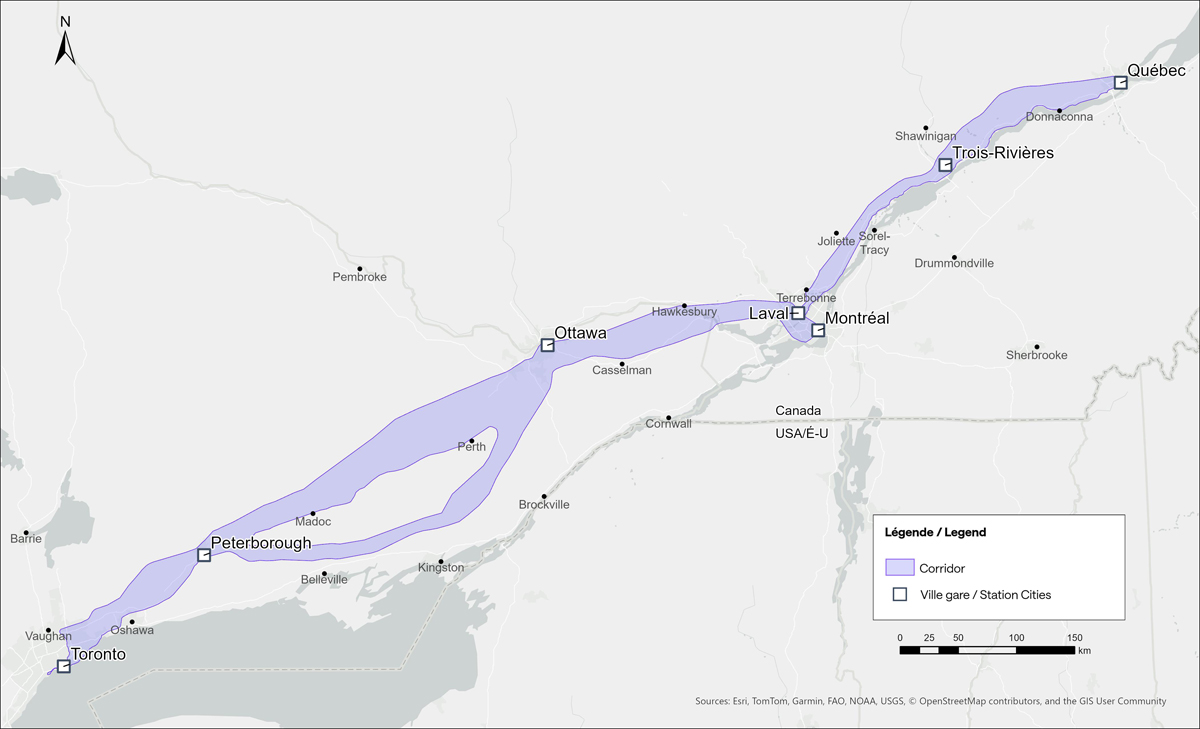
Canada’s Alto high-speed rail project, which is currently in the process of determining the exact route for the Toronto-Montreal-Quebec City project, is running into growing local opposition along its potential path.
Farm organizations in Ontario and Quebec have called for the project to be paused for a more careful assessment, and open houses that are part of Alto’s public consultation process are drawing a significant number of opponents. Even a recent parliamentary hearing, ostensibly to address VIA Rail Canada, included questions about the Alto route.
The farm organizations — the Ontario Federation of Agriculture and l’Union des producteurs agricoles — called for an “immediate suspension” of the project in a Feb. 27 press release.
“Ontario’s farmland is a strategic provincial and national asset, and the highest and best use of our arable land is for agriculture — and let’s not forget that agriculture and agri-food is a cornerstone of Ontario’s economic prosperity,” OFA President Drew Spoelstra said.
Added UPA President General Martin Caron, “Projects deemed to be of ‘national interest’ must not compromise the vitality of rural communities, the long-term viability of agricultural businesses and farmland, maple and forestry potential, or the food security of the population, which should be the true priority.”
 The organizations are calling for Alto to stay out of prime agricultural areas, avoid splitting farms into smaller pieces, and address farmers’ concerns about construction impacts.
Global News reports that a grassroots coalition of farmers, and residents and officials in small towns is expressing opposition. At least five communities in eastern Ontario have passed resolutions opposing a possible southern route for the project, while at least one has come out against a northern option.
An example of the small-town opposition comes from Saint-André-d’Argenteuil, about 50 miles west of Montreal. The Review newspaper, based in eastern Ontario, reports that Stephen Matthews, mayor of the municipality of about 3,000, said there has been no direct contact from Alto, despite the fact it is on the proposed route. He also expressed concern about the impact of construction equipment on local roads and infrastructure, as well as the possibility it could create new barriers for first responders.
Matthews told the newspaper he is personally opposed to the project, saying, “I don’t think it will bring any advantage to the citizens of my community.”
The concern about the project dividing communities was also raised during a Feb. 23 hearing on VIA [see “VIA gets little attention …,” Trains.com Feb. 24, 2026]. MP Philip Lawrence (Conservative-Ontario) told Transport Minister Steven MacKinnon that his constituents are concerned that because of the high speed line, “students will be separated from their classrooms, workers will be separated from their offices, farmers from their fields, and patients, perhaps most troubling, separated from their hospitals,” and asked what guidelines or restrictions would address the distance between crossings.
“Consultations are happening as we speak,” MacKinnon responded, “to get community voices involved to deal with exactly this kind of thing. … We’re obviously very aware of the concerns of the kind you’re raising.”
A local history group raised another concern during a recent open house, presenting a letter to an Alto representative about physical challenges with a portion of the proposed route between Peterborough, Ont., and Ottawa. The letter, which was also sent to Trains, describes a 60-mile segment as a “M.O.W. migraine of rock-n-swamp-n-quicksand … To create a high-speed line, somehow that 60-some-mile stretch from Havelock/Tweed to Sharbot Lake has to be solved.”
Alto continues to hold open-house meetings as outlined on its website, where it also accepts public comment. A blog post on the website says, “Route selection is based on a rigorous analysis combining the technical requirements of high-speed rail, … social and environmental impacts, social acceptability, costs, and feasibility. … Our goal is to progressively refine the corridor to identify the most balanced scenario, integrating the project seamlessly into the landscape and minimizing impacts on communities and ecosystems.”
That same post also says, “Crossing solutions (bridges, underpasses or overpasses) will be developed in collaboration with local authorities and emergency services to meet every territory’s needs. From the design stage, the route’s layout takes into account accessibility and emergency response needs.”
The final route is supposed to be determined later this year.
— To report news or errors, contact trainsnewswire@firecrown.com.
Share this article


Use existing VIA rail line, with some curve realignment most of the southern and middle section is good for 110 MPH, the northern section into Ottawa is very straight so 160 MPH like on the NEC can be done.
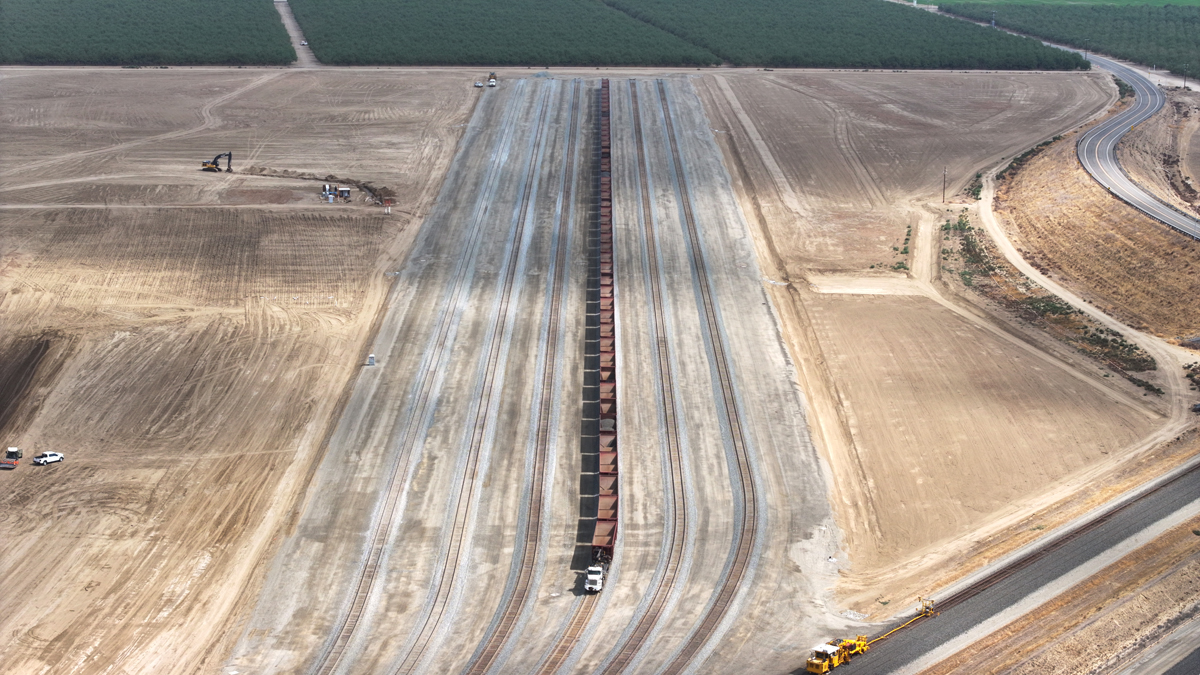
For those of us who have lived/have interests in California’s Central Valley, this all sounds awfully familiar…
Roger and Dharm – These are good posts, both of you.
Not from any personal experience (I’m lifelong city or suburb) but this is a really tough time to be a farmer. The work is hard, the money difficult to earn, the future unsettling, respect from the city folks lacking. Cut these farmers slack.
It’s also as you write a difficult time to propose any new r/w. No matter where the railroad goes, planners would have a fight on their hands each kilometer. Even if the r/w follows concession lines (in Ontario) someone comes out on the short end, some worse than others.
HSR needs straight lines, which are very difficult to obtain in settled country. Every split farm will need its own underpass for farm equipment. And sturdy fencing on both sides to keep out trespassers and livestock. Plus, adjustments to solve one problem are very likely to simply create another. To minimize cost, I expect that track will usually be at ground level, not raised. I feel sorry for those route planners – an almost impossible job.
Do you really need underpasses. When France built their TGV they didn’t which forced farmers to swap or sell their land on what ended up being the other side of the tracks. In other words if the tracks bisect your land and maybe an adjoining farmers land, maybe you swap land and pay the difference in cash for acreage. Similarly, it may make sense to straight sell your land if it ends up on the other side of the tracks. When they widen the road, they pay for the land they need, even it it leaves you with a smaller front yard and diminished property. Such is life…