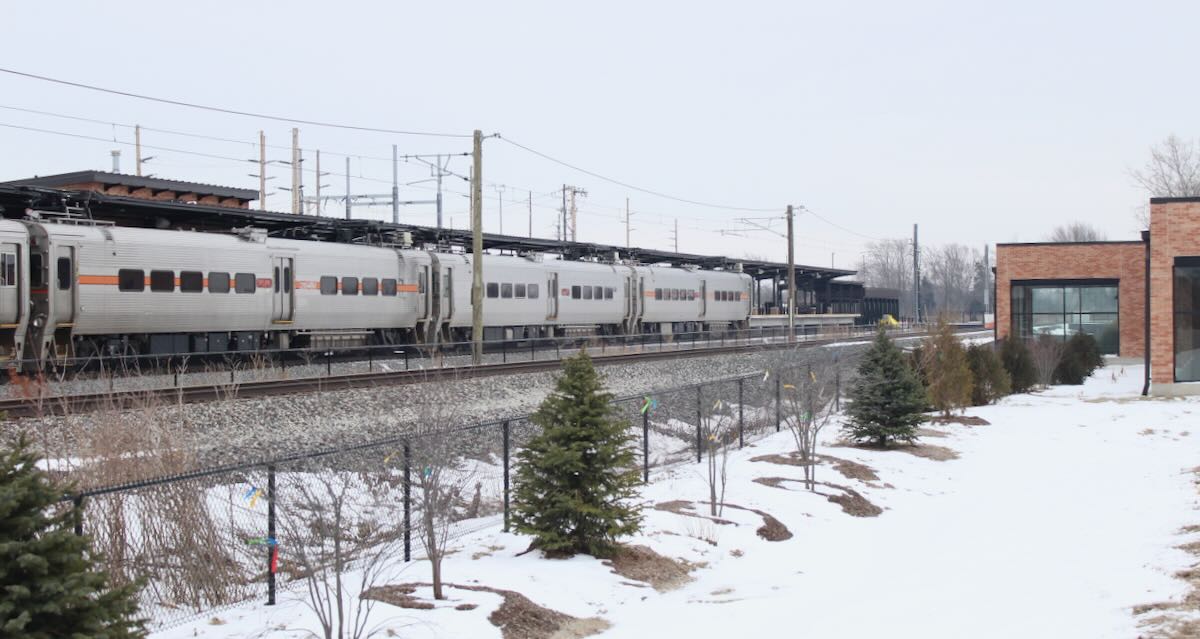
GARY, Ind. — Few rail rehabilitation projects can truthfully claim “better than ever” when physical plant and service improvements are completed, but South Shore Line commuter service appears to be one.
As Northern Indiana Commuter Transit District President Mike Noland told the crowd of gathered in a tent in the parking lot of the newly reconstructed Miller station in east Gary on Monday, “The railroad is poised to perform like never before, and we completed this project on time and under budget!”

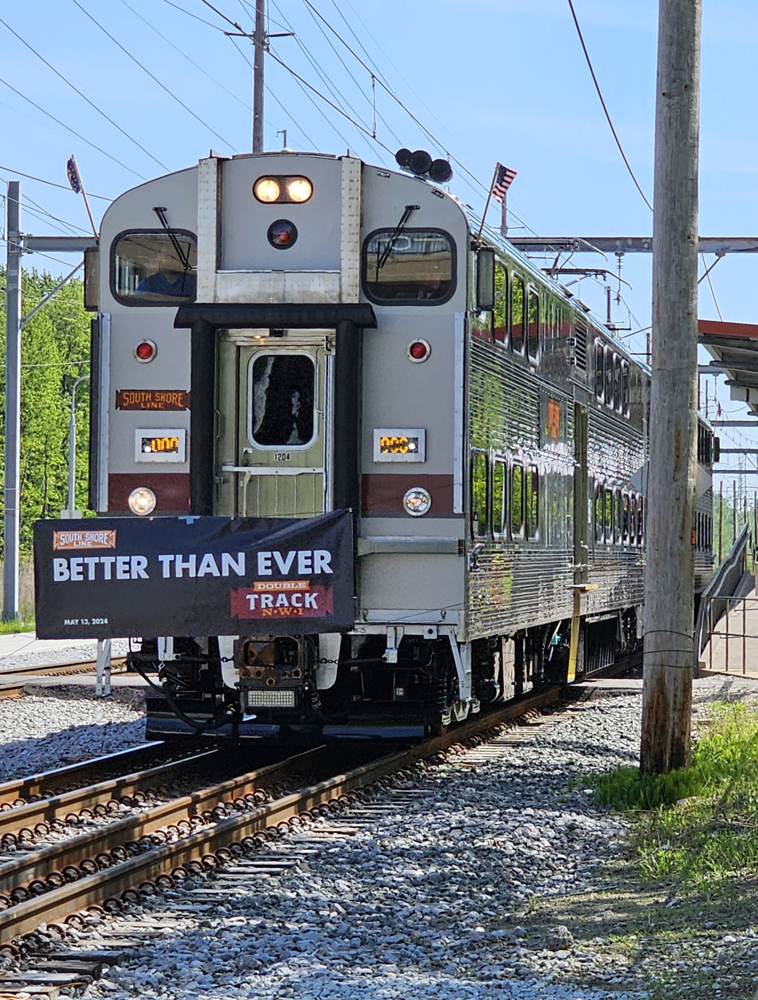
The “Better Than Ever” slogan was on the ribbon Indiana Gov. Eric Holcomb (R-Ind.) cut with ceremonial scissors after he and Noland arrived on a special train from Michigan City, Ind., and on banners the train had broken through en route to Gary. Without one mention of political affiliations, both men acknowledged the roles that local, state, and federal legislators of both parties played in getting the eight-year, $650 million project funded, aided by a $173 million Federal Transit Administration capital investment grant.

Beginning Tuesday, May 14, a completely revamped schedule features 14 additional weekday trains, with nonstop and skip-stop express trains sprinkled through both peak and reverse peak departures. This brings the total number of weekday trains to 53 [see “South Shore to introduce expanded schedules …,” Trains News Wire, April 19, 2024]. Dramatic changes to and time savings on the new schedule include 67-minute, limited-stop expresses to Michigan City; the previous average was about two hours.
Noland told reporters the line’s maximum authorized speed remains unchanged at 79 mph, but slow orders were eliminated. Elimination of street running in Michigan City resulted in increases from 15 mph to 25 and 35 mph [see “South Shore Line’s street running ends …,” News Wire, March 7, 2022]. Twenty crossings were closed and the remaining 13 have been upgraded with warning devices.
Running times have also been cut with the addition of more stations offering level boarding from high-level platforms: Michigan City 11th Street, Portage/Ogden Dunes, and Miller.

Noland said the fare structure is under review, and changes may follow once the line gets a handle on the additional patronage the new schedules are expected to attract: “We’re going to look at fares that encourage more customers to ride between Indiana stations.”
Asked about schedules, Noland added, “We know we need to add more weekend service. We’re actually going to look at all of our train schedules, modifying them in the next few months to make sure we tweak it and make them right. We’re going to be listening to our riders to see what they want.”

Perhaps no one who attended Monday’s event was more excited — and most likely relieved — than NICTD project manager Nicole Barker. She told News Wire, “With the restriction of having only one track through most of our service area east of Gary, we could only run one express train in each direction. More people want to come out and visit this area and the state park. Once the bike trails are paved and connected, we expect more people to come out and enjoy Indiana’s recreation opportunities.”
Next up: completion of the $950 million West Lake project south of the main line at Hammond to Dyer, Ind., utilizing the abandoned Monon right-of-way, and a $200 million downtown Chicago capacity expansion in conjunction with Metra.