

CHICAGO — Expanding on a warning issued by Metra’s CEO earlier this month, the Chicago-area Regional Transportation Authority has released a dire picture of potential cuts to area transit if a potential $770 million funding shortfall is not addressed before the current state legislative session ends in May.
Metra CEO/Executive Director Jim Derwinski said Metra could need to cut service by 40% without funding help at a March 12 presentation to Northwestern University’s Sandhouse Rail Group [see “Metra could face 40% service cuts …,” Trains News Wire, March 12, 2025]. In a press release today (March 21, 2025), the RTA details what those Metra cuts might look like, as well as projecting similar cuts for Chicago Transit Authority and Pace rail and bus service.
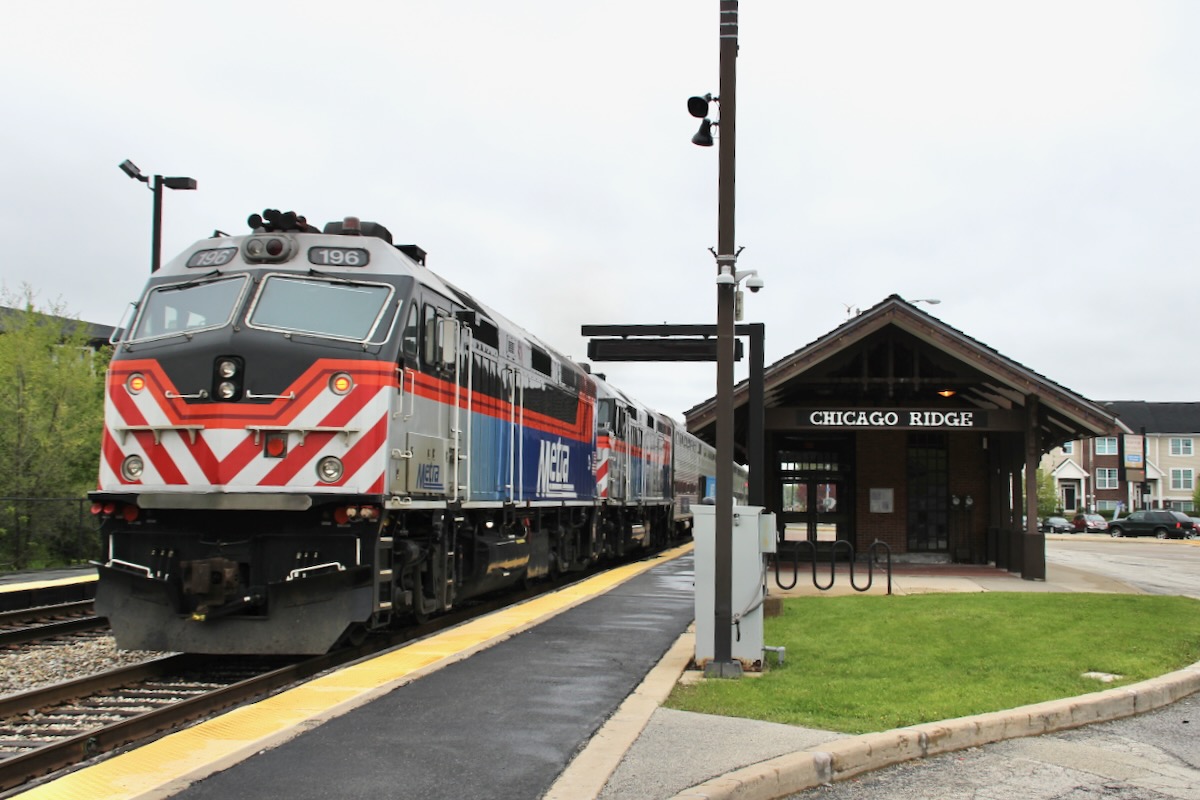
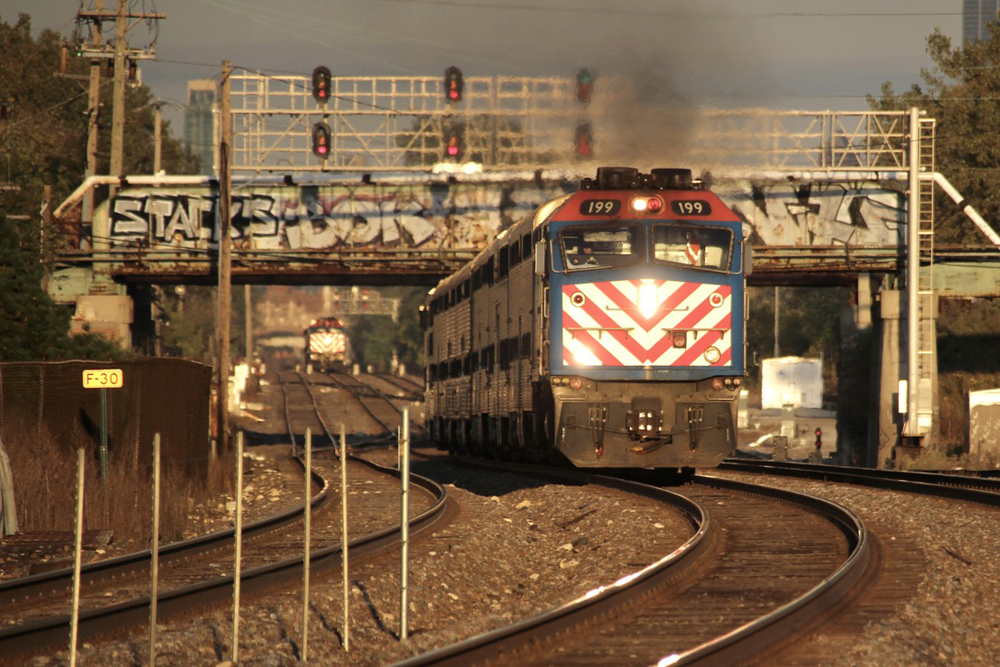
— For Metra, early morning and late evening trains would be eliminated, and trains would run just once hourly on weekdays and every two hours on weekends. Metra’s BNSF line could see less than half of its current 91 trains per weekday; the operator also warns that on lines shared with freight railroads, it would have limited flexibility to restore service once it is cut, meaning restoration could take five years or more even if funding is found later. Service would be eliminated on the Metra Electric’s seven-station Blue Island branch, which currently sees 22 trains on weekdays and eight on weekends.
“No one wants to envision a scenario where such severe cuts are necessary,” Derwinski said in the release. “But we hope that by detailing the cost of inaction, our elected representatives will take action to make sure public transportation not only survives but thrives.”

— Service would be suspended on all or part of at least four of the CTA’s eight rail lines, with 50 stations either closed or seeing drastically reduced service. On the remainder of the system, frequencies would be cut by 10 to 25%. As many as 74 of the CTA’s current 127 bus routes could be cut, leaving Chicago with fewer bus routes than Madison, Wis., and 500,000 current riders without a nearby bus stop.
“The results of a 40% service reduction are unconscionable, and no decisions about our service future will be made without community input,” said CTA Acting President Nora Leerhsen. “…. We’ve yet to see what public transit looks like when fully funded, and we want to make sure we can continue to provide safe, frequent, reliable and accessible services our region deserves.”
— The suburban Pace bus service could see elimination of all bus service, an end to operations after 8 p.m. on 62 routes, and headways increase to 30 to 60 minutes on its more frequently traveled routes. Federally mandated paratransit service would continue, but its service area would decrease by two-thirds on weekends.
“These cuts would have a devastating impact on our region and the people who need transit the most,” said Pace Executive Director Melinda Metzger. “… All the progress we’ve made to adapt to new travel patterns, boost frequency, and expand access would be lost.”
The RTA says the cuts would leave one in five workers in Chicago unable to use public transit for their daily commute and eliminate nearly 3,000 transit jobs. “The magnitude of these cuts is unprecedented and would require several rounds of schedule adjustments in 2026 and beyond,” the agency says in the release.
However, the suburban Daily Herald reports that some state legislators are saying the agencies must be reformed before they provide funding. A proposal floated last year seeks to combine the RTA, Metra, CTA, and Pace into a single agency [see “Illinois bill proposes merger …,” News Wire, April 30, 2024]. And state Rep. Marty Moyland (D-Des Plaines), chair of the House Transportation Committee on Regulation, Roads and Bridges, told the paper he wants the agencies to address overtime, lobbyist costs, and policing: “I’m not going to give them a dime until we get some reforms. If they’re going to threaten me with layoffs, they can start laying off from the top.”
The RTA board is scheduled to further discuss these cuts in a March 27 meeting at 9 a.m. in the board room at 175 W. Jackson Blvd. That meeting is open to the public and will also be available online.
Share this article